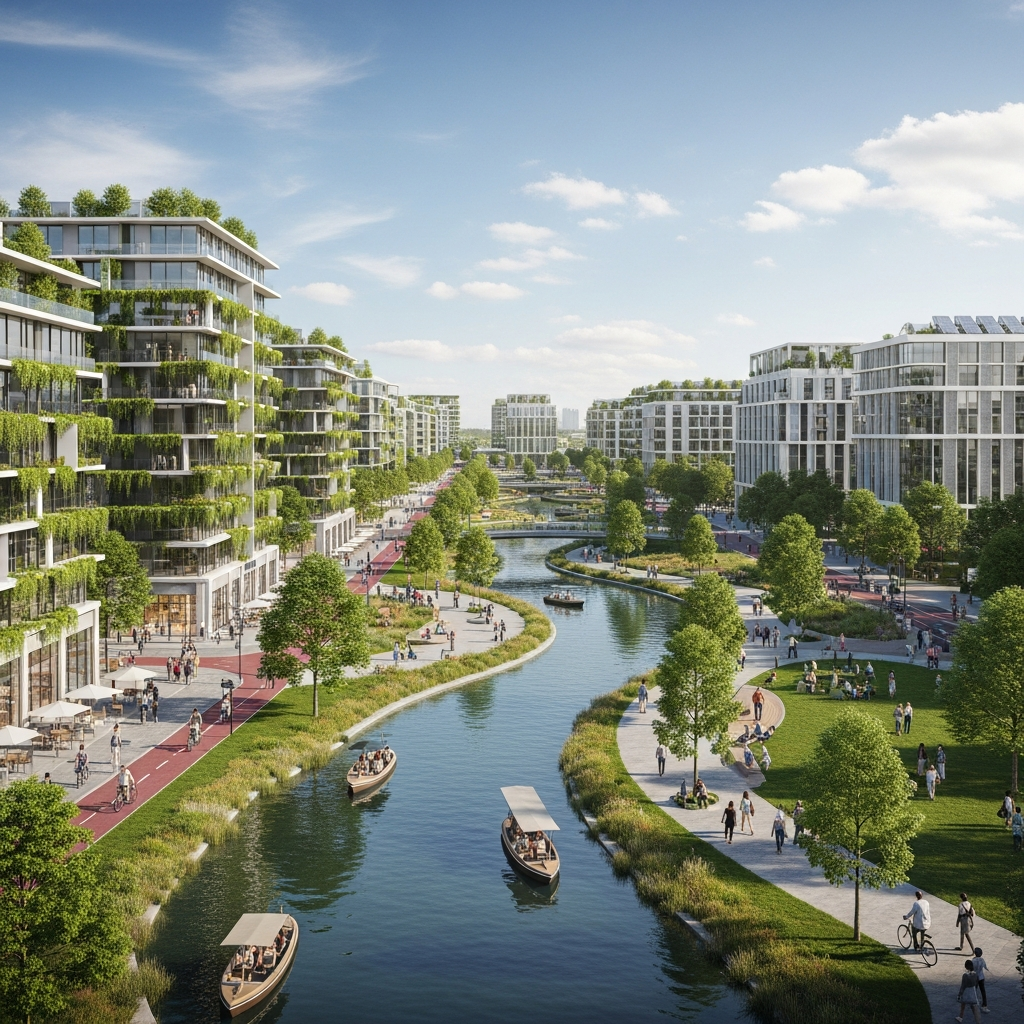
The Jordanian News Agency ‘Petra’ reported on Saturday evening that Jaafar Hassan, during his visit today to the site of the ‘Amrah’ City Project, reviewed the plans for projects that will be initiated in the first phase. These projects will be established on an area of 40,000 dunams out of a total of half a million dunams. It was confirmed that the Jordanian Company for the Development of Cities and Government Facilities will oversee and facilitate the stages of completion, with work set to begin early next year and continue until 2029.
The agency quoted the Minister of Local Administration, Engineer Walid Al-Masri, stating that ‘Amrah City enjoys a strategic location on an important logistical road network. It is situated on the Mwaqqar–Azraq–Amri road, the Zarqa–Free Zone–Azraq road, 93 kilometers from the Jaber Border Center, and is close to Madouna and southeast Amman, as well as being near Zarqa, Russeifa, and the capital Amman. The distance from Amman to the project site is between 40–55 minutes, and from Zarqa about 40 minutes.’
Minister Al-Masri added that ‘all project lands are owned by the state treasury, while the city development company will act as the executive arm of the project in partnership with the local and foreign private sectors.’ He pointed out that population estimates indicate that within the next 25 years, the population of the capital Amman could reach about 11 million people. Additionally, the populations in the cities of Zarqa, Russeifa, and South Amman will increase by millions more, making the creation of new and planned urban spaces a pressing national necessity to accommodate this significant growth and ensure quality of life and services.
The funding for major projects is expected to give a strong boost to the construction sector, which is linked to more than 60 economic sectors in Jordan, in addition to its role in providing features not available in current cities. Al-Masri asserted that state ownership of the land reduces acquisition costs and facilitates investment. He confirmed that ‘the new city will be a green city that adheres to environmental and climate change standards, relying on clean energy, treating and reusing wastewater, and implementing an advanced solid waste management system aimed at recycling about 90% of it. This model will contribute to improving quality of life and providing wide public spaces and green areas serving residents and investors.’