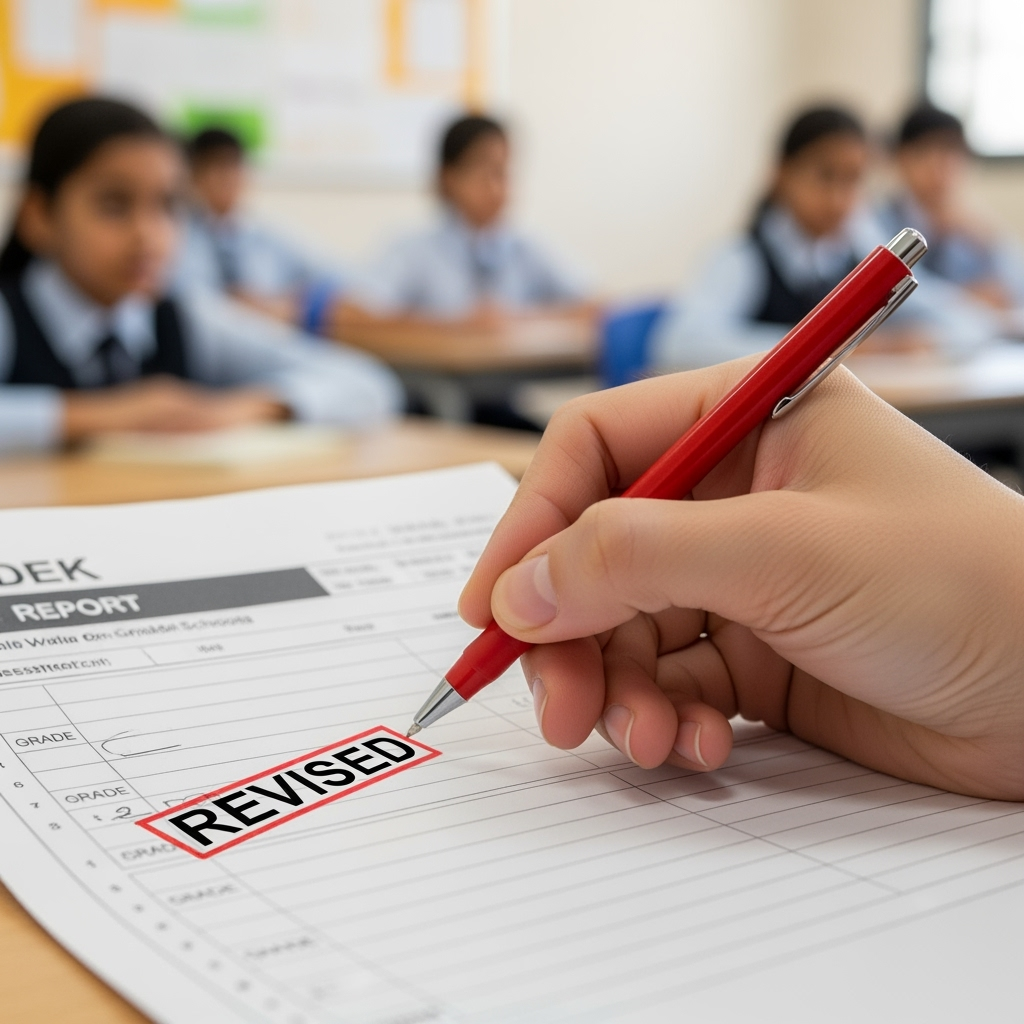
The education authority in Abu Dhabi has intensified its scrutiny of 12 private schools after discovering that internal grades were notably higher than external assessment scores and international standards, suggesting grade inflation. The investigation will now include Grades 9–11.
In a first-of-its-kind action, the Abu Dhabi Department of Education and Knowledge (ADEK) temporarily restricted some private schools in the emirate from enrolling students in Grades 11 and 12 due to concerns about grade inflation.
ADEK highlighted that this initiative, the initial phase of their compliance strategy, was prompted by routine quality assurance checks that revealed significant gaps between internal grades and external criteria.
Stay informed with the latest updates. Follow KT on WhatsApp Channels.
The schools’ identities have been kept confidential to protect all parties involved, stated Mubarak Hamad Al Mheiri, ADEK’s Undersecretary, in an interview with Khaleej Times.
“ADEK routinely carries out quality assurance evaluations to uphold academic standards in Abu Dhabi’s private schools. We identified grading trends that were much higher than external assessment outcomes and international benchmarks. This led to further investigation to understand the root of these discrepancies.”
Understanding grade inflation
Grade inflation is when student grades increase over time without corresponding improvements in actual learning or achievement. When marks rise without genuine academic progress, they lose their authenticity.
This diminishes the value of grades as a true measure of performance, complicating efforts by parents, educators, and admissions officers to assess student skills, allocate resources effectively, or maintain accountability.
After the initial report, when KT contacted institutions nationwide, leaders at compliant schools emphasized they had already strengthened their internal moderation processes.
Some schools now cross-check their predicted grades with external assessments like NGRT, Progress Tests, and Cambridge Checkpoint to maintain fairness and accuracy.
What to anticipate in phase two?
ADEK confirmed that the review will broaden. Al Mheiri stated, “Phase two will extend the investigation to include Grades 9 through 11. Schools will need to submit internal grading information for comparison with external benchmarks. This phase will also feature trend analysis to detect systemic issues at an early stage.”
He further noted, “Our aim is to ensure consistency and precision in assessment practices, not to penalize, but to foster continuous sector improvement.”
Meanwhile, the education body stressed that current Grade 11 and 12 students are unaffected by the enrollment restrictions, which only apply to new admissions.
Al Mheiri added, “ADEK is fully committed to supporting students during crucial academic phases. Schools are guided through necessary improvements without hindering teaching and learning.”
“The ADEK School Policies clearly outline expectations for curriculum planning, student assessment, and preparation for post-secondary pathways, ensuring outcomes reflect real learning and are underpinned by robust internal systems. Concurrently, ongoing compliance checks are conducted to monitor school practices, providing guidance and support to ensure academic integrity and stronger practices across the sector.”
He also emphasized that ADEK’s approach is collaborative, prioritizing a stable, high-quality academic environment while assisting schools in “aligning with best practices and maintaining their educational reputation.”
“This is why we work closely with school leadership teams through a cooperative, solution-oriented approach. Each school has been given a detailed compliance report outlining necessary improvements, with timelines clearly communicated. Support is also offered through technical guidance, professional development, and open communication channels to ensure effective implementation of corrective actions without disrupting students’ learning experiences,” added Al Mheiri.