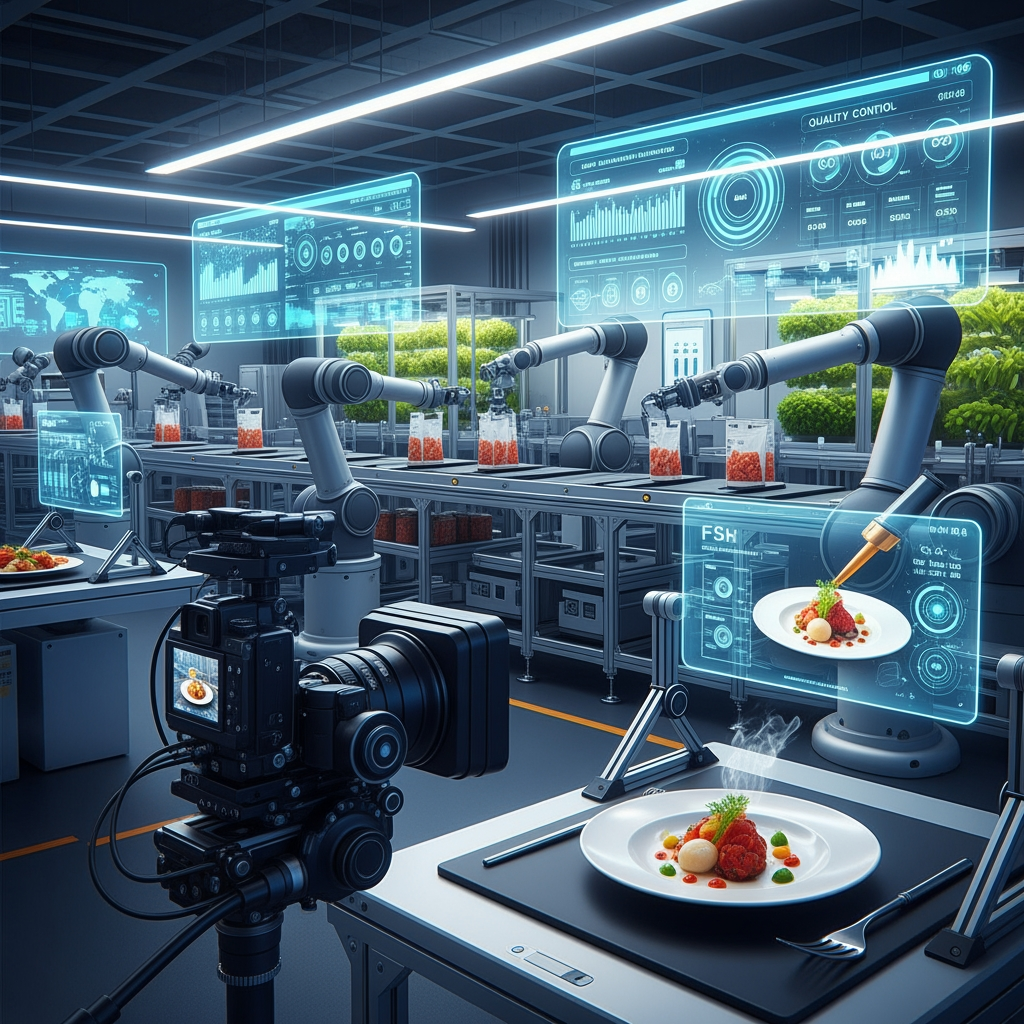
Today, food and beverage (F&B) producers face increasing pressure to achieve more with less—less water, less energy, less waste—while maintaining quality, efficiency, and profitability. By 2050, the world will need 60% more food to feed nearly 10 billion people without significantly expanding land use. Rising costs, changing consumer expectations, and ambitious sustainability goals are prompting producers to rethink their current factory operations to ensure a sustainable future.
For decades, automation has been a reliable driver of progress, enhancing efficiency and safety. However, traditional systems often came with limitations: rigid logic, isolated data, and slow adaptability. They provided improvements but in fragmented ways that restricted visibility and hampered complex decision-making.
Now, the food and beverage (F&B) industry is at a tipping point. Technologies such as edge computing, cloud integration, and artificial intelligence are enabling factories to think, learn, and act in real-time. According to McKinsey, automation will account for 25% of industrial companies’ capital spending through 2028. However, limited data quality and integration complexity remain significant barriers to success. Overcoming these obstacles cost-effectively will allow advanced technologies not only to transform production but also reshape the entire value chain, making agility and resilience the new benchmarks of competitiveness.
Few regions illustrate the potential and urgency of the shift to automation and digitalization more clearly than the Middle East. With up to 85% of food imported, local food and beverage producers face challenges from water scarcity, high energy costs, and legacy infrastructure. Yet, the region’s F&B sector is projected to grow at a 6.5% compound annual rate between 2025 and 2031—a clear opportunity for those ready to modernize.
For regional governments, food security has become a national imperative, embedded in strategies such as Saudi Vision 2030, UAE National Vision 2030, and Qatar National Vision 2030. With just 1% arable land and growing populations, digitalization and automation are essential for building long-term resilience.
In this context, Tetra Pak chose Dubai as the global launchpad for Tetra Pak® Factory OS™, a portfolio of advanced automation and digital solutions built on decades of food and beverage expertise, designed to accelerate the transition to smart factories.
The factories of the future are not defined by the technologies they install, but by how those technologies work together. Connected ecosystems enable a continuous flow of information across the entire factory lifecycle, turning raw data into contextualized insights and insights into decisive action.
Food and beverage producers need more than just smart technology; they need implementation that accounts for the realities of food and beverage manufacturing. Our next-generation automation and digital portfolio, Tetra Pak® Factory OS™, purpose-built for food and beverage production, transforms complexity into clarity, connecting data across the entire factory lifecycle.
Powered by industry standards and open technologies and embedded cybersecurity, it provides a scalable roadmap to digitalization, allowing food and beverage producers to start small and grow as operations expand. The ecosystem of hardware and software connects equipment, data, and people across the factory to help producers make smarter, faster, more consistent decisions every day, reduce costs, improve product quality, and empower teams to deliver higher levels of productivity.
Tetra Pak® Factory OS™ helps manufacturers unlock the full value of their data—turning fragmented signals into actionable intelligence. As producers increasingly invest in analytics and AI, the new portfolio provides the critical foundation to fully realize the transformative potential of these technologies by creating a unified digital backbone ready to apply AI meaningfully.
With more than 1,250 smart factory deployments across over 100 countries, Tetra Pak has seen how digitalization enhances business performance and recognizes that in-context data is essential for all AI tools, which is why we dedicate significant time and effort to getting it right. Highly automated dairies, for example, achieve up to 20% higher overall equipment effectiveness (OEE) and 45% less product waste than less automated counterparts—proof that investments in smart transformation deliver measurable value.
Turning the smart factory vision into reality requires more than new systems. Technology adoption is only the visible part of the iceberg. Beneath the surface lie the real challenges: skills and culture gaps, misaligned incentives, fragmented investments, and the risk of obsolescence.
Overcoming these requires more than software, it requires strategy. Food and beverage manufacturers need clear vision, structured roadmaps, and long-term partners who understand both the operational realities and digital possibilities of the F&B world.
That’s where Tetra Pak comes in as the partner for the next chapter of digitalization. We work closely with producers to share expert knowledge tailored to each production setup, connect automation and digital tools with ongoing support, and help teams manage change confidently. We also ensure that investments stay relevant and future-ready, while turning data into meaningful actions that improve performance.
When all these elements come together, digital transformation becomes not only possible but practical, scalable, and impactful.
Technology remains central to enabling resilience and innovation in a dynamic world. Factories of the future will not just produce food; they will continuously optimize it. They will detect anomalies as they occur, allocating resources automatically to make the best-informed decisions swiftly. They will conserve water and energy by design and empower teams with insights rather than overwhelm them with data.
This is not a distant concept—the wheels are already in motion. As AI, data, and automation converge, the opportunity for the region’s manufacturers is immense. Those who embrace the value of integrated, optimized, and connected smart factories today will be best positioned to lead tomorrow—shaping a more efficient, resilient, and sustainable food future.