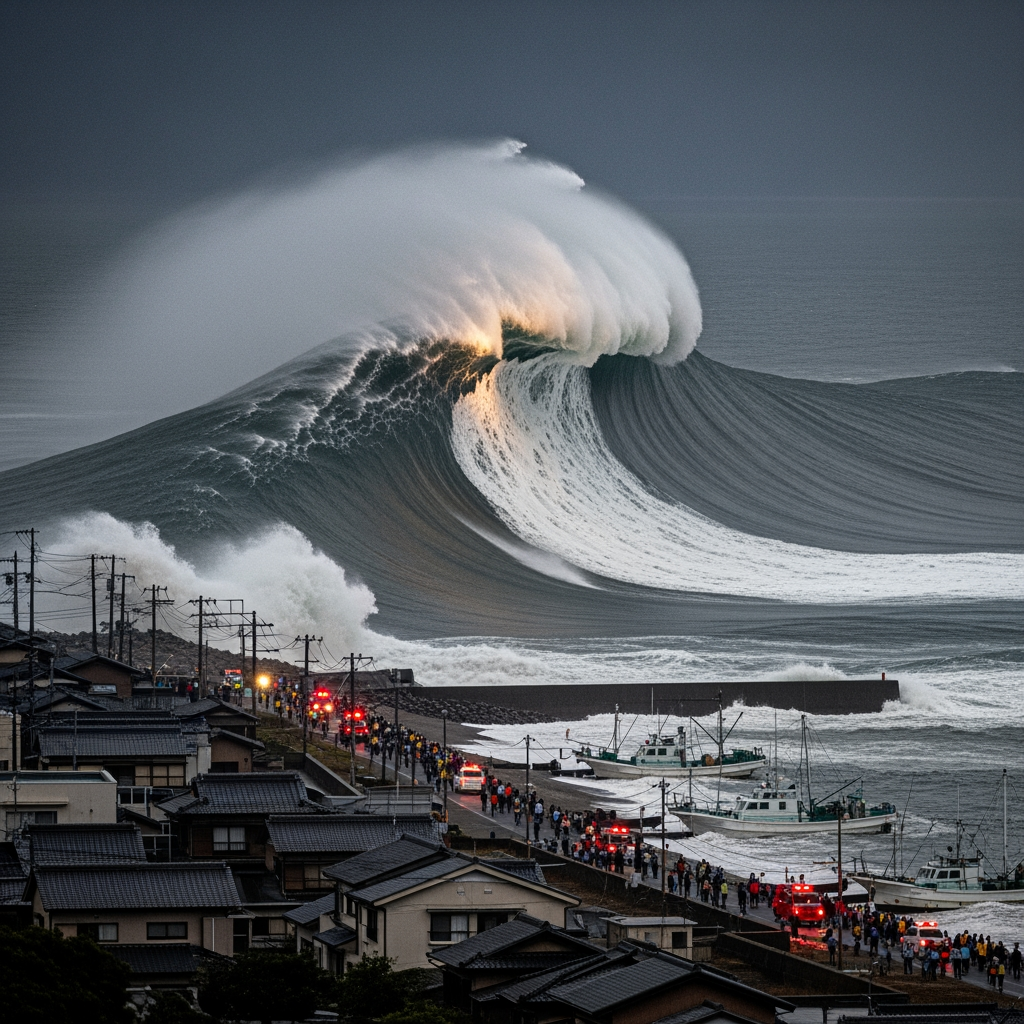
Japan issued a tsunami advisory on Sunday after a 6.7-magnitude earthquake struck a northern Pacific region.
The quake occurred at around 5:03 PM (0803 GMT) in waters off Iwate, prompting an advisory for a possible tsunami up to one meter (three feet) high, according to the Japan Meteorological Agency.
The US Geological Survey measured the quake at a magnitude of 6.8.
Stay up to date with the latest news. Follow KT on WhatsApp Channels.
“A tsunami advisory has been issued” for the Iwate coast, the JMA stated in a bulletin, warning that waves could arrive at any moment.
National broadcaster NHK reported that offshore tsunami waves have been observed and urged residents in the area not to approach coastal regions.
Live television feeds on Japanese television showed calm seas.
The region is haunted by the memory of a massive 9.0-magnitude undersea quake in 2011, which triggered a tsunami resulting in around 18,500 people dead or missing.
The tsunami also caused three reactors to go into meltdown at the Fukushima nuclear plant, creating Japan’s worst post-war disaster and the world’s worst nuclear accident since Chernobyl.
Japan sits on top of four major tectonic plates along the western edge of the Pacific “Ring of Fire” and is one of the world’s most tectonically active countries.
The archipelago, home to approximately 125 million people, experiences around 1,500 jolts every year.
The vast majority are mild, although the damage they cause can vary based on their location and depth below the Earth’s surface.