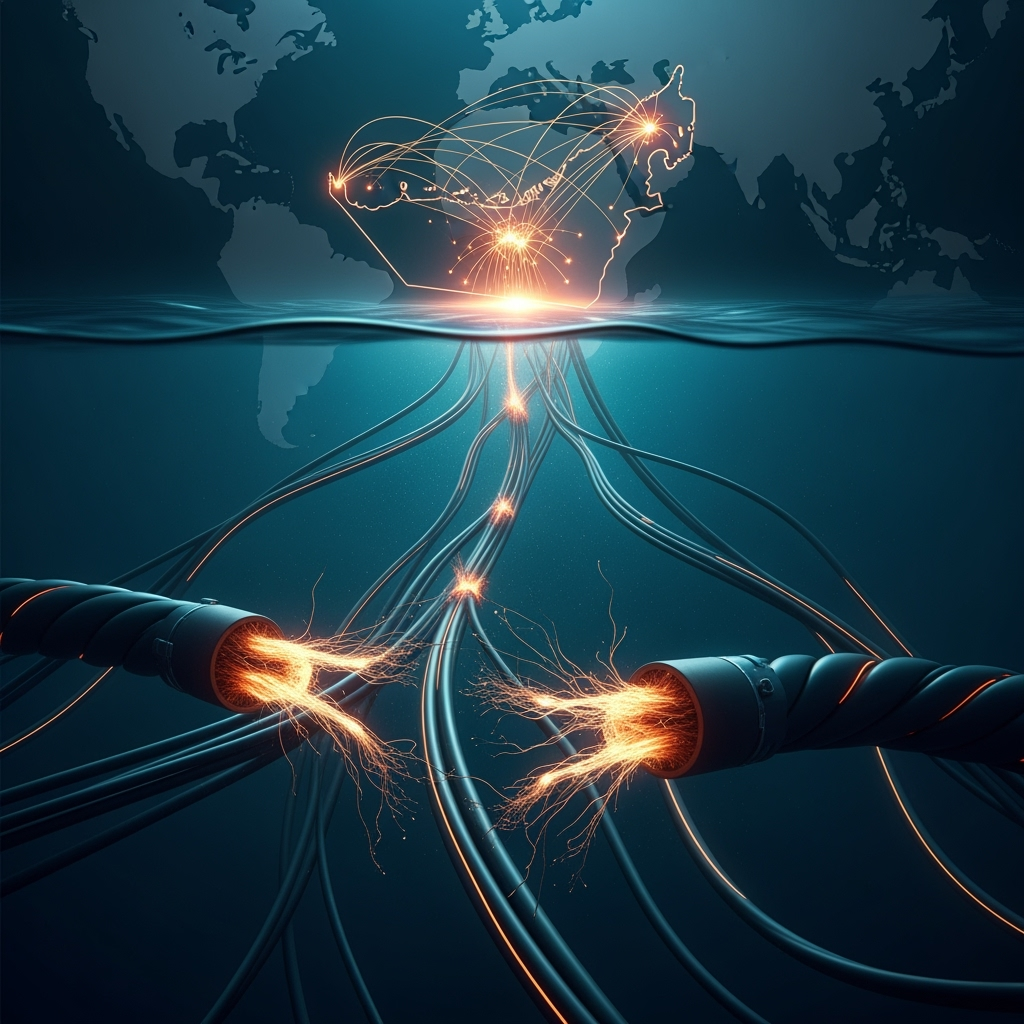
As several UAE residents struggled with internet disruptions for a third day after cables under the Red Sea were cut, experts say the incident could take several weeks, if not months, to be fixed.
“Worldwide, there are only three or four companies that can fix such a cable,” said Yasser Saied, Consulting Systems Engineer at cybersecurity company Palo Alto. “To fix such a cable, you need very high technology as they are buried deep under the ocean. You need special fibre divers who can go to the depths of the ocean. They will need to find exactly where the cut occurred and then fix it. So it is not an easy operation and could take months.”
However, according to him, there is a silver lining — replacing the damaged cable with a new one would ensure longevity. “The issue with fibre cables is that they can be degraded by nature,” he said. “Such incidents occur every five to ten years. Nowadays we have better cable materials. So the new cables will be resistant to any decay or destruction for a longer period.”
Stay up to date with the latest news. Follow KT on WhatsApp Channels.
Internet disruptions continue
Meanwhile, some UAE residents reported facing internet and data disruptions. “I was on my way to a location on the outskirts of Abu Dhabi and my Google Maps wouldn’t load,” said Urmi K. “What should have taken me 1.5 hours ended up taking more than 2.5 hours. It was very frustrating.”
Another UAE resident, who did not wish to be named, shared that she was unable to access her mobile data while at a work event. “Luckily, wifi was available at the location,” she said. “Otherwise I would have been unable to do my work.”
On September 7, telecom operator Du had posted on its social media platforms warning its customers that they may experience “some slowness” in its data services due to the cable cut. “Our technical teams are working with international providers to resolve the issue. We will keep you updated with the latest developments,” it wrote.
E& UAE had also posted a similar message on its social media channels.
Ensure resilience
The reason for the cable cut remains under investigation but according to experts, there were several reasons how the disruption could have occurred.
“What we have seen in the past is that ships do anchorage and they sometimes damage the submarine cables by hitting them,” said Swapnendu M., Solutions Architect at Cisco. “Sometimes, it is related to a natural disaster inside the sea. Rarely, it can be a malicious incident, as was seen in the past between Russia and Ukraine where we saw some such disruptions near Norway.”
He said this incident highlighted the importance of cables as a “critical infrastructure” for countries and continents. “The same set of cables are used by multiple countries,” he said. “So, the dependency is even more. This specific route is very heavy because it connects to Europe. But there are alternate paths already available. To ensure internet resilience, countries should have sufficient capacity through the alternate path, which is the Singapore-India route.”
However, he added that other newer technologies like satellite connectivity are not enough to make up for undersea cables. “Satellites today haven’t reached that level yet,” he said. “They can provide some kind of redundancy as a failover when the physical path is not there. But when we talk about low latency or ultra-low latency and these things, very high bandwidth in terabits, submarine cables is what we rely on.”
Microsoft says Azure cloud service disrupted in Middle East by cable cuts in Red Sea
UAE internet users report outages; e& and du say ‘working to resolve the issue’
‘Long weekend down the drain’: How UAE internet slowdown affected residents