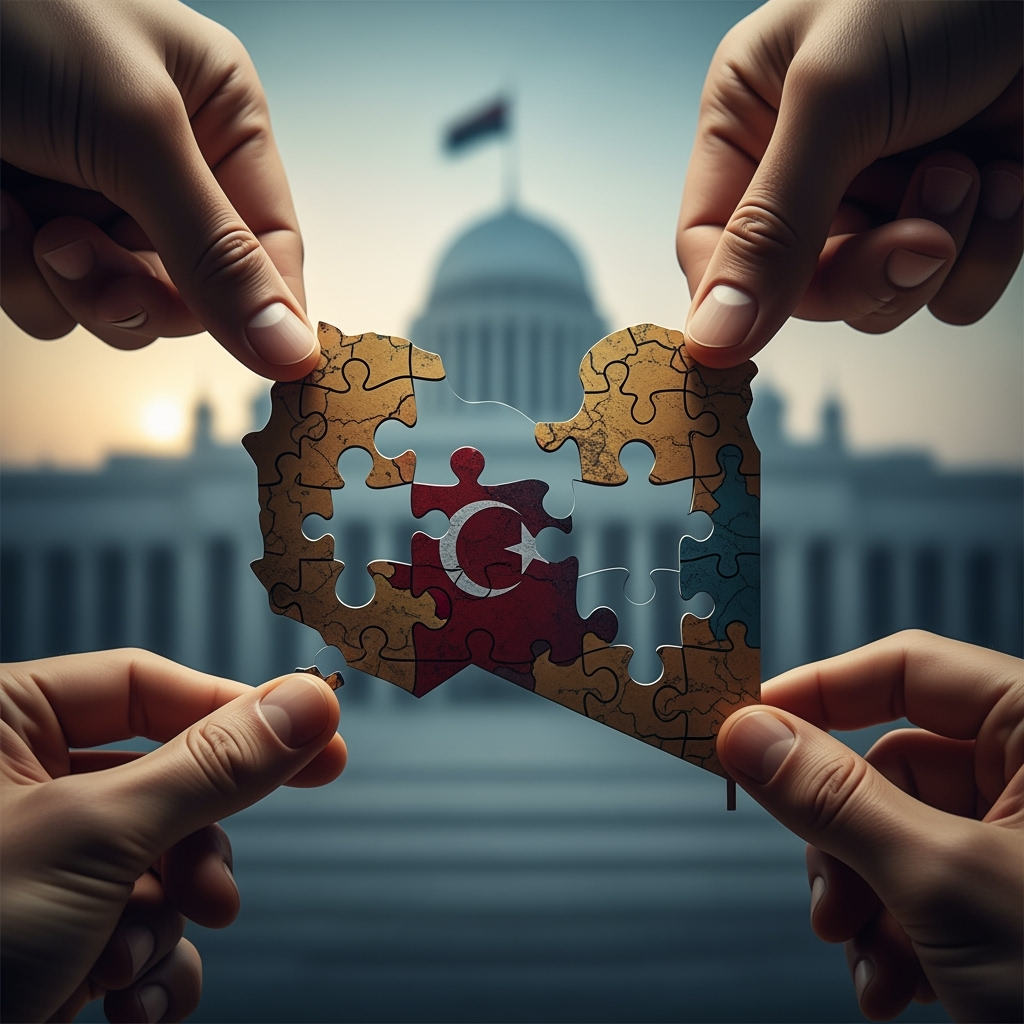
With the Libyan public eagerly awaiting any signs of breakthrough, several fundamental questions arise about the outcomes of this agreement and its actual implementation on the ground. Libyan political analyst, Idris Hmeid, stated that this is an important step in the right direction, but it remains insufficient to resolve contentious issues, particularly concerning candidacy conditions, power distribution, and guarantees of accepting election results, amid ongoing political and institutional divisions.
Hmeid emphasized in a statement to ‘Sputnik’ the necessity of a comprehensive consensus that represents the active forces and social components, considering this an essential factor for the success of any upcoming electoral process. He pointed out that discussing holding elections at this time is a significant challenge unless preceded by a comprehensive political settlement that builds trust among parties and commits everyone to respecting the electoral process results.
He noted that not all parties necessarily reject this agreement or seek to obstruct it, but in the absence of a decisive resolution, the matter remains subject to contention and delay, requiring a real resolution on this issue. Hmeid called on the international community to exert real pressure to support this path, asserting that endorsing such steps could bring about a qualitative shift, provided the scenario of the December 2021 elections, which were bypassed without accountability, does not repeat, exacerbating the trust crisis.
He also stressed the need to launch a broad community dialogue and form a unified government to oversee the elections within a general consensus framework, with the importance of involving all political parties to ensure the inclusivity of the process. ‘What we are witnessing now is a real test of the seriousness of the UN mission and its special envoy, as well as international parties, in supporting real elections, especially in light of American interventions that may seek to pass certain clauses through the mission,’ he said.
Libyan political analyst Moatasem Al-Shaer stated that the meeting held under the auspices of the United Nations Support Mission in Libya primarily aimed to reach a consensual legal formula that satisfies all parties, paving the way for presidential and parliamentary elections that spare the country further internal disputes and divisions.
Al-Shaer explained to ‘Sputnik’ that the essence of positivity in this consensus lies in the agreement of political parties, alongside the advisory committee and the 6+6 committee, with direct support from the UN mission, to unify the executive authority to oversee the electoral process. He confirmed that the extent of political bodies’ acceptance of the outcomes of this consensus will depend on the legality and feasibility of these outcomes, and on the UN mission and international community’s approval of them. If achieved, it is likely that the consensus will enjoy broad acceptance within Libya.
Al-Shaer continued, ‘Supporting this consensus requires first the UN mission’s adoption of these committees and their outcomes, and perhaps the matter will be presented to the UN Security Council within the expected roadmap in August. This roadmap, as expected, will be comprehensive of the outcomes of the 6+6 committee, the advisory committee, along with the observations and amendments agreed upon by the different Libyan parties.’
Al-Shaer expressed hope that the UN mission will provide a clear roadmap leading to free and transparent elections as soon as possible, ensuring real consensus among all conflicting parties. In a previous statement to ‘Sputnik’, Dr. Jaziya Shaiteer, a member of the advisory committee, confirmed that the meeting between the 6+6 committee and the advisory committee deeply discussed the electoral laws prepared by the 6+6 committee and the extent of their need for amendment according to the advisory committee’s outcomes.
Shaiteer explained that all proposed amendments by the advisory committee were subject to serious discussion, including issues of ‘linkage and delinking,’ the principle of ‘synchronization and succession,’ and the ongoing debate over the necessity of a second round of presidential elections. The meeting also addressed candidacy conditions, distribution of electoral seats, and what is referred to as ‘Option No. 1,’ where guarantees of its success and the possibility of transitioning to holding only legislative elections as an alternative option were discussed.
The advisory committee member confirmed that the 6+6 committee showed great openness during the discussions, noting that the committees concluded with a consensus on the need for a constitutional amendment, to be carried out by the competent authority represented by the House of Representatives, with a specific legal quorum.