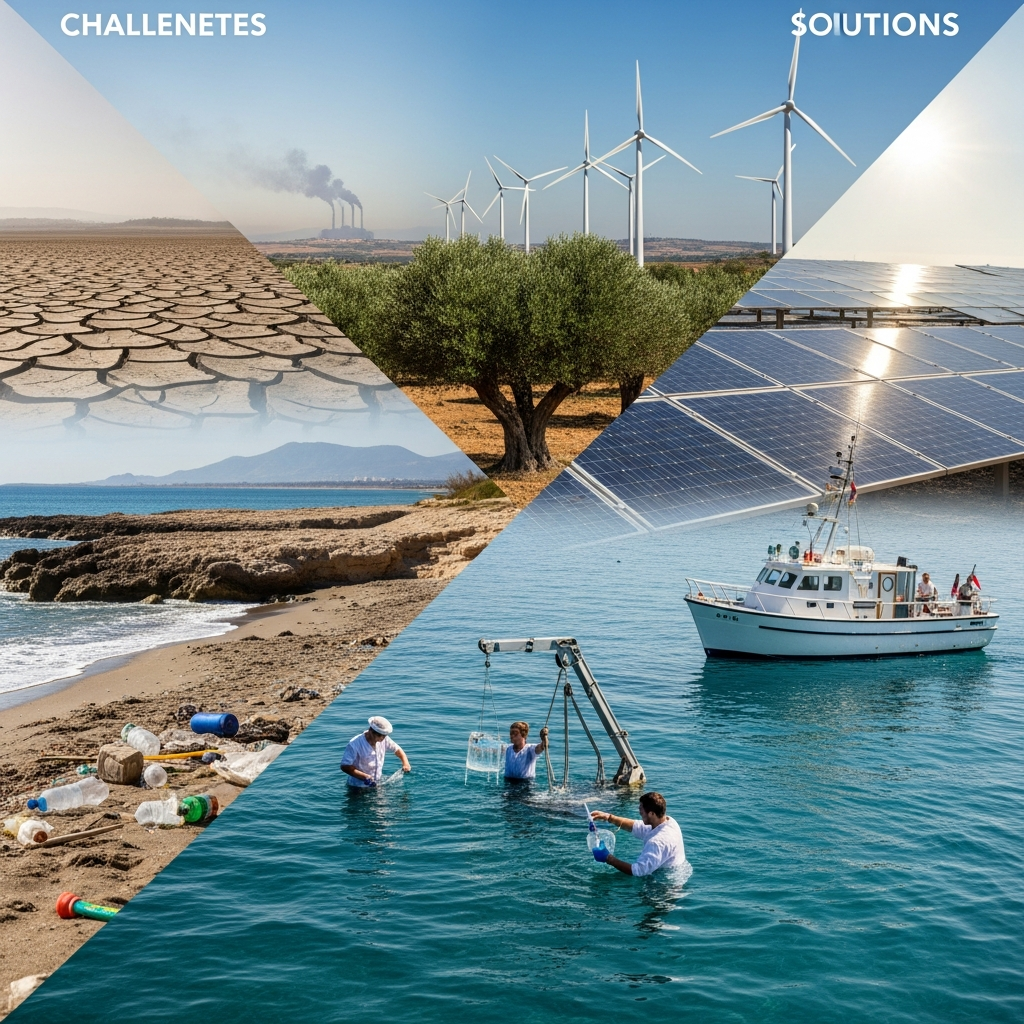
Kabila added in a special statement to “”, that the challenges discussed in the meeting relate to pollution and the impacts of land-based pollution sources such as nutrients, nitrogen, and phosphorus, and their effect on the productivity of the Mediterranean Sea. We also see the importance of treating wastewater coming from coastal cities and the impacts on marine life in terms of marine debris and plastic pollution. These are three very key elements.
He explained that in terms of climate change, the main concern is the rising temperature of sea waters, and this rise affects the coral reefs in the Mediterranean. He continued, “If you link this to ocean acidification, we are witnessing a decline in coral reefs, which affects the productivity of fisheries and coastal tourism. So, there are many effects that may be hidden, but we need to address them.”
He pointed out that the third element relates to the loss of biodiversity, as we are losing many species in the Mediterranean, whether as a result of overfishing or the loss of habitats and ecosystems. He explained, “When you start to see the accumulation of each of these crises, you really see the effects where natural ecosystems cannot recover. This is what we are seeing now, the three crises of climate change, biodiversity loss, and pollution are occurring simultaneously, proving that ecosystems cannot renew themselves quickly enough to address these crises.”
Regarding the role of the Barcelona Convention, he said it was established 50 years ago, in 1975, as a commitment by countries that they have a shared responsibility and a common commitment to protect the Mediterranean Sea. He added, “If you put yourself in 1975, you need to understand the geopolitics that were happening during that time.” He continued, “Countries came together to address the main problem they were facing at that time, which was pollution. Thus, the shared commitment, collective responsibility, and unity shown by the countries around the Mediterranean in 1975, still apply today. Regardless of all the conflicts and geopolitics we see in the world, I truly believe that this region can prove that through shared responsibility, collective commitment, and unity, it can overcome even some of the major challenges and conflicts we face today.”
The twenty-fourth meeting of the contracting parties to the Barcelona Convention for the Protection of the Marine Environment and the Coastal Region of the Mediterranean (COP 24) kicked off this morning in the Egyptian capital, Cairo. According to Sputnik’s correspondent, the conference includes representatives from 21 Mediterranean Basin countries, along with high-level delegations from the United Nations Environment Program and several environment ministers.
The opening witnessed prominent attendance by Tatiana Hema, the United Nations Environment Program Coordinator, and the Mediterranean Action Plan, and Mitja Bricelj, the current president of the conference and representative of Slovenia, alongside government and diplomatic figures concerned with environmental and sustainable development issues. The conference discusses a number of crucial files that will contribute to shaping the features of regional environmental work in the coming period, as well as for the period 2026/2027, in addition to exploring the development of mechanisms for cooperation between member states and enhancing their capabilities in facing environmental challenges, especially those related to climate change and marine pollution.