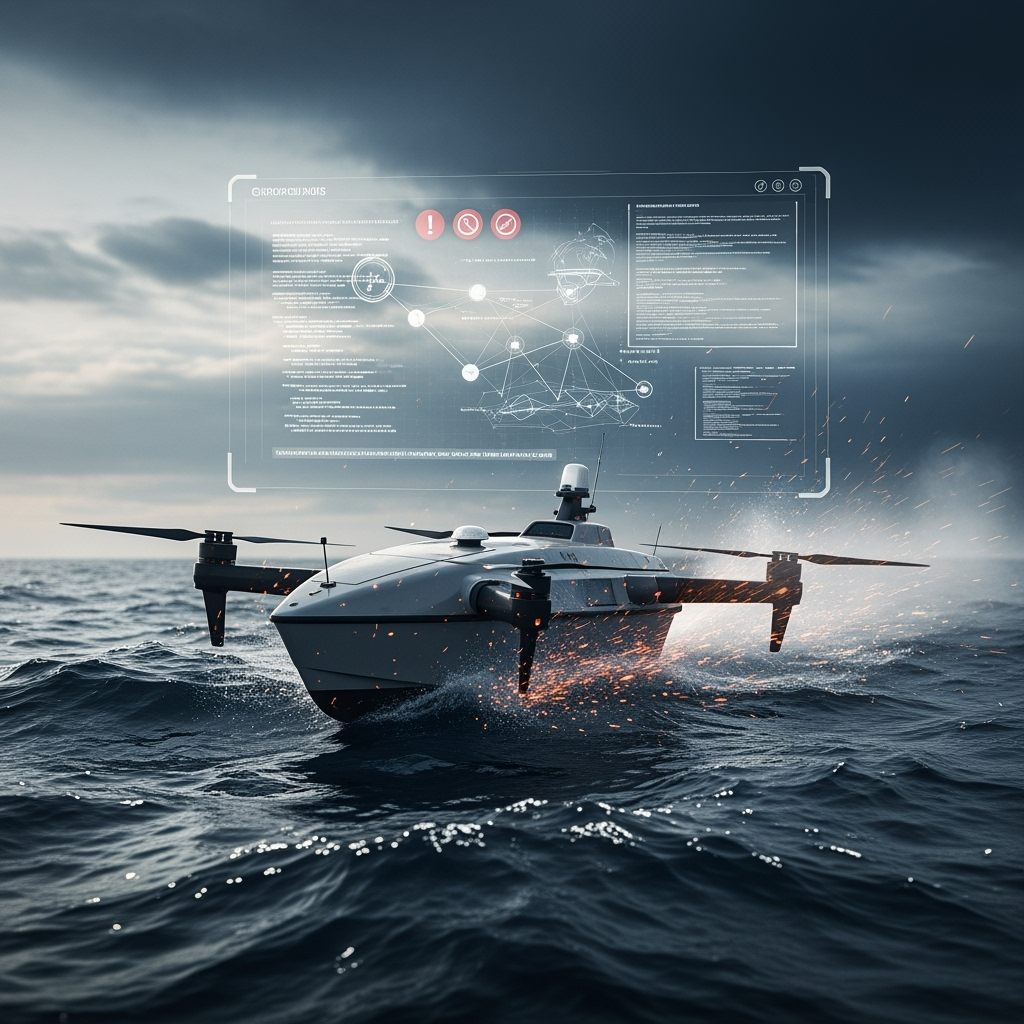
Last month, during a US naval test off the California coast aimed at showcasing the Pentagon’s leading autonomous drone boats, one vessel unexpectedly stalled.
As officials hurried to resolve a software glitch, another drone collided with the stationary boat’s starboard side, vaulted over its deck, and crashed into the water. The incident was captured in videos obtained by Reuters.
The previously unreported event, involving vessels from US defense tech competitors Saronic and BlackSea Technologies, is among several setbacks in the Pentagon’s efforts to develop a fleet of autonomous vessels, according to a dozen sources familiar with the program. Weeks earlier, during another Navy test, a support boat captain was thrown overboard when an autonomous BlackSea vessel it was towing suddenly accelerated, capsizing the support boat, according to four people with knowledge of the incident. The captain was rescued and refused medical care. Defense Scoop first reported the incident.
These incidents were caused by a mix of software failures and human errors, including communication breakdowns between onboard systems and external autonomous software, according to a source with direct knowledge who requested anonymity to discuss sensitive information.
The Navy, Saronic, and BlackSea declined to comment on the incidents. U.S. military leaders, noting the significant impact of maritime drones in Ukraine, have repeatedly stated the need for autonomous drone swarms to counter a potential Chinese advance across the Taiwan Strait. Taiwan is also acquiring maritime drones.
The drones developed in Ukraine resemble speedboats without seats and can carry weapons, explosives, and surveillance gear. Primarily remote-controlled, they cost around $250,000, making them ideal for kamikaze missions that have effectively neutralized Russia’s Black Sea Fleet.
The US aims to create an autonomous naval fleet capable of operating in swarms without human command, a more ambitious and costly endeavor, with each speedboat potentially costing millions. Recent test failures underscore the challenges the Navy faces in deploying these emerging technologies, said Bryan Clark, an autonomous warfare expert at the Hudson Institute. The Navy must adapt its tactics to better understand the systems’ capabilities and limitations.
Beyond technical issues, the Navy’s autonomous maritime drone acquisition unit has been affected by the firing of its top admiral, and a senior Pentagon official expressed concerns about the program in a frank meeting with Navy leaders last month, as reported by Reuters.
Following the latest incident, the Pentagon’s Defense Innovation Unit (DIU), which acquired technology for the tests, has indefinitely paused a nearly $20 million contract with L3Harris, a company providing autonomous software for some vessels, according to two sources familiar with the situation.
The Pentagon did not respond to questions about the accidents’ causes or the paused L3Harris contract, which has not been previously reported.
A Pentagon spokesperson stated that drone tests are part of a “competitive and iterative approach between operators and industry.”
L3Harris declined to comment on the contract and referred inquiries to the DIU, which also declined to comment.
“L3Harris is committed to the safety, integrity, and capability of our autonomy command-and-control product,” said Toby Magsig, who manages L3Harris’ autonomous software products.
RISE OF SEA DRONES To accelerate its drone initiative, the Pentagon launched the $1 billion Replicator program in 2023, through which branches like the U.S. Navy and the DIU plan to acquire thousands of aerial and maritime drones, along with the software to control them. The first systems from this program are expected to be announced this month.
The Navy has committed at least $160 million to BlackSea, which produces dozens of its Global Autonomous Reconnaissance Craft boats monthly, according to procurement records.
Saronic, recently valued at $4 billion with backing from Andreessen Horowitz and 8VC, manufactures the competitive sea drone Corsair but has not yet announced a major contract. Federal procurement records show the company has earned at least $20 million from prototype agreements.
“These systems will play a crucial role in future naval warfare by extending fleet reach, enhancing situational awareness, and boosting combat effectiveness,” said acting chief of naval operations Jim Kilby during a visit to BlackSea’s facility in June.
NAVY TURMOIL
Since resuming office, President Donald Trump has prioritized deploying drone swarms as a military objective. Trump’s “Big Beautiful Bill,” passed last month, included almost $5 billion for maritime autonomous systems.
However, the Navy’s approach has faced skepticism under the new administration.
In April, the Navy’s key drone boat procurement unit, known as Program Executive Office Unmanned and Small Combatants (PEO USC), celebrated a successful demonstration of the software used to control BlackSea’s vessels in a LinkedIn post, calling it “a major step forward in advancing #maritime autonomy.”
In response, Colin Carrol, then-chief of staff to Deputy Secretary of Defense Steven Feinberg, suggested the program was duplicating other Pentagon efforts. “I sense changes in this program’s future,” he replied to the LinkedIn post. Carrol, no longer with the Pentagon, declined further comment.
The PEO USC has been placed under review, according to four sources familiar with the matter, due to a series of setbacks, and may be restructured or disbanded.
This follows the Navy’s announcement two months ago that it had dismissed the unit’s leader, Rear Admiral Kevin Smith, citing a loss of confidence in his leadership after the Naval Inspector General substantiated a complaint against him. Reuters was unable to reach Smith.
During a meeting last month, Feinberg questioned Navy officials about their autonomous vessel capabilities, including those under the PEO USC, according to three people briefed on the meeting. Feinberg was unimpressed by some capabilities and questioned their cost-effectiveness, the sources said.
A Pentagon spokesperson stated, “We’re not going to comment on private internal meetings” and directed questions about PEO USC to the Navy.
The Navy declined to comment on the meeting or the acquisition unit under review. Spokesperson Timothy Hawkins said the PEO USC stands by its mission, including its role as the acquisition authority for maintaining and modernizing unmanned maritime systems.
This turmoil occurs as shipbuilders and software providers vie for larger autonomous maritime projects, such as unmanned submarines and cargo ships.
Last week, the PEO USC began accepting proposals for the Modular Attack Surface Craft, seeking medium and large vessels capable of carrying containers, surveillance equipment, and conducting strikes.
T.X. Hammes, an autonomous weapons expert and Atlantic Council fellow, stated the Navy is navigating uncharted waters, trying to rapidly overhaul decades of tradition.
“You’re dealing with a system accustomed to building large projects, taking years to decide, and now you’re asking them to move swiftly,” he said.