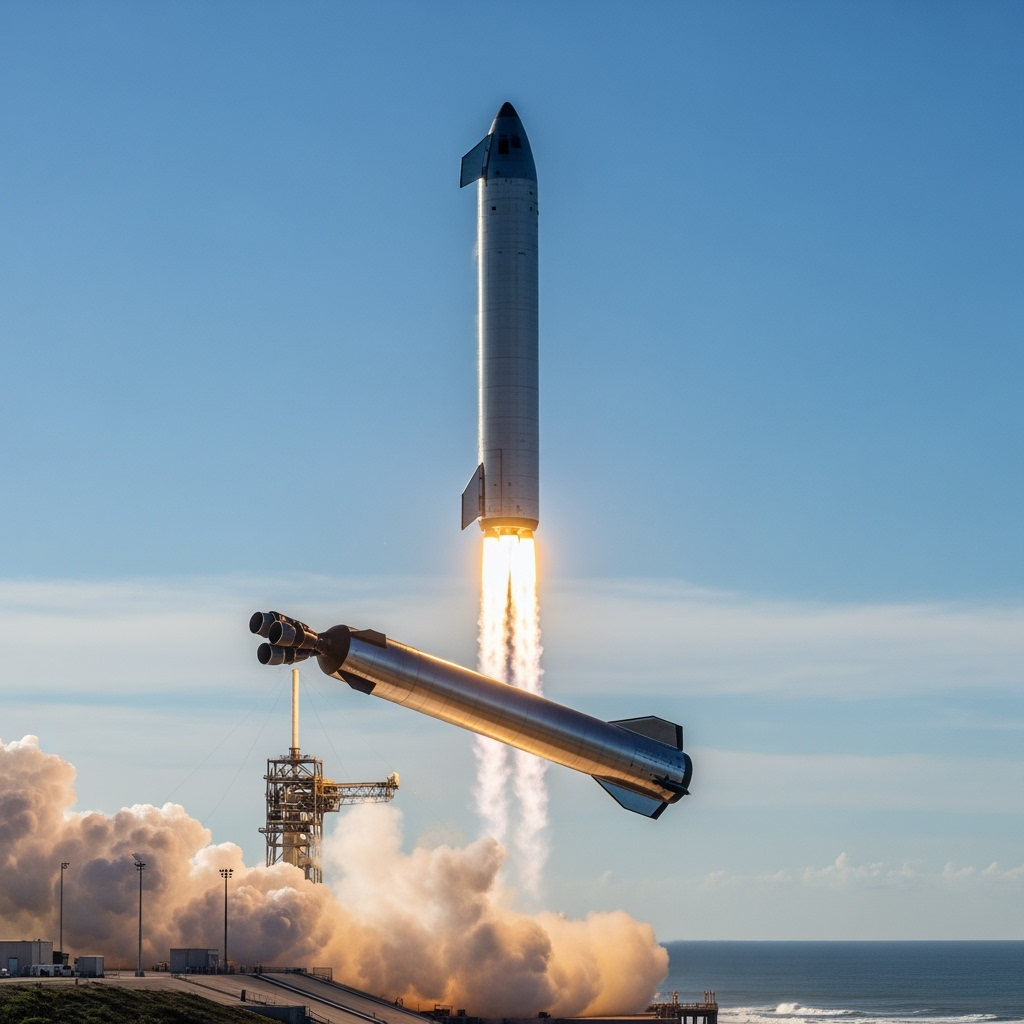
SpaceX’s formidable Starship rocket soared skyward on Tuesday during its tenth test flight, delivering a stellar performance after previous fiery failures had cast shadows on its prospects.
Standing tall at 403 feet (123 meters), Starship is the most powerful rocket ever constructed, integral to Elon Musk’s ambition of transporting humans to Mars and central to NASA’s lunar missions.
The stainless steel giant launched from SpaceX’s Starbase in southern Texas at 6:30 pm local time (2330 GMT), met with enthusiastic cheers from the engineering team, as broadcasted in a live stream.
Minutes after liftoff, the first-stage booster, known as Super Heavy, splashed down in the Gulf of Mexico, creating a sonic boom during its descent. Unlike recent tests, SpaceX chose not to attempt a catch with the launch tower’s massive “chopstick” arms, instead testing an engine-out scenario.
The focus then shifted to the upper stage—also called Starship—intended to eventually transport crew and cargo, showcasing its abilities as it ventured into space.
In a breakthrough, SpaceX successfully deployed eight mock Starlink internet satellites, with cameras on board providing live footage of a robotic arm releasing each satellite one by one.
However, the flight wasn’t without issues. Some heat tiles detached, and a small section of a flap burned off during the vessel’s fiery re-entry, enveloped in pink and purple plasma.
SpaceX’s communication manager Dan Huot noted that these events were anticipated, as the vehicle was flown on a challenging trajectory with certain tiles removed.
“We’re being a bit tough on this Starship,” he remarked during the webcast. “We’re thoroughly testing it to find its weaknesses.”
“Great job by the SpaceX team!!” Musk posted on X.
Critical Mission
This mission was critical, following three previous flights where the upper stage exploded—twice over the Caribbean and once post-space entry. In June, an upper stage explosion occurred during a ground test.
Despite recent setbacks, Starship isn’t viewed as being in crisis. SpaceX’s “fail fast, learn fast” strategy has already secured its dominance in launches with Falcon rockets, while Dragon capsules transport astronauts to the ISS, and Starlink has become a geopolitical asset.
Yet, significant challenges remain despite the successful tenth flight. Musk highlights developing a fully reusable orbital heat shield as the biggest hurdle, recalling it took nine months to refurbish the Space Shuttle’s shield between flights.
“We’re aiming for a heat shield that can be reused immediately,” he stated during a webcast on Monday.
Another challenge is proving Starship can be refueled in orbit with super-cooled propellant—a crucial yet untested capability for deep-space missions.
Time is pressing to prepare a modified version as NASA’s lunar lander for 2027 and for Musk’s goal of sending an uncrewed Starship to Mars by next year.