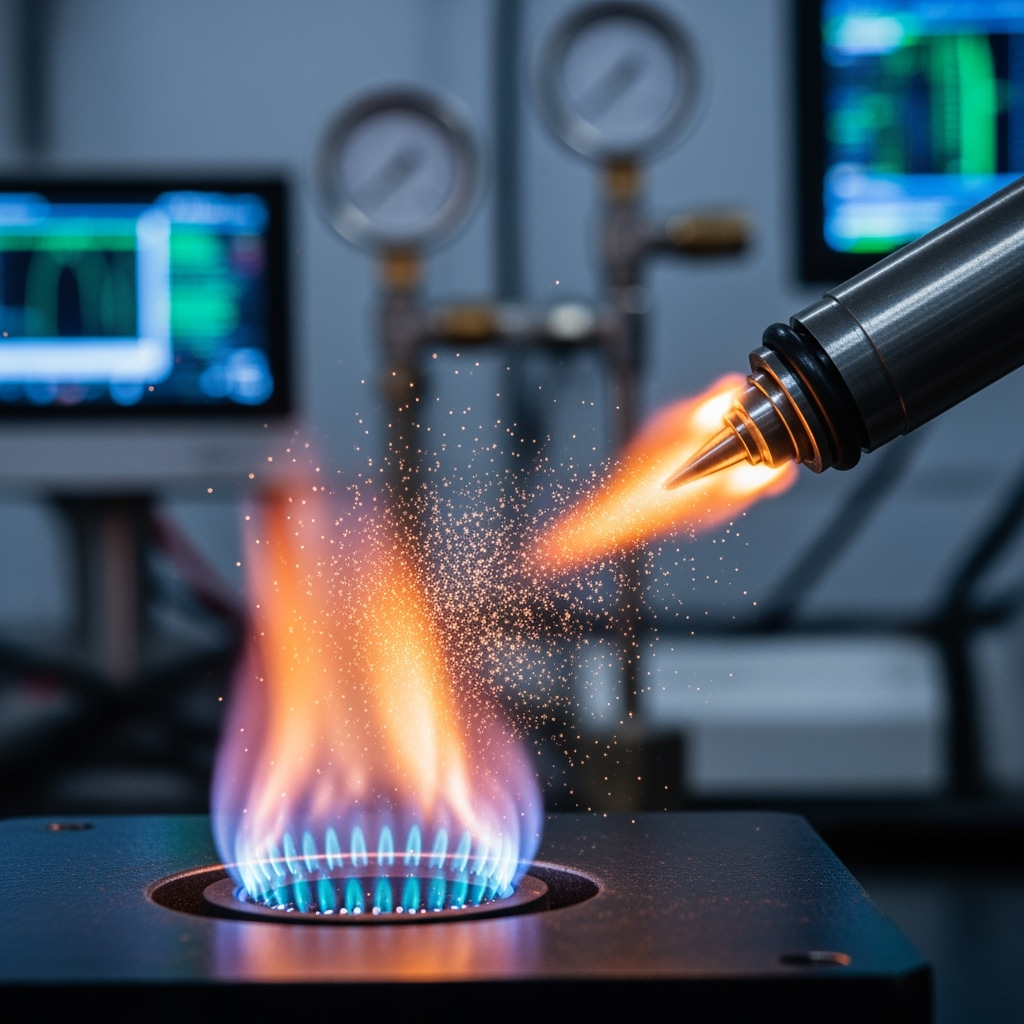
The study published by scientificrussia shows that sub-droplets are droplets that separate from the ‘mother’ droplet during the fine fragmentation of explosives. Any research in the field of fuel energy begins with the study of individual droplets. During the heating of heterogeneous droplets containing fuel and water, microscopic explosions can occur, caused by the boiling of minute water droplets. The study showed that these droplets go through two phases: heating to fragmentation conditions and the fine disintegration of explosions. Moreover, the decomposition can be partial, which we also call ‘puffing,’ or complete, which is a ‘microscopic explosion.’ Understanding this mechanism allows us to improve spray parameters, increase fuel combustion efficiency and overall engine performance, and reduce the level of pollutant emissions in the atmosphere,” said a research engineer at the TPU Heat and Mass Transfer Laboratory.
To test their model, the Polytechnic conducted more than 150 experiments, during which droplets composed of water and fuel (diesel fuel and rapeseed oil) were heated in a hot gas flow with temperatures ranging from 300 to 973 degrees Celsius. At the temperature of the mother droplets, the speed of the gas, their composition, and size. It showed that as the ambient temperature rises, the size of the emerging droplets decreases. This is due to increased pressure in the vapor layer and the accelerated disintegration of the droplet shell.
Additionally, droplet characteristics such as shape and size play an important role in the fine fragmentation processes of explosives. For example, when the water core moves relative to the center of the droplet, the size of the emerging droplets increases. These patterns allow us to accurately predict how fuel combustion parameters change under different operating conditions and open new horizons for managing these processes. It was also found in the composition of emerging droplets for different mixtures. Thus, droplets composed of more viscous fluids, such as rapeseed oil, showed less intense disintegration compared to diesel-based droplets. This affected the sizes of the sub-droplets, which often exceeded 20-30 micrometers in the case of more viscous fluids, while in the case of less viscous fluids, they did not exceed 10 micrometers. This will help improve fuel atomization systems in engines, as well as innovate new technologies for the thermal processing of liquid fuels.