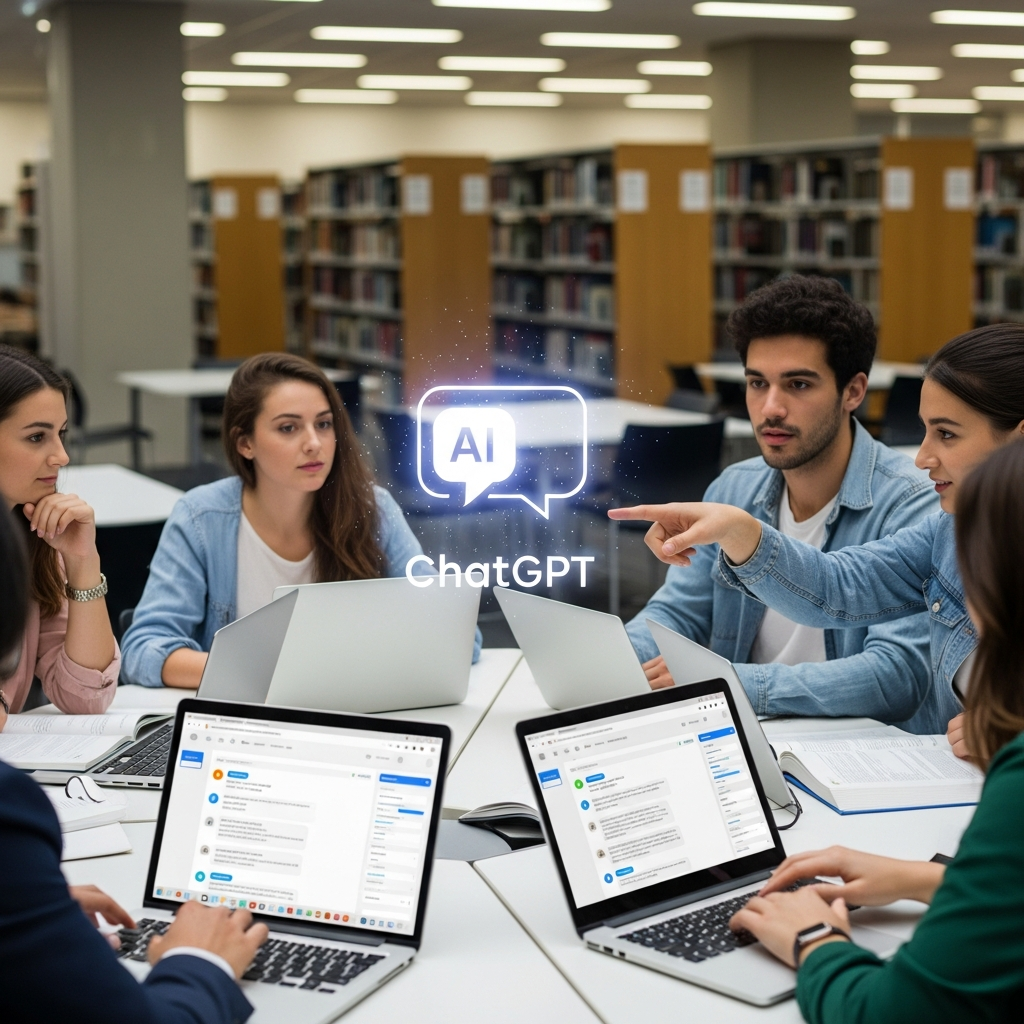
As artificial intelligence (AI) increasingly impacts education, UAE experts note that students are already working with ChatGPT.
ChatGPT, an AI-driven chatbot launched in November that has rapidly gained traction in education, is seen as a ‘necessary adjustment,’ they explain. However, they acknowledge its “numerous advantages” if used wisely.
“Blocking or banning these tools isn’t the answer. Such actions are too restrictive and shortsighted. We should integrate these tools into education to enhance teaching and learning, making them more relevant and purposeful,” said Rohan Roberts, Director of Innovation and Future Learning, GEMS Wellington Academy – Al Khail.
He highlighted that while AI will significantly contribute to personalized learning, “the teacher’s role remains secure and will likely be one of the last to be automated.”
Pedagogical Intelligence Stands Alone
Howard Gardner, renowned cognitive psychologist and advocate of the Multiple Intelligences Theory, recognizes Pedagogical Intelligence as a distinct form of intelligence.
“This is the human ability to understand another’s mind and customize learning to their unique educational needs. AI is far from replicating this. Yes, teachers’ roles will evolve, but they will remain vital in education. We must overcome our short-term fears. AI is here, and I expect its use in many Dubai schools, contingent upon its sustainability and potential cost,” said Roberts.
Leading colleges in the US, France, Australia, and some Indian universities have banned ChatGPT, but local educators believe that following this path might not be wise.
They emphasize that generative AI could be as transformative for human productivity as the steam engine, making it crucial to educate students on its benefits and limitations.
“In Dubai, educators are already leveraging ChatGPT for lesson planning, creating model answers, and formulating policies. It’s present, and I anticipate its use in several Dubai schools, depending on its longevity and whether it becomes a paid service,” said Neal Oates, Principal of Star International School, Mirdif.
Experts indicated that these technologies have documented limitations and don’t always yield accurate content.
Beyond concerns of ‘cheating,’ they argue that AI tools could potentially hinder critical thinking.
“Students need to understand these limitations. It’s crucial that these technologies don’t replace learning to write. Writing involves organizing thoughts or conveying ideas. Just as schools teach division despite calculators, they must continue foundational teaching while using technology appropriately,” said Kurt Muehmel, Everyday AI Strategic Advisor at Dataiku.
Professor Stephen Clark Wilhite, Senior Vice President for Academic Affairs and Student Success/Provost at American University of Ras Al Khaimah, stated: ‘The extensive use of AI tools will fundamentally alter classroom assignments and assessments. To protect academic integrity, many assignments and tests will need to be completed in class, ensuring that the work truly reflects students’ intellectual efforts and not just AI output.’
Some tools like Zero GPT can reportedly identify if content was generated by AI or humans.
Jeff Maggioncalda, CEO of Coursera, remarked: “ChatGPT has the potential to revolutionize student writing and thought, serving as an excellent writing assistant and thought partner. However, students shouldn’t depend entirely on ChatGPT for thinking. It should supplement their thoughts and enhance their content and ideas.”
ALSO READ:
Microsoft-backed OpenAI to let users customize ChatGPT
In the age of AI, focus on being human