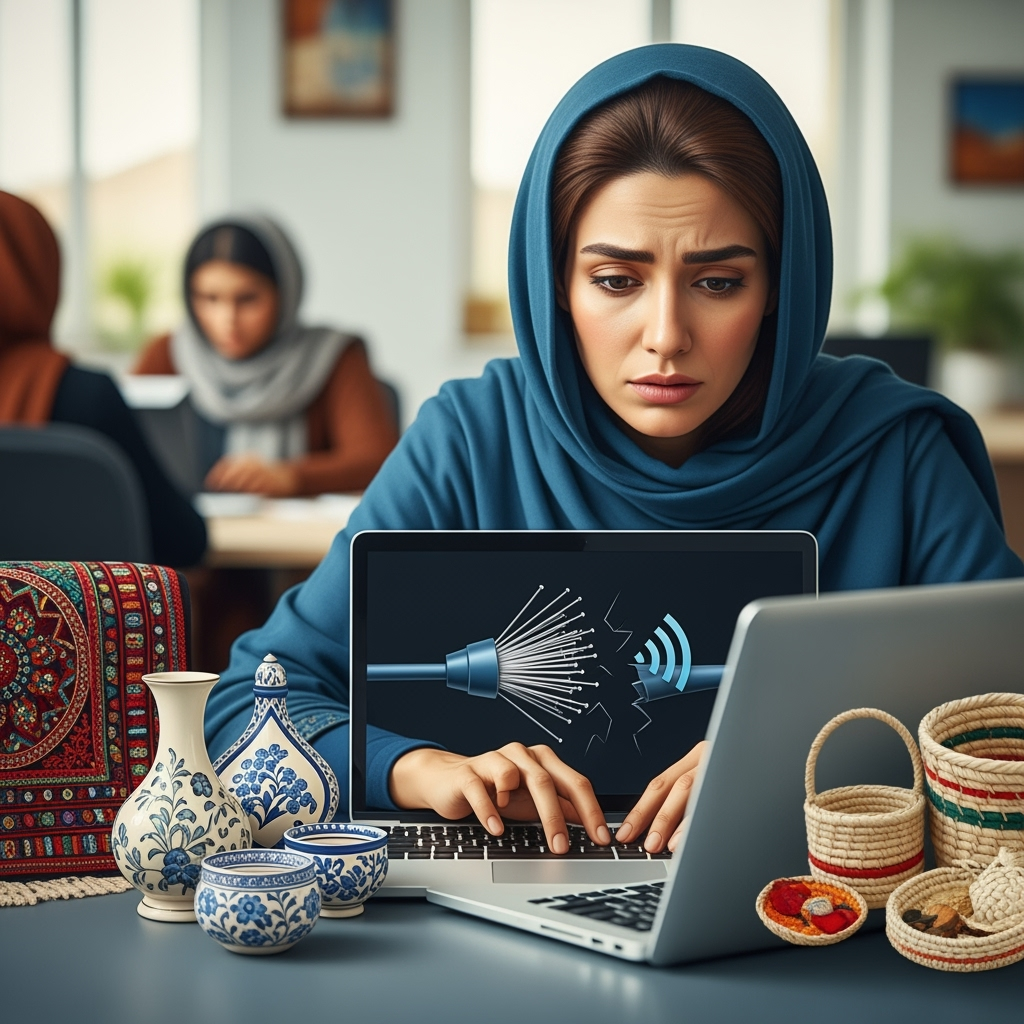
In a dimly lit home in Afghanistan, used as a small business, women lean over bright cloth using needles to create intricate embroidery. However, their fiber-optic network in Kandahar, their main connection to buyers, has now gone dark.
Local government officials confirmed a ban on fiber-optic services in five northern provinces — Balkh, Kunduz, Badakhshan, Takhar, and Baghlan. Officials stated that the ban aims to prevent “immoral activities.” Residents in other provinces, including Kandahar, Herat, and Parwan, have reported disruptions, although these have not been formally acknowledged by authorities.
The loss of access to the fiber-optic network has left thousands of homes, businesses, and schools relying on costly, unreliable mobile phone connections.
A Taliban flag flutters near telecom equipment installed over a rooftop providing internet services overlooking Hazrat-e-Ali Shrine, or Blue Mosque, in Mazar-i-Sharif on September 16, 2025, as the Taliban administration banned fiber-optic internet in Balkh province.
This measure marks the first large-scale internet shutdown since the Islamist group seized power in 2021, although it is not nationwide.
For Sabrinna Hayat, who runs Hayat Handicrafts with nine women breadwinners stitching firaq partug, the long embroidered dresses commonly worn by Afghan women, along with other handmade items, the outage has tripled internet costs.
She mentioned that her group used to receive orders from Afghanistan and abroad but now must repeatedly activate mobile internet packages that cost three times as much as fiber, just to keep up with customers.
“A complete ban has been imposed on fiber-optic cable… This action has been taken to prevent immoral activities, and an alternative solution will be developed within the country to meet necessary needs,” Haji Zaid, a spokesman for the governor of Balkh province, said last week.
The Kunduz provincial media office issued a similar statement. The Ministry of Communications in Kabul did not immediately respond to a request for comment.
Across town, a tailor who asked to be identified only by her family name, Dawrani, said her workshop employing widows and women in need has been devastated, given that sales and orders depend on connectivity.
“If I cannot even earn this small piece of bread, I will be forced to leave this country,” she stated.
CUT OFF FROM THE WORLD
The internet has been a lifeline for students, especially girls barred from secondary schools and universities, but the shutdown has even cut off that option in northern Afghanistan.
Dawrani mentioned that her daughters were no longer able to take their online English classes.
Digital rights advocates argue that the Taliban’s reasoning is less about morality than about control.
Obaidullah Baheer, a Kabul-based academic, stated that the ban echoes earlier Taliban moves that used immorality as justification for restrictions, including on women’s education, and were followed by promises of reform that never materialized.
“It shows a very anti-modern version of the Taliban. It seems like their fight is against modernity, fitting the bill of those who used to call them draconian.”
For some women, the debate is distant.
“Through this tailoring work, I managed to put food on the table. Without internet, even that may disappear,” said Dawrani.