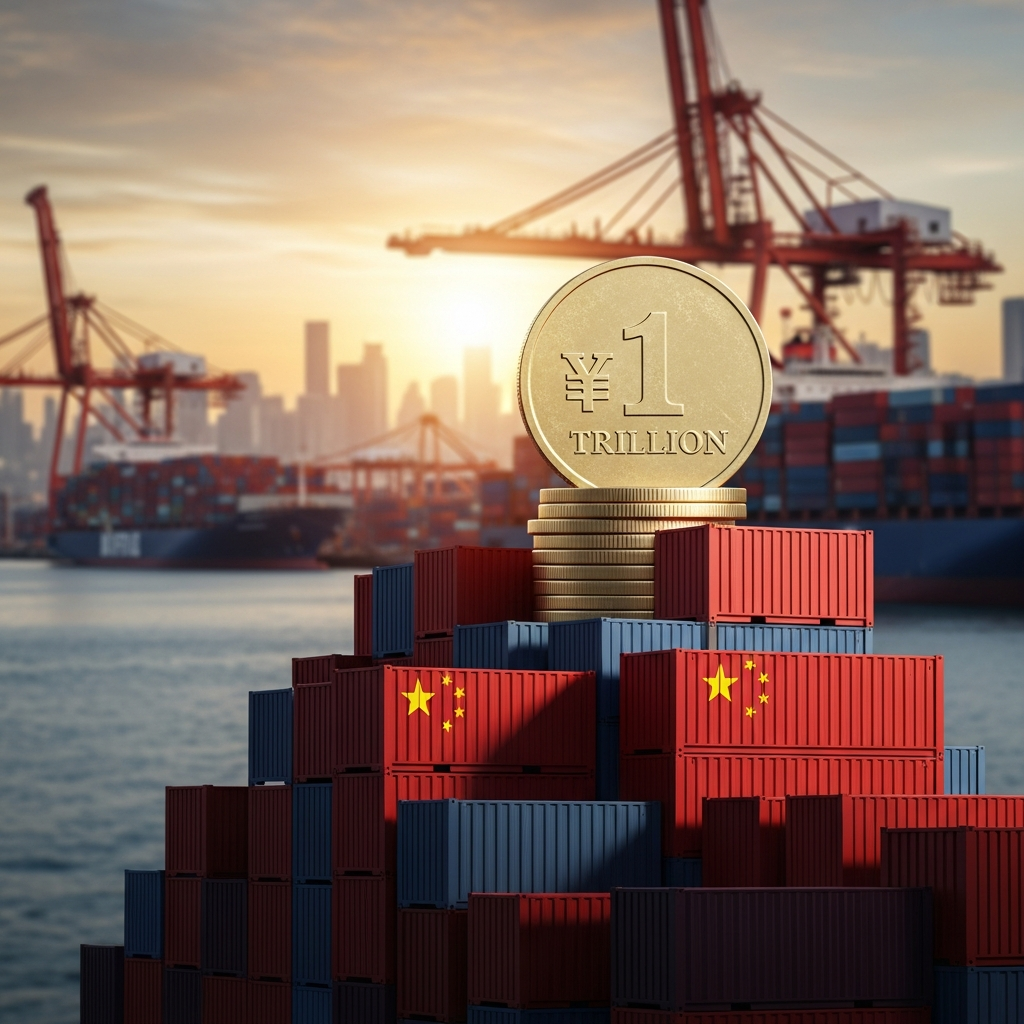
China’s trade surplus exceeded $1 trillion for the first time as manufacturers, seeking to avoid President Donald Trump’s tariffs, increased shipments to non-U.S. markets in November. Exports to Europe, Australia, and Southeast Asia witnessed a significant rise.
Shipments to the United States fell by nearly one-third compared to the same month the previous year.
“The tariff cuts agreed under the U.S.-China trade truce didn’t help to increase shipments to the U.S. last month, but overall export growth rebounded nonetheless,” said Zichun Huang, China economist at Capital Economics. “We expect China’s exports will remain resilient, with the country continuing to gain global market share next year.”
The role of trade rerouting in offsetting the impact of U.S. tariffs still appears to be increasing, she added.
Chinese exports overall grew 5.9% year-on-year in November, customs data showed on Monday, reversing October’s 1.1% contraction and surpassing a 3.8% forecast in a Reuters poll.
Imports were up 1.9%, compared with a 1.0% increase in October. Economists had expected a 3.0% rise.
China’s trade surplus was $111.68 billion in November, the highest since June and up from $90.07 billion recorded the previous month. This was above a forecast of $100.2 billion.
China has intensified efforts to diversify its export markets since Trump won the November 2024 U.S. election, pursuing closer trade ties with Southeast Asia and the European Union. It has also leveraged Chinese firms’ global presence to establish new production hubs for low tariff access.
Chinese shipments to the United States dropped 29% year-on-year in November, while exports to the European Union grew by an annual 14.8%. Shipments to Australia surged 35.8%, and the fast-growing Southeast Asian economies imported 8.2% more goods over the same period.
Declining exports to the U.S. occurred despite news that the world’s two largest economies had agreed to scale back some of their tariffs and implement other measures after Trump and Chinese President Xi Jinping met in South Korea on October 30.
The average U.S. tariff on Chinese goods stands at 47.5%, well above the 40% threshold that economists say erodes Chinese exporters’ profit margins.
China’s yuan strengthened on Monday, bolstered by the stronger-than-expected export data, with investors also awaiting policy signals from key year-end meetings.
The Politburo, a top decision-making body of the ruling Communist Party, pledged on Monday to take steps to expand domestic demand, a shift analysts view as crucial for reducing the $19 trillion economy’s reliance on exports.
Economists estimate that diminished access to the U.S. market since Trump returned to the White House has reduced China’s export growth by roughly 2 percentage points, equivalent to around 0.3% of GDP.
October’s unexpected downturn, following an 8.3% surge the prior month, indicated that Chinese exporters’ tactic of front-loading U.S.-bound shipments to beat Trump’s tariffs had run its course.
Although Chinese factory owners reported an improvement in new export orders in November, they were still in contraction, highlighting continued uncertainty for manufacturers as they struggle to replace demand in the absence of U.S. buyers.