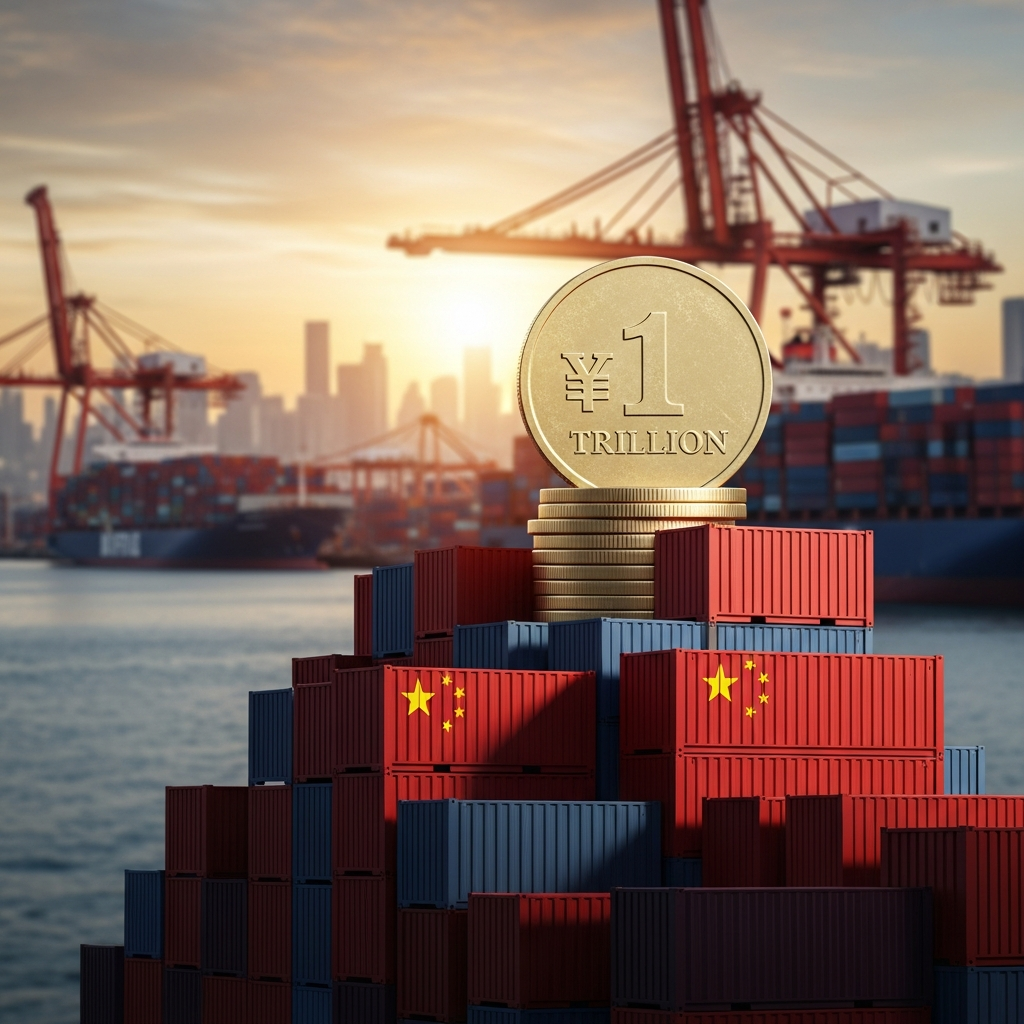
For the first time, China’s trade surplus exceeded $1 trillion as manufacturers redirected exports to non-U.S. markets in November, aiming to bypass President Donald Trump’s tariffs. Exports to Europe, Australia, and Southeast Asia saw significant increases.
Exports to the U.S. fell by nearly a third compared to the same month last year.
“Despite the U.S.-China trade truce tariff cuts, shipments to the U.S. didn’t rise last month, but overall export growth showed a strong rebound,” stated Zichun Huang, a China economist at Capital Economics. “We anticipate that China’s exports will stay robust, continuing to capture global market share next year.”
Stay informed with the latest updates. Follow KT on Whatsapp Channels
She added, “The impact of rerouted trade in mitigating the effects of U.S. tariffs continues to grow.”
Customs data on Monday revealed that Chinese exports overall rose 5.9% year-on-year in November, reversing October’s 1.1% drop and outperforming a 3.8% prediction from a Reuters poll.
Imports increased by 1.9%, compared to a 1.0% rise in October. Economists had anticipated a 3.0% increase.
China’s trade surplus in November was $111.68 billion, the highest since June, and up from $90.07 billion in the previous month, surpassing the forecast of $100.2 billion.
Since Trump’s November 2024 election victory, China has intensified its efforts to diversify export markets, strengthening trade relationships with Southeast Asia and the European Union. It has also utilized Chinese companies’ global reach to establish new production hubs for low-tariff access.
Chinese exports to the U.S. decreased by 29% year-on-year in November, while exports to the European Union grew by 14.8% annually. Exports to Australia surged by 35.8%, and fast-growing Southeast Asian economies received 8.2% more goods during the same period.
Exports to the U.S. fell despite an agreement to reduce some tariffs and other measures following a meeting between Trump and Chinese President Xi Jinping in South Korea on October 30.
The average U.S. tariff on Chinese goods is 47.5%, significantly above the 40% threshold that economists say affects Chinese exporters’ profit margins.
Key meetings focus amid US-China trade uncertainty
On Monday, China’s yuan strengthened due to better-than-expected export data, with investors also looking for policy signals from important year-end meetings.
The Politburo, the ruling Communist Party’s key decision-making body, pledged on Monday to implement measures to boost domestic demand, a shift analysts believe is essential for reducing the $19 trillion economy’s dependence on exports.
Economists estimate that reduced access to the U.S. market since Trump’s return to the White House has decreased China’s export growth by roughly 2 percentage points, equating to around 0.3% of GDP.
October’s unexpected downturn, following an 8.3% surge the previous month, indicated that the strategy of advancing U.S.-destined shipments to circumvent Trump’s tariffs had reached its limit.
Although Chinese factory owners reported an increase in new export orders in November, they remained in contraction, highlighting ongoing uncertainty for manufacturers as they struggle to replace the demand lost from U.S. buyers.