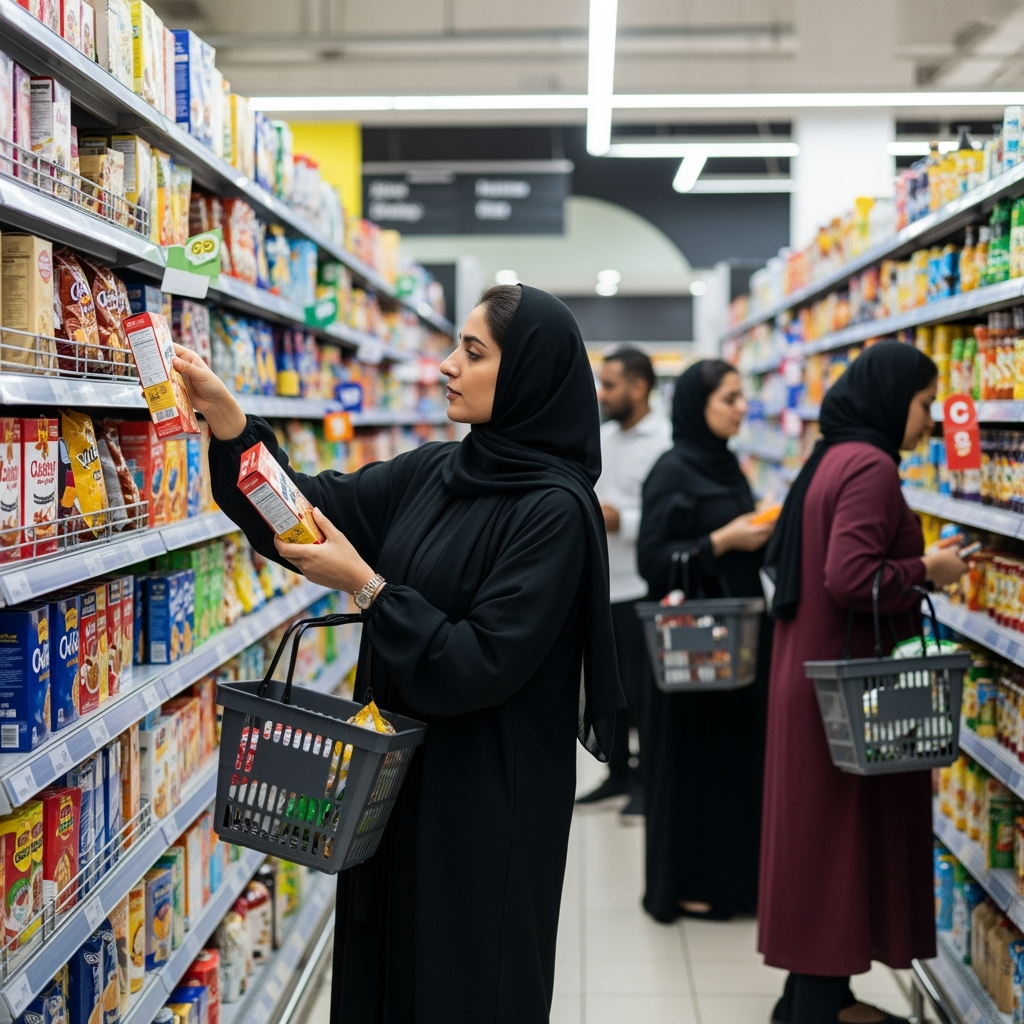
Shoppers in the UAE are increasingly purchasing smaller packets of food but are shopping more frequently, according to market research. They are also opting for smaller packs in beverages and dairy products and are on the lookout for discounts.
“The number one behavior change that we see among the shoppers is that the cost of living is going up, making shoppers sensitive about the volume,” said Imtiaz Hashem, Consumer Insights Director of market research company Worldpanel by Numerator. “Shoppers are buying less per trip, but the frequency of shopping has significantly increased compared to 2023.”
He was speaking at the two-day Future Food Forum, which took place in the UAE earlier this week, urging businesses to reconsider pack size formatting, bundling strategies, and product placement to align with evolving consumer preferences.
“This is definitely of functional importance to understand how to do bundling, what to do about pack size formatting, and where shoppers are buying,” he explained.
Gen Z shoppers
Mohamed Al Hashemi, CEO of Union Coop, said he had seen similar changes in shopping patterns, especially among Gen Z. “Generally, millennials would go to the grocery store once a week,” he said. “But among Gen Z, we are seeing them shopping two or three times a week. One is physical and the remaining are refills done online. So, they are shopping smaller baskets but more frequently.”
He added that the company was using artificial intelligence to customize the shopping experience for its clientele. “We have an AI-enabled loyalty program which we launched in April,” he said. “It understands consumer behavior to give hyper-personalized offers that suit them. The new generation doesn’t want to get a leaflet that is seven pages long and has 70 offers out of which just one or two might be of interest to them.”
Healthy alternatives
Customers are now becoming more health-conscious in their shopping, according to Milana Boskovic, Director of Marketing and R&D at Al Ain Farms. “We do a lot of innovation in the health segment, such as the organic range and Greek yogurt without sugar,” she said. “Our key focus is to deliver products that meet consumer needs. We see a lot of our consumers looking for healthier options, which ramped up during the Covid time and has continued since.”
She added that Al Ain Farm was also reducing packaging sizes, being present on online channels, and producing more healthier varieties of products to meet Gen Z demands. “We have seen a massive increase in e-commerce and convenience apps,” she said. “They are looking for quick information, QR codes, and transparency on the packaging. Many are reading labels, they are asking where their food is coming from, and trusting more local sources.”
Online shopping
Imtiaz added that the UAE is cementing its position as one of the top global markets for e-commerce in Fast Moving Consumer Goods (FMCG). “According to our numbers, we see that the number one country that does online shopping is South Korea, but the UAE is not far away. It’s probably number five or number six in the world,” he said.
Online FMCG purchases in the UAE now contribute nearly 7 percent of total volume, and more than 43 percent of UAE households are engaging in online shopping for these goods, with the frequency of purchase rising from 12 times to 16.3 times per year in just one year.
He added that UAE shoppers are willing to pay more online in exchange for time savings and ease of access. “On average, consumers are paying more online than offline,” he said. “So what the shopper is trying to do is they’re trying to capture the convenience. Consumers are time-poor, and they need convenience.”