As the late afternoon sun dips, I find myself nodding off with a book in hand, only to be stirred by the rhythmic sound of drums outside my room at the Four Seasons Resort Chiang Mai. Stepping onto the verandah, I notice that the morning’s light drizzle has transformed into radiant sunshine. The paddy fields shimmer with renewed vibrancy, their lush green stalks gracefully swaying in the breeze.
In front of me, a group of men and women dressed in loose cotton attire and conical bamboo hats winds through the muddy paths beside the guest rooms, moving onto the narrow trails within the rice paddies, drumming and singing in perfect harmony. This is the daily Farmers Parade, a tradition at the resort marking the end of a long workday in the rice fields of northern Thailand. It’s a fitting homage, given the resort’s traditional Lanna design, with living and dining spaces encircling a central rice field.
Heading into town, an hour’s drive from the resort, the farmers’ songs fade into the chants of monks. Chiang Mai, with its rolling hills and lush valleys, is unlike any other place in Thailand. This city favors Buddhist temples over beachside bars, drawing visitors who seek tranquility through waterfall chases and rainbows rather than the thrill of surfing and snorkeling.
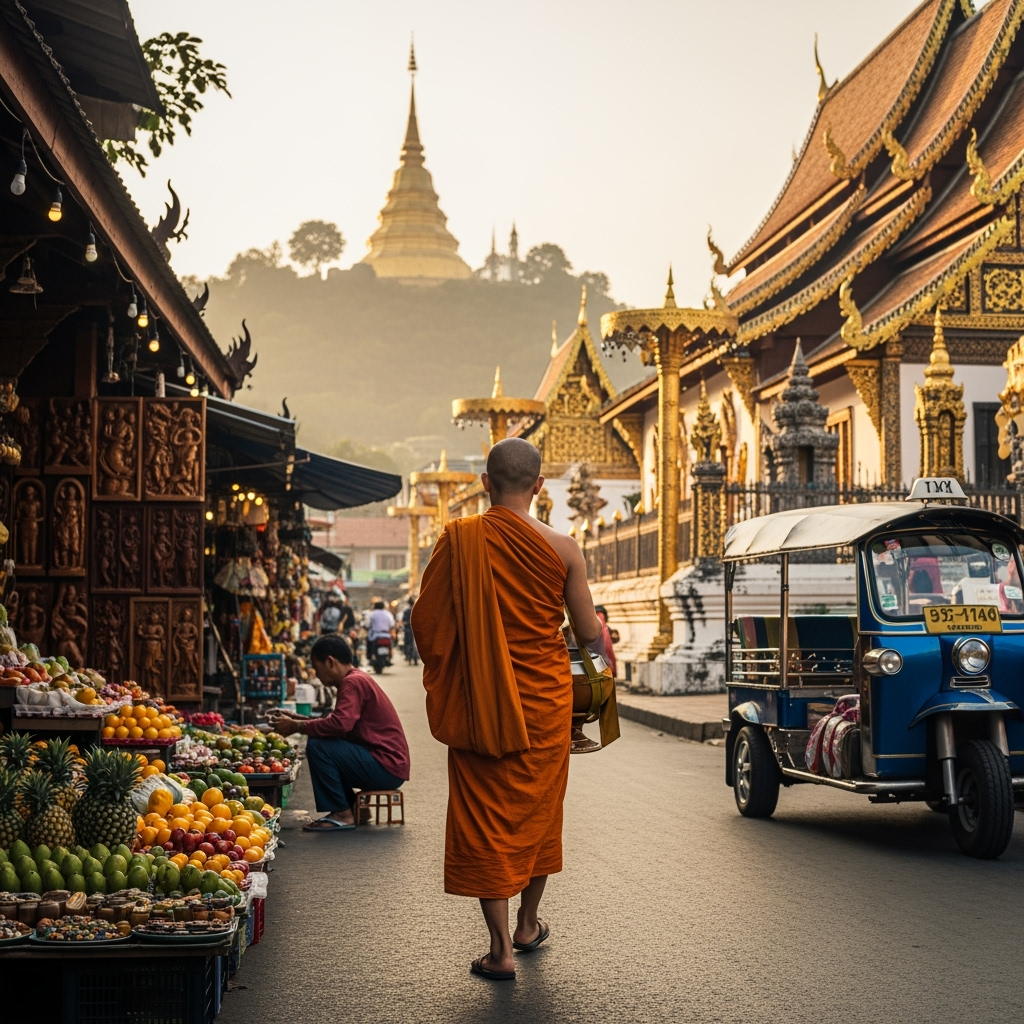
Chiang Mai exudes a vibe best described as spiritual chic. As I wander through the town center, I encounter golden stupas gleaming under the morning sun and monks in orange robes deep in meditation. The main streets are lined with vibrant cafés and upscale shops, and in the distance, I glimpse the Tha Phae Gate, a historic entry to this walled town, home to nearly 300 wats (Buddhist temples).
Despite being Thailand’s second-largest city, Chiang Mai maintains a gentle pace, free from the hustle and bustle associated with Bangkok. Founded in 1296, it served as the capital of the Lanna kingdom until 1558 when it fell to Burmese control. Modern Chiang Mai is far removed from its past political significance, yet it retains a rich cultural heritage.
While visiting all of Chiang Mai’s wats in one trip is impossible, I prioritize the highlights, starting with Wat Phra Singh, the Temple of the Lion Buddha. The complex is adorned with numerous shrines and prayer halls, featuring intricate wood and stone carvings, and exquisite wall murals depicting the lives of kings and commoners.
Nearby Wat Chedi Luang appears more subdued but was once the region’s largest stupa, housing the sacred Emerald Buddha before it was relocated to Bangkok’s Grand Palace. I muster energy for one last wat, taking a tuktuk to Wat Sri Suphan, or the Silver Temple, with its walls sheathed in silver and adorned with statues and carvings.
Back at the resort, I find the perfect remedy for a day of temple hopping: a luxurious session at the in-house Wara Cheewa Spa. My ‘rose of the north’ scrub and massage, paying homage to Chiang Mai, utilizes local ingredients like rose petals and jasmine rice. After two hours in my masseuse’s skilled hands, I feel rejuvenated as I head to Khao restaurant for dinner, savoring Khao Soi, the aromatic noodle soup I first tasted in Myanmar.
The next morning at my cooking class at Rim Thai Kitchen restaurant, I learn that Northern Thai cuisine is subtle and distinctive, influenced by neighbors Laos and Myanmar. After lunch, I visit the rustic Chaan Baan workshop to try my hand at Lanna pottery and tie-dye.
As the day’s heat wanes, I ascend to the hilltop Wat Phra That Doi Suthep, a temple of great cultural importance. Climbing the 306 stone steps flanked by Naga (serpent) statues is challenging but rewarding. The temple’s golden spires gleam in the evening sun; devotees bow at various shrines; monks chant softly. Below, Chiang Mai unfolds like a patchwork quilt. Despite the crowds, this place exudes peace and calm.
As night falls, the weekend market livens up Chiang Mai’s main street, closed to traffic. I peruse stalls filled with charming, quirky souvenirs, tempted to buy everything. From silk scarves and scented candles to carved wooden bowls and handmade notebooks, the local crafts are captivating. I find vegetarian delights like spicy tofu skewers and som tam (papaya salad), concluding with delicious mango sticky rice.
Back in my room, the calming hum of cicadas and the faint scent of jasmine lull me to sleep. It doesn’t get more quintessentially Thai than this.
wknd@khaleejtimes.com