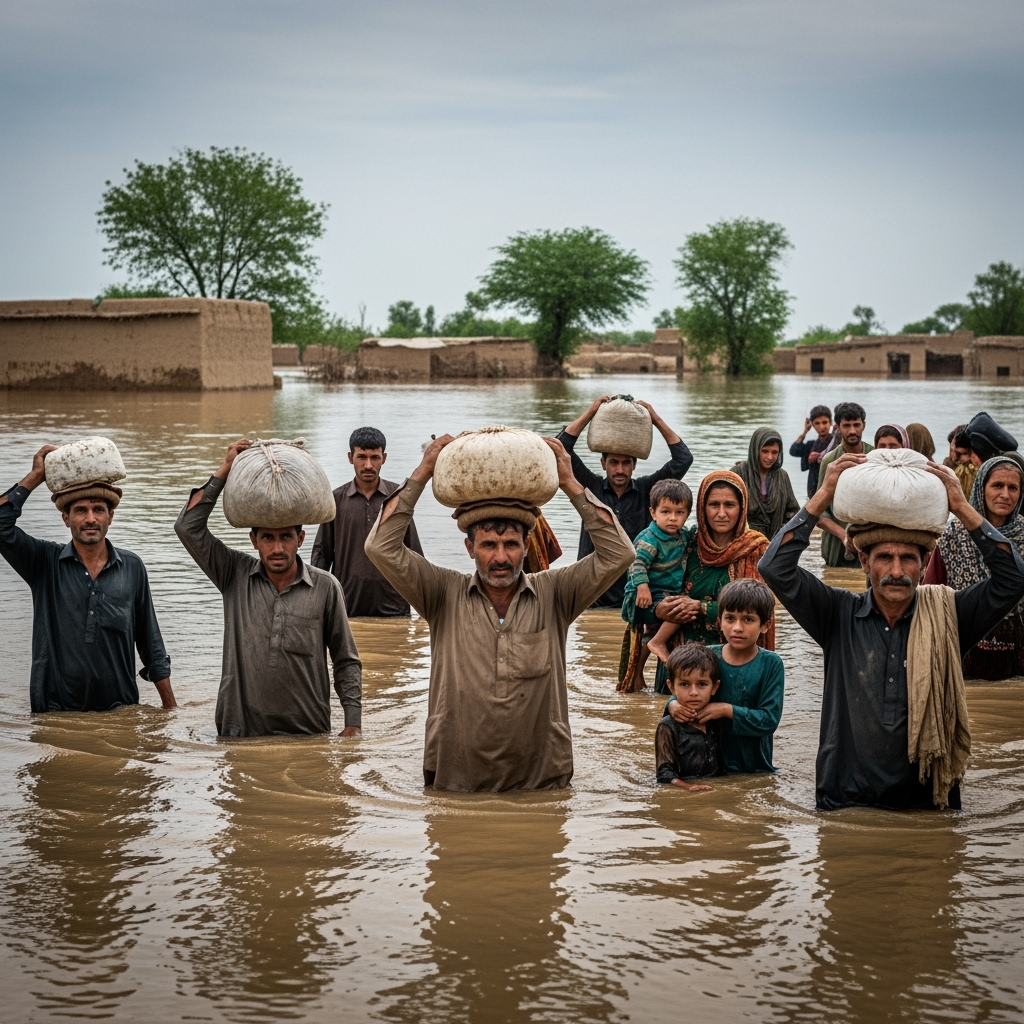
This month, Shama faced rising floodwaters from across the Indian border in her eastern Pakistani village. She knew she had to act quickly: gather her four children and prepare to evacuate. It was the second time this year she had to leave her home, the first being in May during cross-border conflict between India and Pakistan.
“How many more times must we evacuate?” asked the 30-year-old, whose husband was busy transporting their 10 cows to safety by boat. “We’ve already lost so much to the conflict, like the children’s school days, and now the floods force us to leave again. Trouble is trouble.”
Shama’s struggle is shared by many in flood-stricken Kasur, as families express exhaustion from repeated displacements, first due to conflict and now due to natural disasters.
“The floods began earlier this month and have only worsened,” said 27-year-old Bibi Zubaida, who lives with seven family members in a three-bedroom house near a mosque now broadcasting evacuation alerts.
From the mosque’s loudspeakers, usually reserved for prayers, came an urgent message: boats are ready for those who wish to evacuate.
“Living here means accepting the threats of war and floods. Where can we go?” Zubaida questioned.
Kasur is just kilometers from the Indian border. Residents, from rooftops and rescue boats, can see Indian checkpoints on the horizon, tying their fate to decisions made across the border.
The countries share rivers governed by the Indus Waters Treaty for over 60 years. India suspended this treaty earlier this year after an attack by militants, which India claimed were supported by Pakistan—an allegation Islamabad denies.
This attack led to brief but intense clashes, forcing villagers like Shama to flee. Then the monsoon turned rivers into floods.
Families, balancing motorcycles, possessions, and animals alongside children, were ferried by rescue workers through submerged fields on narrow wooden boats.
Rescue worker Muhammad Arsalan noted many villagers hesitated to leave.
“People fear leaving their possessions behind to thieves. They’re reluctant because they’ve evacuated so often,” said Arsalan, who has rescued over 1,500 people recently.
“They love their livestock and hesitate to leave without them,” he added, pausing to clear debris from the boat motor before continuing his efforts.
The Punjab disaster management authority reported record-high flow in the Sutlej River at Ganda Singh Wala, following a breach at an Indian barrage. At least 28 deaths have been reported, with water moving further south in Punjab, threatening new areas.
In India, cloudbursts in Jammu and Kashmir’s Ramban and Mahore regions resulted in 10 deaths. Pakistani officials claimed the crisis worsened due to India’s suspension of the Indus Waters Treaty, halting the exchange of river data. Islamabad accused India of releasing large amounts of water without adequate warning.
“If the treaty operated, we could have managed the impact better,” said Pakistan’s Planning Minister Ahsan Iqbal to Reuters.
India denied deliberately flooding Pakistan, blaming heavy monsoon rains and stating multiple flood alerts were issued. Surging water damaged two gates of the Ravi River’s Madhopur barrage, Indian officials reported.
Farmers lament the flood’s devastation on their livelihoods. “Thirteen of my 15 acres are gone,” said Muhammad Amjad, a rice and vegetable farmer. “Women and children evacuated, while men stayed behind to protect what’s left.”
Frequent displacements highlight the vulnerability of communities along Pakistan’s volatile eastern border.
Officials warn the crisis may worsen as climate change intensifies monsoons and cross-border river disputes hinder disaster management.
“I’ve seen many floods, but they’re more frequent now,” said Nawabuddin, a 74-year-old landowner, recounting past floods in 1988, 2023, and currently.
“We don’t want war or excess water. We just want to live,” said Zubaida, whose renovated home and farmland are now submerged.