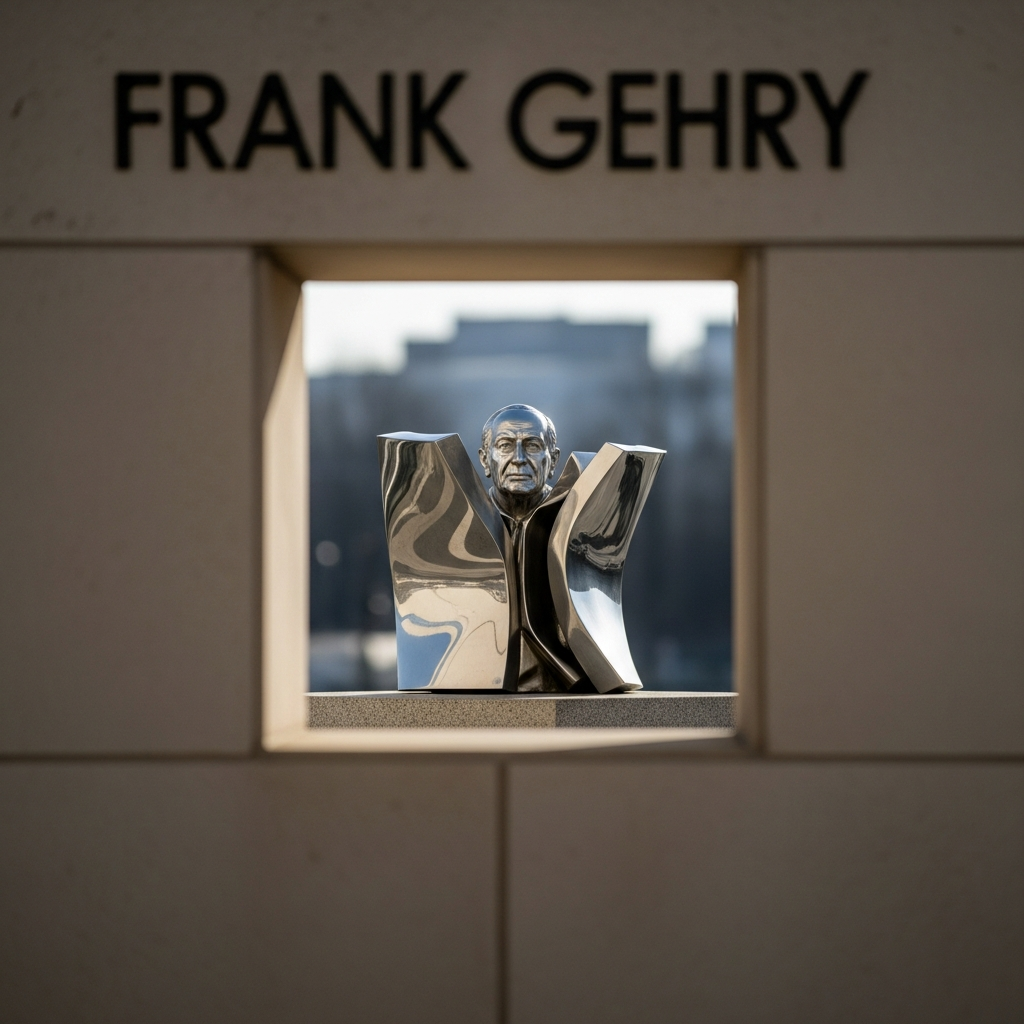
Frank Gehry, renowned for his bold and imaginative designs like the Guggenheim Museum in Abu Dhabi and Bilbao, passed away on Friday at the age of 96.
Meaghan Lloyd, Gehry’s chief of staff, confirmed his passing through an email to Reuters, stating he died “early this morning at his home in Santa Monica after a brief respiratory illness.”
Gehry’s iconic and vibrant works often seemed like they were artistically collapsing or in the process of doing so. They were celebrated as masterpieces or criticized as extravagant chaos.
Stay informed with the latest updates. Follow KT on WhatsApp Channels.
His designs were so extraordinary that even he sometimes questioned them, as he did with the Bilbao museum.
“I visited just before the opening and thought, ‘Oh, my God, what have I done?'” Gehry told Vanity Fair. “It took me years to appreciate it.”
In 2010, a Vanity Fair panel named the Bilbao museum the most significant architectural work since 1980. Architect Philip Johnson deemed it “the greatest building of our time,” and Gehry “the greatest architect we have.” Yet, Gehry was uneasy with the “starchitect” label.
Significant Creations: Museums and Facebook Campus
In March 2015, Gehry designed a major expansion for Facebook’s campus in Menlo Park, California, with instructions to ensure it blended with its environment.
Gehry also unveiled the Fondation Louis Vuitton museum in Paris in 2014.
Following Gehry’s passing, French billionaire Bernard Arnault honored him.
“Frank Gehry, with his unmatched ability to shape forms and make glass dance, will remain a lasting inspiration for Louis Vuitton and all LVMH Maisons,” Arnault said.
Other notable works include the Walt Disney Concert Hall in Los Angeles, Prague’s Dancing House, Seattle’s Experience Music Project, and New York’s 8 Spruce Street tower.
Critics accused Gehry of prioritizing form over function. The Disney Center faced criticism as “a pile of broken crockery” and “deconstructionist chaos.”
Gehry was unfazed by critics, telling the New Yorker in 2007, “At least they’re looking!”
However, in October 2014, when questioned about the flamboyance of his work in Spain, Gehry retorted: “98% of today’s architecture is pure nonsense. No design sense, no respect for humanity. They’re just buildings.”
Toronto Roots
Born Frank Owen Goldberg on February 28, 1929, in Toronto to Polish Jewish parents, Gehry was crafting buildings and cities from wood scraps as a child.
“That childhood memory guided me to architecture,” he told the New Yorker in 1977. “It showed me adults could play.”
After graduating from the University of Southern California, Gehry worked at several LA architecture firms, entered Harvard but left without a degree, served in the U.S. Army, and spent a year in Paris.
By 1962, he had changed his last name to Gehry upon returning to LA, at his wife’s suggestion, to evade anti-Semitism.
1989 Pritzker Prize Winner
His breakthrough was his own Santa Monica home in 1978, transforming a traditional house using chain-link fencing, aluminum, and plywood.
By the mid-1980s, Gehry gained international recognition with buildings featuring stainless steel or aluminum that seemed to bend and sway.
In 1989, Gehry received the Pritzker Prize, architecture’s top honor. His Guggenheim Museum in Bilbao, completed in 1997, marked his peak, made possible by advanced software for creating eccentric shapes.
Gehry, married twice with four children, also designed furniture, jewelry, watches, a vodka bottle, and a hat for Lady Gaga resembling a crumpled silver mass.