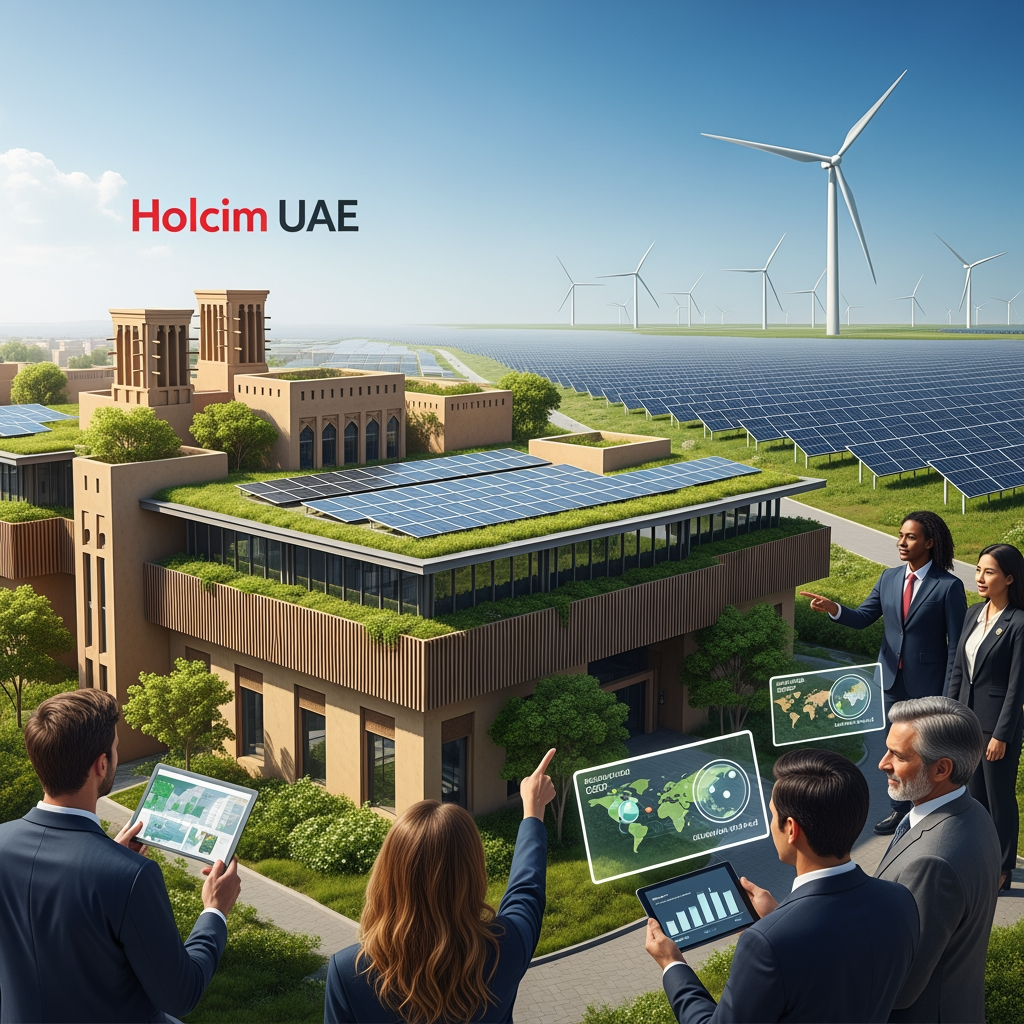
Holcim UAE, previously known as Lafarge Emirates Cement, is on a dynamic growth path in the UAE, focusing on sustainability, innovation, and strategic expansion. This week’s rebranding reflects a stronger alignment with Holcim Group’s global NextGen Growth 2030 strategy and the UAE’s Net Zero 2050 goals.
“Our rebranding goes beyond a name change; it’s a launchpad for accelerating innovation, strengthening partnerships, and promoting sustainability in the built environment,” stated Ali Said, CEO of Holcim UAE. “We aim to transform the construction industry with smarter, more resilient, and sustainable practices.”
Holcim UAE is unique in the market, operating fully integrated cement plants and concrete operations, managing everything from its quarry in Fujairah to construction sites in Dubai. This integration helps reduce carbon emissions and develop advanced low-carbon mixtures.
Holcim’s sustainability efforts are highlighted by two flagship products: EcoPlanet, a low-carbon cement that reduces CO₂ emissions by at least 30%, and ECOPact, a low-carbon concrete with similar reductions. Depending on project needs, these solutions can decrease emissions by up to 70%. Holcim is also leading in thermal insulation concrete for energy-efficient buildings and exploring 3D concrete printing technology.
Holcim’s dedication to sustainable construction is evident in major UAE projects like Al Shera’a – DEWA Headquarters, the largest net-zero-energy government building globally; Zuhha Island, constructed with 88% ECOPact concrete; and Etihad Rail, the national rail network built with Holcim’s low-carbon materials.
Currently serving Dubai and Sharjah, Holcim plans to expand into Abu Dhabi and Dubai South, while upgrading its Fujairah plant to produce near-zero building materials. “The UAE is a critical market for us,” said Said. “We’re not boosting traditional cement output—we’re investing in materials that lower carbon emissions.”
Decarbonization and Innovation
Holcim UAE is addressing emissions across all scopes. For Scope 1, it uses over 40% alternative fuels, including industrial waste and byproducts, and uses construction and demolition waste as raw materials. For Scope 2, a waste heat recovery system in Fujairah will reduce electricity consumption by 25%. For Scope 3, Holcim collaborates with Etihad Rail to cut transport emissions.
A key project is a carbon capture and mineralization initiative with climate-tech firm 44.01, utilizing Fujairah’s ultramafic rock formations to permanently store CO₂. The pilot project is in progress, with significant scaling planned by 2030.
Holcim anticipates strong demand for sustainable materials as awareness increases among developers and consultants. “The UAE’s visionary leadership and sustainability goals align perfectly with our global roadmap,” said Said. “We are optimistic about the future and committed to creating a smarter, more circular, and sustainable built environment.”