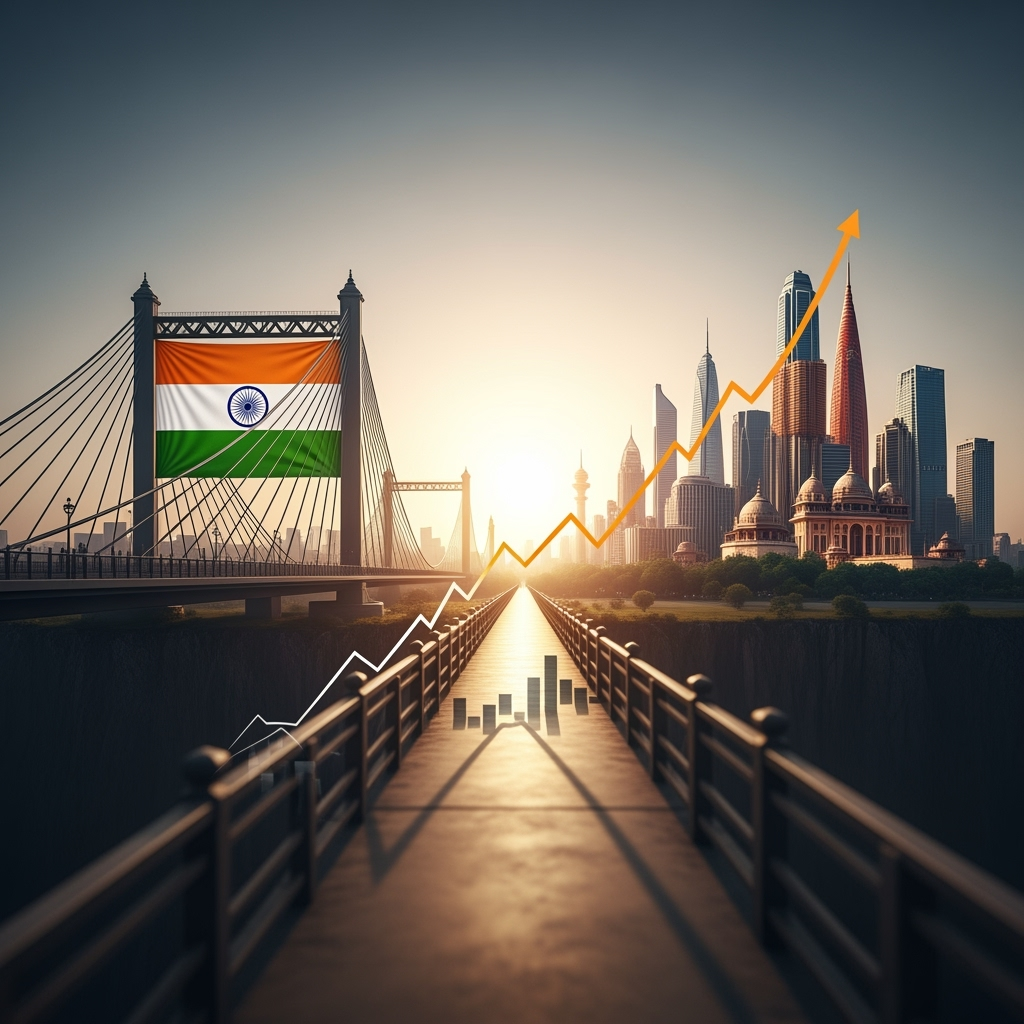
As the US implemented punitive tariffs of up to 50% on Indian goods on Wednesday, the world’s fourth-largest economy faced its most significant trade challenge in years.
Despite concerns in trade circles, analysts and policymakers believe the disruption will be temporary and unlikely to hinder India’s long-term growth. As the fastest-growing major economy, India is seen as resilient and capable of overcoming these challenges.
India’s capacity to handle economic shocks is built on recent experiences. After the pandemic downturn, the economy rebounded with 9.2% growth in FY24, then moderated to 6.5% in FY25 due to tighter credit conditions. Corporates and banks used this period to reduce debt and strengthen balance sheets, resulting in a more robust financial system today. This structural fortification positions India better to withstand global challenges than at any time in the past decade.
Stay updated with the latest news. Follow KT on WhatsApp Channels.
The tariffs stem from geopolitical tensions. President Donald Trump imposed an additional 25% levy on Indian exports in response to New Delhi’s purchases of Russian oil, adding to an earlier 25% duty on a range of Indian goods. The combined 50% tariffs, among the highest ever imposed on India, target textiles, gems and jewellery, footwear, chemicals, sporting goods, and furniture. However, high-value sectors like pharmaceuticals and electronics are exempt, highlighting the selective nature of these sanctions.
While the US remains India’s largest trading partner, the impact is less severe than it appears. Government estimates indicate $48.2 billion in exports are directly affected, equivalent to about 2% of India’s GDP. When exemptions are factored in, the effective exposure is closer to 1.2%. “India relies less on trade, with about 60% of its growth coming from domestic consumption,” S&P Global Ratings noted. “The tariffs are painful but won’t derail India’s long-term growth.”
S&P’s director YeeFarn Phua emphasized that although exporters will experience difficulties, the fundamentals remain strong. “There may be a one-time hit to growth, but the overall impact will be limited. India’s strong consumption base and investment cycle ensure long-term prospects remain secure,” he said. SBI Research estimates GDP growth could dip by 40–50 basis points at worst, with higher input costs potentially increasing inflation. However, India’s buffers are strong. Foreign exchange reserves close to $660 billion cover over 10 months of imports, bank credit growth is over 14%, IPO fundraising is robust, and UPI transactions now exceed 10 billion monthly, indicating resilient, digitally-driven domestic demand.
India’s Chief Economic Advisor V Anantha Nageswaran acknowledged that textiles, gems and jewellery, and seafood are the hardest hit, but believes the disruption will ease within a quarter or two. “In the short term, there will be some pain, but India is well-positioned to adapt and adjust. Exporters will quickly reorient markets,” he noted.
This reorientation is already underway. Negotiations with the European Union, which purchased €120 billion of Indian goods in 2024, are advancing into their 13th round this September. A free trade agreement with the UK, expected by 2026, aims to double trade to $100 billion by 2030. Meanwhile, exporters are exploring Latin America, Africa, and Southeast Asia for seafood, textiles, and engineering goods—sectors most affected by US tariffs. Gems and jewellery exporters, who previously sent a third of their $28.5 billion shipments to America, are targeting Europe and the Middle East. Shrimp exporters are pivoting towards Japan and Southeast Asia, while textile producers are exploring opportunities in Latin America.
Global agencies continue to place confidence in India’s resilience. The IMF forecasts GDP growth of 6.5% in FY26, with non-oil GDP expected to grow above 6% annually through 2027. India’s industrial policy aims to double manufacturing output to $1 trillion by 2031, supported by production-linked incentive schemes and significant infrastructure investments. Even in energy, the core of the current dispute, the fiscal cost of diversifying suppliers seems minimal. The price gap between Russian and global oil has narrowed, while the Reserve Bank of India has expanded rupee-denominated trade settlement mechanisms, reducing dollar dependency for exporters.
Analysts acknowledge that competitors like Vietnam and China, facing lower tariffs, might gain short-term advantages. However, India has steadily gained market share in US supply chains, especially in textiles, where China’s dominance is declining. “The structural shift is already in India’s favor, and temporary trade barriers won’t reverse this trend,” an industry observer noted.
Policymakers warn against complacency. Nageswaran highlighted the risk of over-reliance on new inputs. “We cannot shift from crude oil import dependence to critical minerals dependence. Indian policymakers must commit resources for strategic independence,” he said, stressing the urgency of developing domestic capacity in batteries, semiconductors, and AI hardware. Industry associations have also called for faster reforms to reduce logistics costs, improve labor flexibility, and enhance competitiveness in high-value sectors. With green technologies and artificial intelligence reshaping global commerce, India’s next decade presents a rare opportunity to reposition its export profile.
The political angle is noteworthy. Trump framed the tariffs as punishment for India’s stance on Russian oil, displaying an “America First” image with an oil barrel on his social platform. In contrast, Prime Minister Narendra Modi declared he would “never compromise” the interests of India’s farmers and workers, signaling a stance of national resilience.
Analysts argue that India’s path forward lies in maintaining its course: leveraging its vast domestic market, diversifying trade partnerships, and accelerating reforms to boost competitiveness. As geopolitical rivalries intensify, India’s scale, adaptability, and stability uniquely position it to absorb external shocks while maintaining momentum. “India’s high growth rates need to be sustained over a long period to benefit from its demographics,” S&P concluded. “Steep tariffs alone won’t alter that path.”