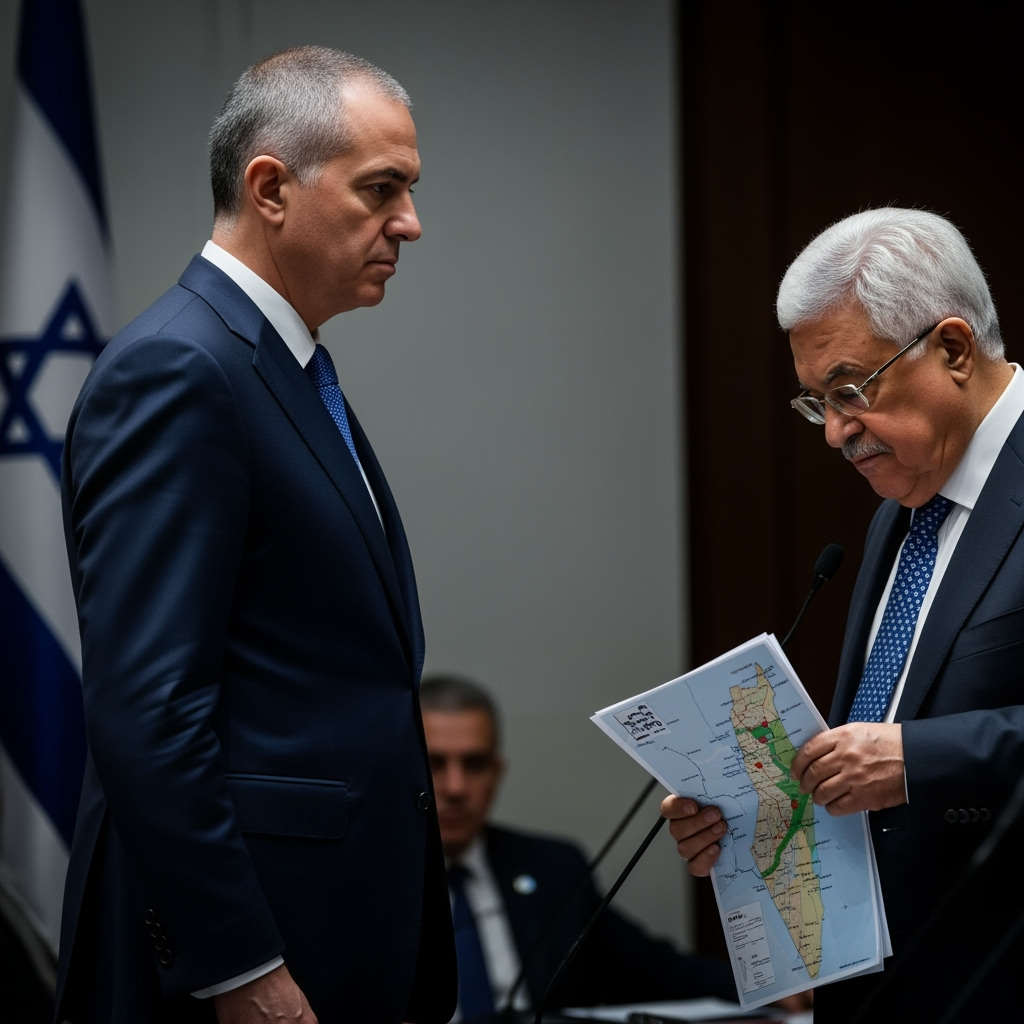
Sa’ar criticized on the “X” platform Abbas’s announcement of his readiness to take control of Gaza after the war without a role for the Palestinian “Hamas” movement, describing it as ironic “since Abbas lost control of the sector to ‘Hamas’ in 2007,” according to him. He pointed out that “the Palestinian President, Mahmoud Abbas, did not commit to combating terrorism, which is the basic commitment of the Palestinian Authority,” warning the West of the symbolism of his actions and goals towards Israel. Israeli Foreign Minister Gideon Sa’ar wrote in his tweet: “Mahmoud Abbas, in his speech at the United Nations General Assembly, said he is ready to take over the Gaza Strip, which he easily lost to ‘Hamas’ in 2007, how kind of him!” Sa’ar added: “Mahmoud Abbas says nice words to the West, but his people are supposed to draw their conclusions from the ‘key’ pin he wears on the lapel of his suit, this is the symbol, this is the symbol of flooding Israel with the descendants of the descendants of Arab Israelis who left the country in 1948, and annihilating Israel.” A small pin in the shape of a key, worn by Palestinian President Mahmoud Abbas during his recorded speech to the United Nations General Assembly last Monday, sparked angry reactions from Israel. The pin, symbolizing the “Key of Return” for Palestinian refugees, was previously considered a “threat to the existence of Israel.” The Israeli Ministry of Foreign Affairs criticized Abbas’s appearance with the key pin, describing it in a post on the “X” platform as reflecting “dangerous duplicity.” It said: “Abbas wore a ‘key’ pin, a clear symbol of his goal to erase Israel.” It added: “Abbas wants a flood of his own under the guise of a two-state solution, and his key represents the old PLO plan: two states for one Palestinian people and the destruction of the Jewish state. This will not happen.” Abbas delivered his speech last Monday at the “Two-State Solution” conference held via video technology, after the United States prevented him and other Palestinian officials from obtaining entry visas.


 Technology
Soyuz MS-27 Returns Astronauts from ISS
Technology
Soyuz MS-27 Returns Astronauts from ISS Hot news
Hostages in Gaza: Videos Reveal Crisis
Hot news
Hostages in Gaza: Videos Reveal Crisis





