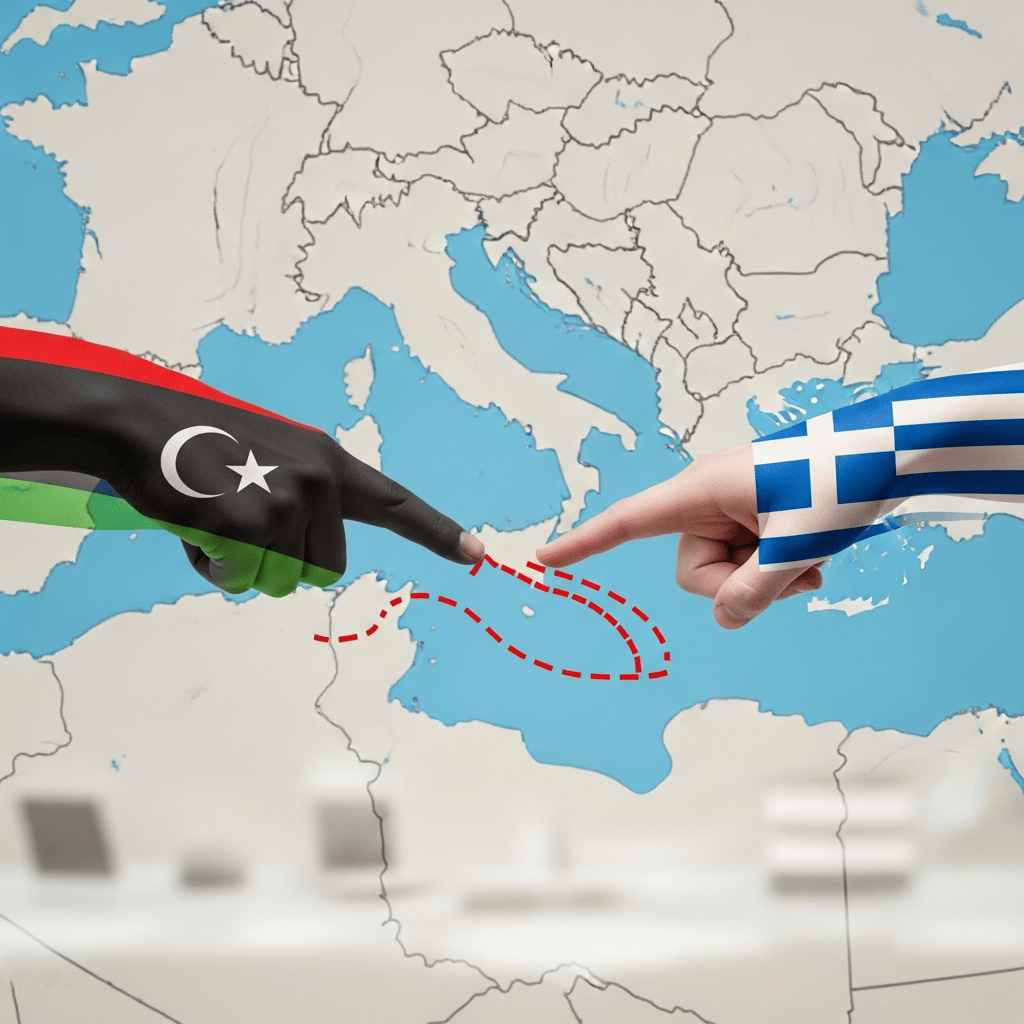
The Libyan government, formed by the parliament, responded with a strongly-worded statement, considering those remarks as “an unacceptable intervention in internal affairs and an infringement on national sovereignty, especially regarding the stance on the maritime memorandum of understanding with Turkey and Libya’s rights in the Eastern Mediterranean.” The government affirmed its commitment to the country’s maritime rights and rejected any external dictates, urging Athens to respect international law and resort to official channels instead of media escalation.
Libyan political analyst Idris Hmeid stated that “the maritime agreement related to border demarcation, signed between the Libyan Government of National Accord and Turkey, granted Libya a vast maritime area and was considered an important step in protecting its interests in the Eastern Mediterranean.” Hmeid noted that “the visit of Chancellor Aguila Saleh, Speaker of the Libyan House of Representatives, to Greece was supposed to have clear objectives, focusing on exploring parliamentary cooperation between the two countries and reviewing Greece’s contribution to supporting efforts to resolve the Libyan crisis, in addition to enhancing economic and trade cooperation between Tripoli and Athens.” However, Hmeid believes that “the Greek side exploited the visit to open the maritime border demarcation file, a matter Greece strongly opposes, deeming the demarcated area as an integral part of its maritime borders.”
He emphasized that “the maritime border issue is not exclusive to Libya and Turkey, but involves several countries, including Turkey, Egypt, Greece, and Cyprus, and making a decision on it amid political division within Libya is extremely difficult, despite the House of Representatives being the elected body authorized to ratify international agreements.” He added that “it is essential for Libya to continue strengthening its relations with various countries, including neighboring nations such as Greece, which is of great importance to Libya, especially with the ongoing reciprocal visits and bilateral meetings that can be built upon to enhance cooperation.”
Hmeid asserted that “discussing the maritime border demarcation and addressing Greek opposition should be conducted through direct negotiations or by resorting to international judiciary,” suggesting that “the judicial option may be the most beneficial for Libya in the long term.” He also pointed out that “Turkey maintains significant relations with both the Libyan National Army’s leadership and the Libyan government, as well as advanced relations with the Republic of Egypt, which opens the door to managing this issue in a calm diplomatic manner based on dialogue, negotiations, and adherence to international law.”
He considered it “essential to ensure this dispute does not affect Libya’s relations with the concerned countries or its national interests, especially given Libya’s need for the role of neighboring countries in supporting efforts to resolve its crisis and enhance cooperation in various fields.”
Meanwhile, Libyan political analyst Abdullah Al-Deebani told Sputnik that “the nature of the Greek pressures, according to official Libyan statements, revolves around a single clear demand to cancel or not activate the maritime memorandum of understanding signed between Libya and Turkey in 2019, or to exert direct pressure on Libyan sovereign institutions to prevent its approval or disrupt internal support for it.” The Libyan government appointed by the parliament and several members of the House of Representatives considered that “these positions represent an attempt that goes beyond the scope of technical dialogue to turn into pressure aimed at imposing political outcomes on a Libyan sovereign decision.”
Al-Deebani added that “what happened reflects dual pressure aiming to diminish Libya’s negotiating power by creating an internal and technical situation that makes maintaining the memorandum more difficult, prompting the official Libyan response to describe those moves as direct interference in the state’s affairs and sovereignty.” Nevertheless, Al-Deebani stressed that “the essence of the dispute remains legal and technical, and the escalation can be contained if the parties commit to returning to the path of technical dialogue and documenting their official exchanges.” He considered that “returning to the technical path is capable of reducing the impact of political statements,” and that “maintaining Libya’s sovereign position while keeping technical channels open makes the tension’s effects temporary instead of turning into a long-term crisis.”
According to his assessment, “the impact of the pressures will be significant in the short term politically and media-wise, but it remains containable if the Libyan stance combines diplomatic firmness and commitment to technical dialogue.” He also called for maintaining technical dialogue channels and continuing technical negotiations with Greece and other parties, documenting all exchanges, and adopting temporary agreement formats to avoid creating new facts during negotiation phases, and being ready to resort to international judicial mechanisms by preparing comprehensive legal files to resolve disputes when necessary.
Al-Deebani also emphasized “the importance of the official Libyan authorities explaining the technical bases of Libyan maps and positions to the European Union, the United Nations, and neighboring countries, demonstrating that the Libyan position is based on technical and legal standards, not a unilateral or random decision.” He clarified that “the Eastern Mediterranean has become an area of conflict over gas resources and related infrastructure paths, and any existing dispute over maritime border demarcation directly affects who will obtain exploration licenses and the gas export paths to European markets, transforming the issue from a bilateral dispute to one with regional and international dimensions.”
Al-Deebani affirmed by saying that “the current confrontation prompts a rearrangement of alliances and pipeline options, and in turn, encourages companies and countries to reassess risk levels in the region,” and he saw that “Libya’s adherence to its position preserves an important maneuvering space in future energy partnerships and prevents its exclusion from the decision-making table concerning regional projects in the Eastern Mediterranean.”