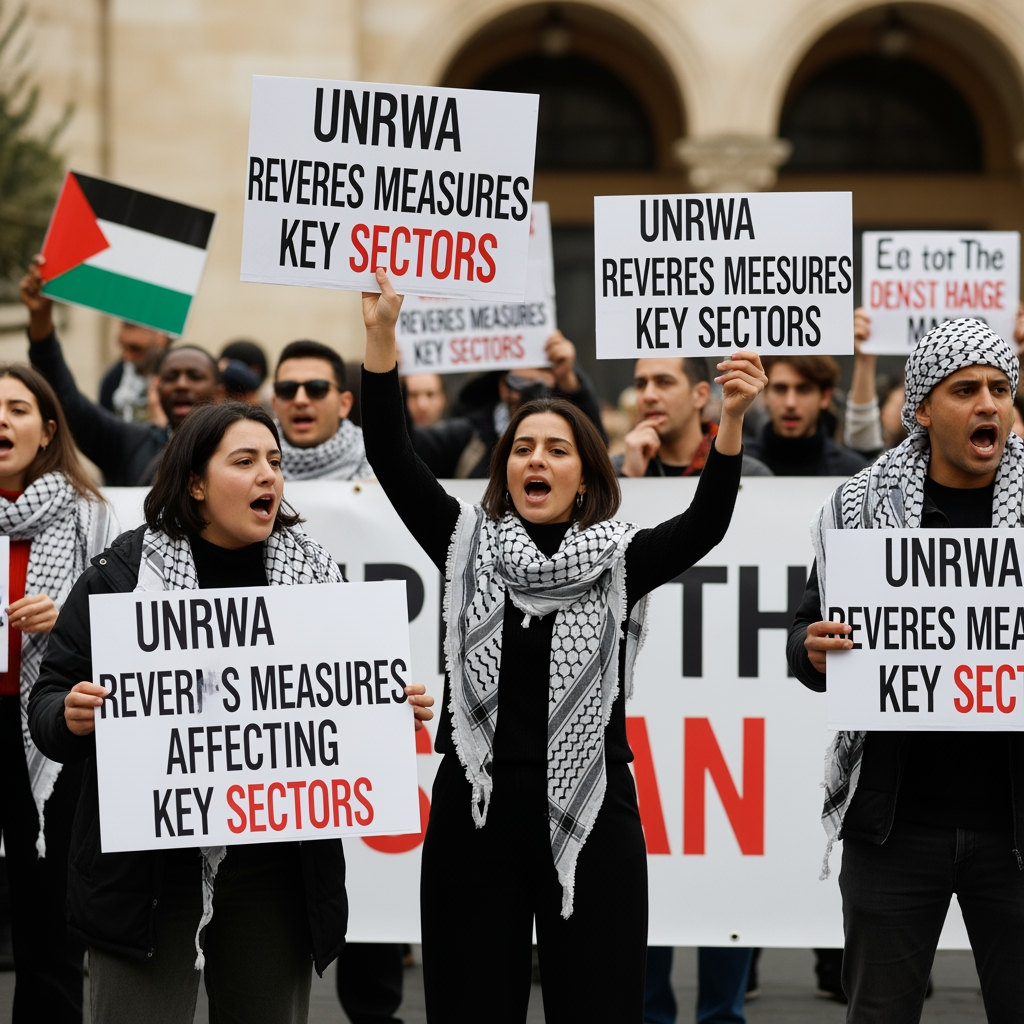
The demands focused on the necessity for the agency to retract its measures that affect vital sectors such as education, health, and relief, affirming the refugees’ commitment to UNRWA’s role as a witness to their cause and their right to return.
In the city of Sidon, southern Lebanon, the ‘Democratic Front for the Liberation of Palestine’ organized a large public sit-in in front of the UNRWA headquarters. The sit-in included the leadership of the front, representatives of factions and popular committees, and a crowd of Palestinian refugees. They raised banners denouncing the overcrowding of classrooms due to the integration policy, delays in the renovation of schools in the ‘Ain al-Hilweh’ camp, in addition to the absence of relief plans and the decline in health coverage.
At the conclusion of the protest, a memorandum was delivered to the agency’s administration containing clear demands to establish a rescue plan to address overcrowding in schools and increase health coverage.
Simultaneously, the town of Taalabaya in the Lebanese Bekaa witnessed a large public protest also called for by the Democratic Front. Abdul Rahim Awad, the front’s official in the region, stated that ‘the reductions are not just financial procedures, but a direct political targeting of the refugee issue and an attempt to eliminate the right of return.’ An urgent list of demands was presented to UNRWA’s administration, including the provision of diesel for heating in winter, the acceleration of building a new school, increasing medical coverage, and resuming cash assistance.
These protests come amid a severe financial crisis afflicting the UN agency, which recently accused Israel of ‘deliberately crippling relief efforts in the Gaza Strip.’ Commissioner-General Philippe Lazzarini warned that ‘the acute funding deficit, exacerbated after the United States suspended its funding, threatens basic services for millions of Palestinian refugees,’ confirming that the agency ‘is living week by week.’