For centuries, the pipes of a medieval organ lay hidden near the Church of the Nativity in Bethlehem, only to be rediscovered and now fill a Jerusalem monastery with ancient sounds once more.
“This is a unique glimpse into history… we’re able to hear a medieval sound that’s a thousand years old for the first time,” said David Catalunya, a Spanish researcher who spent over five years restoring the 11th-century instrument.
“It’s not a replica or a theoretical reconstruction; it’s the genuine sound: the same vibrations the Crusaders heard at the Nativity Church,” he explained to AFP.
Dating back nearly as far as the instrument’s invention, it was found in 1906 at the birthplace of Jesus Christ.
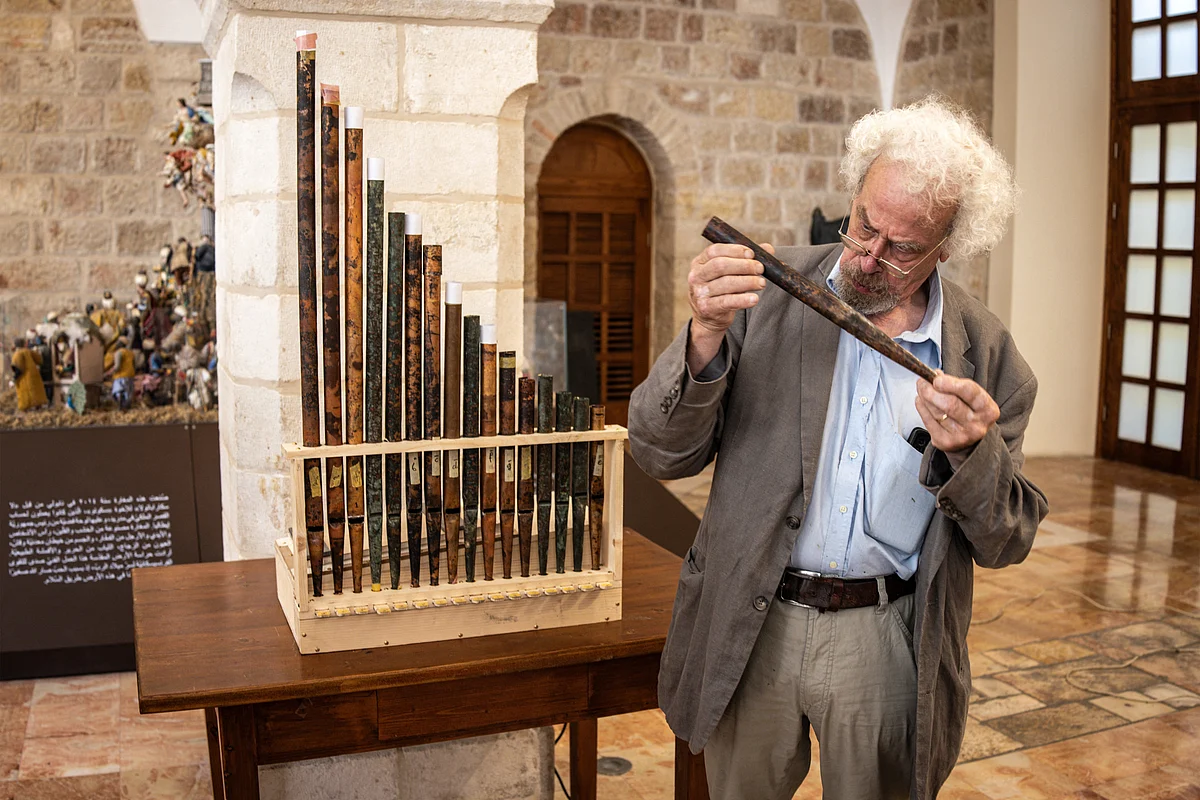
A man examines a piece of the operational replica of the oldest organ in Christendom (featuring original pipes) during its unveiling at Saint Saviour’s Monastery in Jerusalem on September 9, 2025. — AFP
Catalunya plays the organ by pulling small tabs, calling it a “miracle” as it releases a powerful sound from the modest wooden structure.
Now located in the Monastery of Saint Saviour in Jerusalem’s Old City, the organ will be showcased in a museum of the Franciscan Custody of the Holy Land.
“It’s akin to discovering a living dinosaur, known only from fossils,” said Alvaro Torrente, a musicologist involved in the restoration.
“This is no fossil; it’s the authentic object and sound,” he stated to AFP.
– Fortuitous discovery –
The organ was found “almost by chance,” as described by Father Eugenio Alliata, a Franciscan archaeologist linked to several holy site missions, including the Church of the Nativity in Bethlehem.
During the construction of a pilgrim hostel, 222 copper pipes and a bell carillon were unearthed nearby.
Buried with “great care,” according to Catalunya, researchers were able to meticulously reconstruct it.
Koos van de Linde, a leading organ specialist, commented that “the Crusaders’ hope that these pieces would play again was not in vain.”
“It was a tremendous honor to witness and partake in their revival,” he added.
Experts value the organ not only for its complexity—18 pipes for a single note—or what Catalunya terms its “amazing preservation,” but also for its age.
While historians typically study organs from the 15th century, this one was crafted in the 11th century in France and brought to Bethlehem by Crusaders in the 12th century, Catalunya noted.
“European Christians brought to the Church of the Nativity in Bethlehem the most advanced liturgical instrument of the time: the organ, destined to become the hallmark of sacred music,” Torrente stated to AFP.
He hopes the discovery will ignite more interest in what the research team calls the “Bethlehem organ,” which Torrente believes has more stories to share.