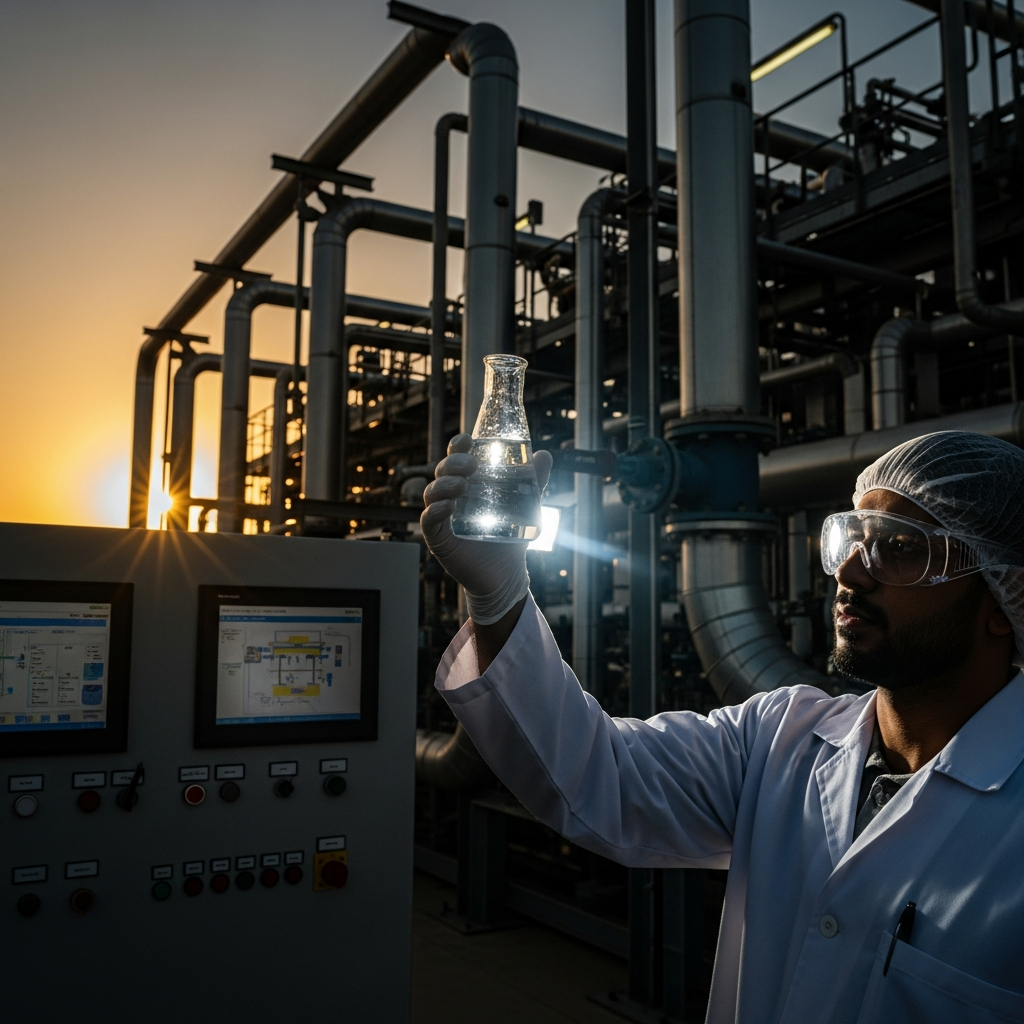
The GCC region constitutes nearly 60% of the world’s desalination capacity, with Saudi Arabia alone contributing 22%. As freshwater demand surges, the Kingdom’s desalination capacity is expected to increase by 10%, reaching 17.8 million cubic meters daily by 2030. Traditionally, desalination brine was considered waste, but this partnership repurposes it to align with Vision 2030’s sustainability and economic diversification objectives.
Saudi Arabia aims to reshape the future of water and climate innovation through a groundbreaking partnership between the Saudi Water Authority (SWA) and U.S.-based Ebb Carbon. This collaboration represents the first large-scale initiative to decarbonize desalination, a sector vital to the Kingdom’s water security and economic expansion.
Ebb’s electrochemical technology transforms brine into three valuable products: caustic soda, hydrochloric acid, and recyclable low-salinity brine for further freshwater extraction. These chemicals, currently imported at high costs, will now be produced domestically, reducing import dependence and fostering new industrial opportunities. “This waste-to-value strategy integrates the Circular Carbon Economy framework into core water infrastructure,” stated Ben Tarbell, Ebb’s CEO and Co-founder.
Beyond recovering freshwater, the technology enables large-scale carbon removal—up to 85 megatons annually at full capacity—by enhancing seawater alkalinity for permanent CO₂ storage. This innovation positions desalination plants as climate solutions, directly supporting Saudi Arabia’s Net Zero targets and the Saudi Green Initiative’s 278-million-ton emissions reduction goal.
Facility launch and strategic impact
The initial deployment will occur at SWA’s Water Technologies Innovation Institute and Research Advancements (WTIIRA) in Jubail, a leading global center for desalination R&D. “We are not merely adopting technology—we are cultivating a domestic carbon removal industry that supports economic diversification and positions the Kingdom as an exporter of climate solutions,” stated Tariq Alghaffari, SWA Vice President for Research & Promising Technologies.
The partnership also fortifies the water-energy nexus crucial to sectors such as district cooling. While the GCC’s cooling industry has moved towards treated wastewater for sustainability, reliable, low-carbon water remains crucial. “Incorporating Ebb’s technology positions the region to lead in both water efficiency and climate innovation,” noted Tarbell.
By leveraging existing infrastructure, Saudi Arabia aims to create a model for water-scarce nations globally. The initiative not only tackles water scarcity and climate change but also develops a circular, self-sustaining industrial ecosystem—transforming desalination from a cost center into a source of economic and environmental value.