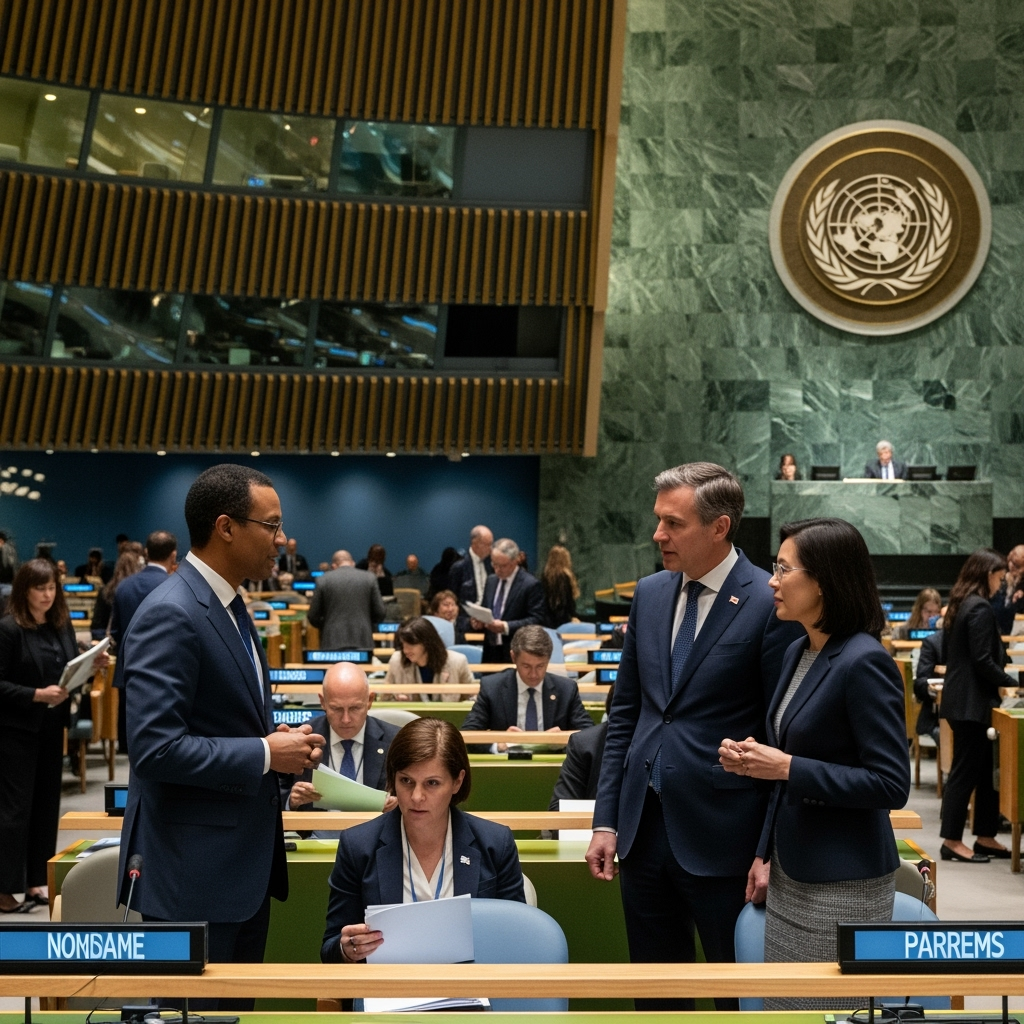
The meeting was held on the sidelines of the UN General Assembly’s High-Level Week. Before the talks began, the two ministers exchanged warm greetings, then the session continued behind closed doors. Lavrov and Rubio discussed the situation in Ukraine and the development of bilateral relations, emphasizing mutual interest in resolving the crisis. Lavrov stressed Moscow’s readiness to adhere to the lines set by the Alaska Summit between Presidents Trump and Putin. He also pointed out Russia’s rejection of plans promoted by Kyiv and some European countries, and a ‘comprehensive review’ of bilateral relations was conducted. Both sides agreed to resume the work of diplomatic missions. Rubio, for his part, renewed the US President’s call to end the conflict in Ukraine and urged Russia to take steps towards achieving long-term peace. The parties discussed practical issues in bilateral relations, including cooperation in trade and economic fields. Slovak Foreign Minister Juraj Blanar confirmed that Russia managed to adapt to European sanctions better than the EU itself, and that Slovakia has no alternative to Russian energy. Blanar demanded that his country be exempted from the EU’s plan to abandon Russian sources, warning of losses exceeding ten billion euros if supplies were halted. He also supported Trump’s criticism of the EU’s immigration policy, describing its problems as a ‘monster’s head’ threatening the continent’s stability. Lavrov and Hungarian Foreign Minister Peter Szijjarto exchanged views on practical cooperation in multiple areas, and discussed urgent international issues, including the conflict in Ukraine. Szijjarto emphasized the importance of high-level Russian-American communications to avoid the worst global scenarios, noting that continuing energy cooperation with Russia serves Hungary’s national interest, and that Russian supplies are necessary on a practical level without any relation to politics or ideology. Szijjarto also criticized some European countries, describing their behavior as hypocritical, affirming that Hungary purchases only 2.2% of Russian oil compared to other countries that obtain larger shares through Asian intermediaries. The parties discussed humanitarian activity in major conflict areas, including Ukraine, the Gaza Strip, Syria, and Sudan, and reviewed the operational mechanisms of the International Committee in Russia. Lavrov and the President of the International Committee of the Red Cross, Mirjana Spoljaric Egger, emphasized the desire to continue regular communications and enhance practical cooperation between the parties. Lavrov explained that Switzerland has lost its reputation as a reliable neutral mediator, and that Switzerland’s unfriendly policies towards Russia are taken into account when determining Russia’s stance towards this country. The meeting also addressed other international issues, including the Ukrainian conflict and the performance of the Organization for Security and Co-operation in Europe, which Switzerland will chair next year. Lavrov also held meetings with the foreign ministers of Cuba and the Dominican Republic, Bruno Rodriguez and Roberto Alvarez, and with Morocco’s Foreign Minister Nasser Bourita, as well as representatives from the Sahel Union countries (Mali, Burkina Faso, Niger). These meetings come in the context of the UN General Assembly’s High-Level Week, where the Russian Foreign Minister seeks to enhance bilateral cooperation and discuss urgent international issues, especially regional conflicts and humanitarian challenges.