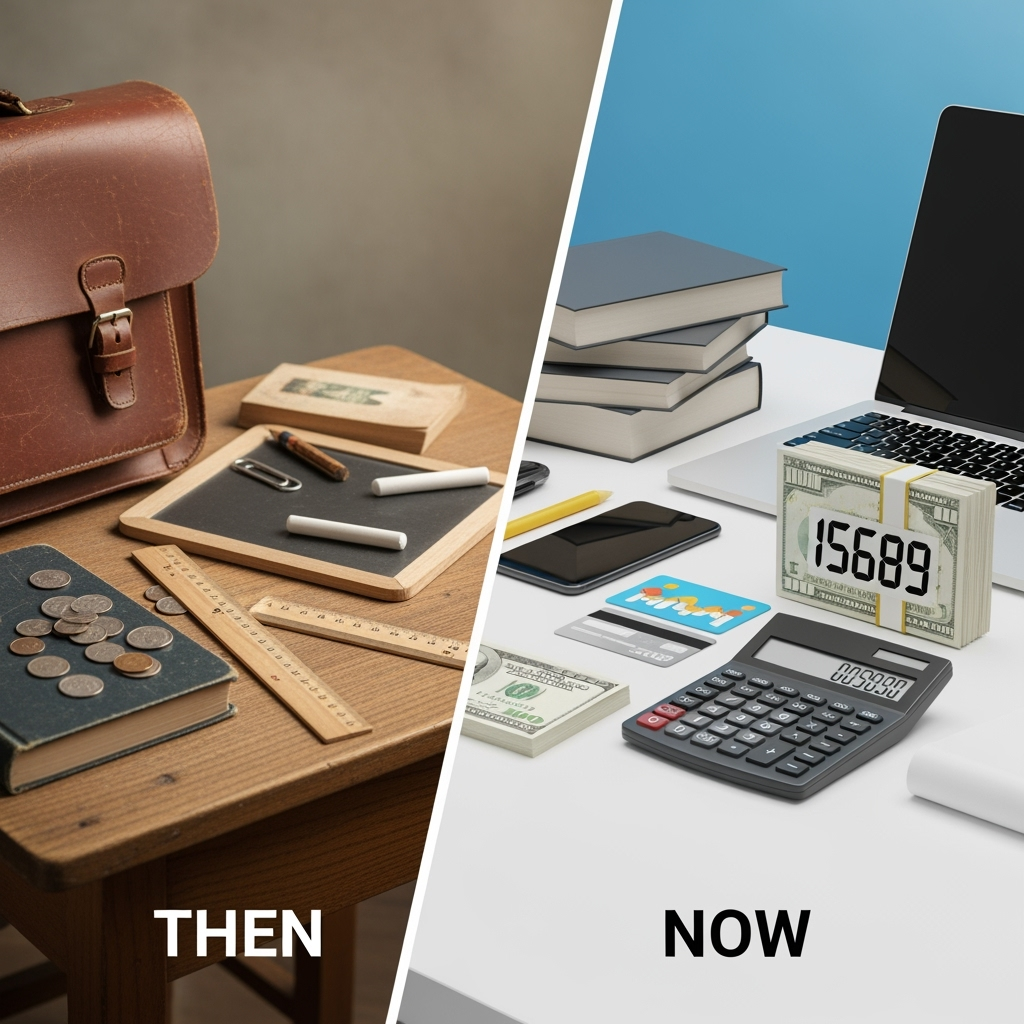
As Parveen Abdullah reviewed her children’s school costs this year, she reminisced about her own school days. Raised in Qusais, she attended Our Own English High School, where education was straightforward and affordable.
“In Grade 12, my father paid Dh6,360 annually for tuition, which included computer classes. The transport fees were Dh180 monthly, paid over 10 months,” she shared. Her daily commute was just 30 minutes, and until Grade 7, the school bus lacked air-conditioning. “When AC was added in Grade 8, the bus fee increased by Dh20, which was a significant hike.”
Today, the same school’s tuition fee is Dh16,562, nearly triple what Abdullah’s father paid two decades ago. Transport fees are now separate and location-dependent.
Stay informed with the latest updates. Follow KT on WhatsApp Channels.
Back then, the canteen was a highlight. “The priciest item was a Dh1 pizza and 50 fils Areej juice, which we enjoyed,” she recalled. Books and stationery were bought from Sharjah’s Rolla area for about Dh200 yearly. Classrooms featured blackboards and chalk; projectors were rare, and gadgets were nonexistent.
From Simple Days to Tech-Powered Classrooms
Two decades later, Parveen’s perspective has shifted. Her children’s school fees are Dh26,000 annually, one of Dubai’s more affordable options. “The school bus costs Dh10,000 yearly, and instead of a 30-minute commute, my children face nearly two hours in traffic,” she explained.
Seemingly minor expenses now accumulate quickly. Textbooks and notebooks are about Dh1,000 annually, while trendy items like Dh150 water bottles or smart backpacks are typical requests. “Having a laptop is almost mandatory for older students, and younger ones need an iPad. Everything is digital, from assignments to projects,” Abdullah noted.
The canteen has transformed significantly. “What cost Dh1.50 now costs my children Dh12 daily. Over the month, it’s another significant cost.”
The facilities are incomparable. “My children’s school boasts football, basketball, and cricket pitches, as well as smart boards and speakers. It’s a world away from the single playground we had.”
“We made do with so little, yet we were content. Today, children have everything, from laptops and iPads to international-level facilities. But the costs are staggering. What my father paid for an entire year, I now spend in two months,” added Abdullah.
‘Walk to School Then, Hi-Tech Buses Now’
Mohammed Salim, a Sharjah Indian School alumnus from the early 2000s, shares a similar perspective. His father paid just Dh1,200 monthly for his education and that of his three sisters. “One sister studied for free due to the school’s policy for families with multiple children. My father managed the education of three children with what today’s parents spend on one,” he said.
Their home was only a kilometer from school, and they walked together daily. There were no school runs plagued by traffic, no Metro, just a simple walk through sandy paths.
“The only gadget we used was a calculator, permitted only in higher classes,” Salim remarked. Fancy pens or colorful erasers were luxuries. Bags were patched and reused for years, and uniforms were made large to last and passed down to siblings.
Today, Salim’s children travel in air-conditioned, GPS-enabled buses, with tuition fees at Dh800 monthly per child. “That doesn’t include uniforms, books, gadgets, or extracurriculars. The difference exceeds 300%,” he stated.
Gone are the days of heavy book stacks, as his children now utilize tablets, smart screens, and apps for homework. “Even the most advanced tablet is considered basic now, as new models launch annually. These gadgets are no longer a luxury,” he said.
Lunchboxes once filled with home-cooked meals have given way to cafeteria food. Stationery has evolved from simple pens, rulers, and pencil boxes to lists of branded supplies. “Back to school feels like a festival, with malls crowded with parents shopping and hefty bills before the term starts.”
When a Geometry Box Was a Luxury
Amr Abdelaziz, who studied at Ittihad School in Al Mamzar during the 1990s, remembers the simplicity. “There were no large malls or traffic jams during school runs. We walked or rode in old yellow buses without AC, windows down in the summer heat,” he said.
Back-to-school shopping involved a trip to the local stationery store. “Notebooks had plain brown covers. If you were lucky, you got a new geometry box. Bags lasted two or three years, and shoes were polished until they wore out.”
In classrooms, blackboards and chalk were the norm, and computers were relegated to a lab. “We visited the computer lab once or twice a month, and most didn’t work half the time. If you lost your notebook, you lost your entire lesson because everything was copied by hand,” Amr recalled.
Now, as a father of three, he finds the comparison striking. “Back to school has become like a festival with malls, promotions, and endless lists. Just supplies cost over Dh1,500 per child. Add extracurriculars, cafeteria food, bus fees, and it’s Dh7,000 to Dh10,000 before classes even begin,” he said.
What astounds him most is the cultural shift. “My first-day anxiety revolved around meeting new teachers. For my kids, it’s about posting first-day photos on Instagram or making a TikTok video with their new shoes. Real-time updates from schools on apps notify parents like me if the bus is five minutes late. It’s a completely different world.”
Then vs. Now
For today’s parents, comparing their childhood to their children’s education goes beyond financial concerns. It reflects a generational shift in values, lifestyle, and expectations.
“We grew up with less and made the most of it. Today, children have more than we ever dreamed of. But perhaps they miss out on the simplicity we enjoyed,” said Amr.