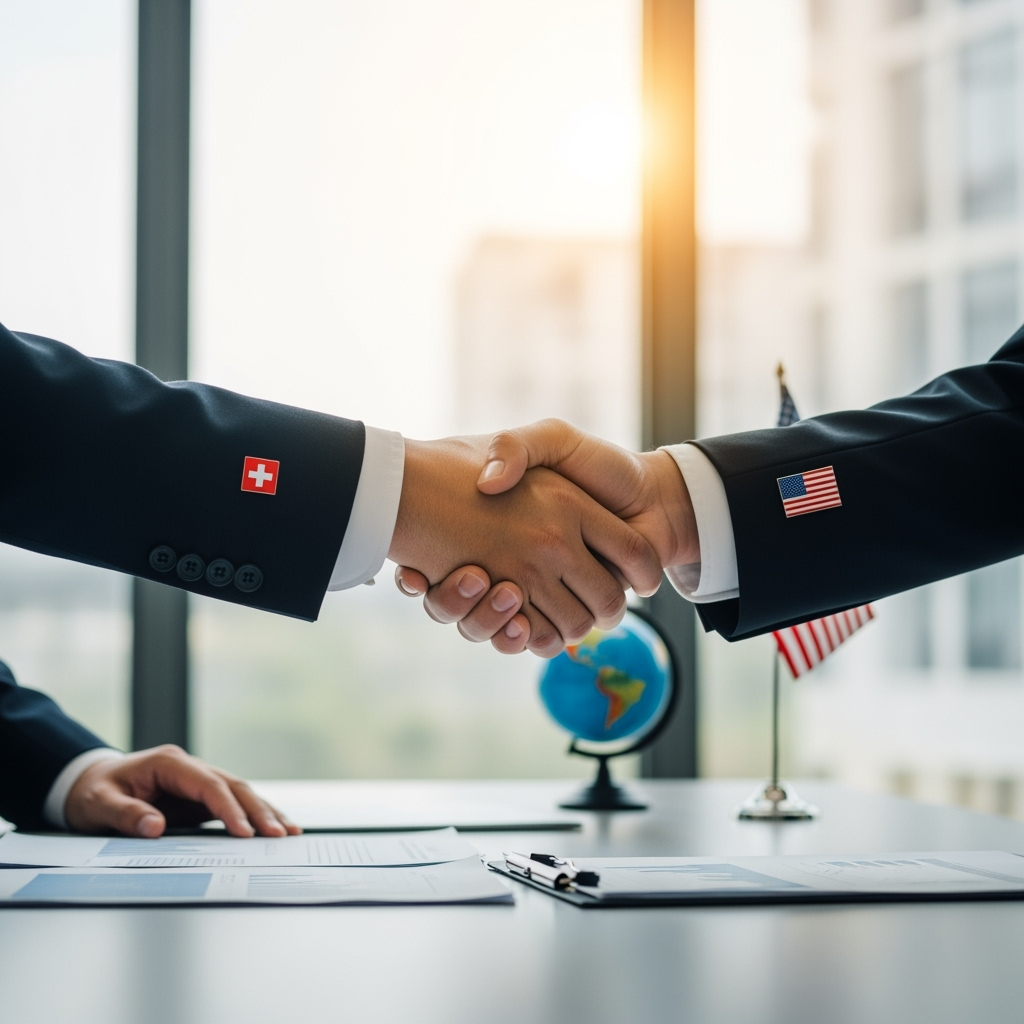
Switzerland’s vice president announced on Saturday that he engaged in “constructive meetings” with top US officials as Switzerland seeks to address the steep import tariffs imposed by US President Donald Trump.
Following his return from Washington, Economy Minister Guy Parmelin expressed optimism, noting a “real opportunity ahead” for both nations, though he withheld specific details.
Switzerland was caught off guard when Trump declared that Swiss imports would face a substantial 39 percent tariff starting August 1, one of the highest new tariffs imposed among numerous countries.
Stay informed with the latest updates. Join KT on WhatsApp Channels.
Swiss President Karin Keller-Sutter and Parmelin rushed to Washington in early August to discuss solutions for the tariff issue.
However, a short meeting with US Secretary of State Marco Rubio, who does not handle tariff policy, did not yield significant progress.
“I had constructive discussions in Washington with Secretary of Commerce Howard Lutnick, Secretary of the Treasury Scott Bessent, and Trade Representative Jamieson Greer,” Parmelin stated on X, following his recent trip.
“Switzerland sees a promising future for bilateral relations and is dedicated to strengthening our economic ties.”
Switzerland’s Keystone-ATS news agency reported that the economy ministry is withholding details of the talks “for tactical negotiation reasons.”
Foreign Minister Ignazio Cassis informed the agency on Friday that Switzerland had proposed an “optimized offer,” which Parmelin presented.
Earlier in May, Parmelin and Keller-Sutter had discussions with Bessent and Greer in Geneva to negotiate a tariff agreement.
Chocolate and Cheese Concerns
The 39 percent tariff marks an increase from the 10 percent “baseline” levy that Trump initiated in April on US imports globally.
This elevated rate threatens entire sectors of Switzerland’s export-focused economy, notably watchmaking and industrial machinery, as well as chocolate and cheese industries.
Swiss companies fear that competitors in other affluent economies might gain an advantage, as the European Union and Japan secured a 15 percent tariff and the UK a 10 percent rate.
Bern has argued that the US enjoys a substantial services trade surplus and that most US industrial goods enter Switzerland without tariffs.
Last week, the State Secretariat for Economic Affairs indicated that the Swiss economy is projected to grow by 0.8 percent next year instead of 1.2 percent due to the increased US import tariffs.