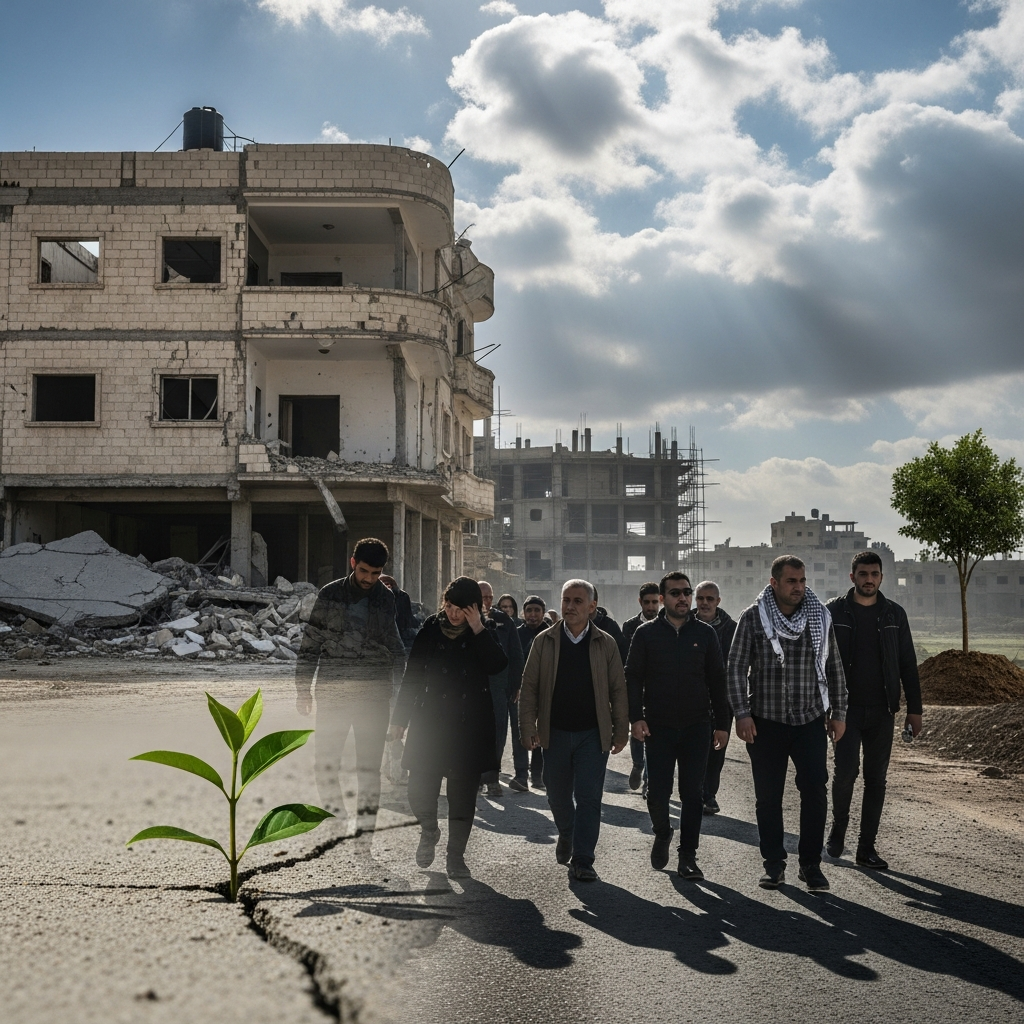
Throughout an entire year, the Syrian scene faced security challenges, regional interventions, and significant international shifts that completely hindered the country’s stability. The country passed through several notable stages that were outlined after Assad’s departure. On January 29, Ahmed Al-Sharaa was appointed as the head of the transitional phase, after the spokesperson for the ‘Military Operations Administration’ in Syria announced the dissolution of the army, its derivative committees, and the annulment of the 2012 constitution and exceptional laws. In the wake of shaping a new Syria, Israel rushed to make new geographical incursions in southern Syria. Just hours after Assad’s departure, Israel destroyed the Syrian fleet in the ports of Latakia and ‘Al-Bayda’, warplanes, warships, and strategic installations, and took over the summit of Mount Hermon and the demilitarized zone, bolstering its defenses on the Golan Heights, where it set up barriers and conducted extensive arrest campaigns.
On March 7, the Syrian coast witnessed ‘horrific massacres’ that claimed the lives of hundreds of civilians, including children, women, and the elderly, during a counterattack by government forces supported by armed factions against what Damascus described as ‘remnants of the regime’. While the scene was boiling internally and internationally with the release of successive videos of the coastal massacres, Al-Sharaa and the commander of the Syrian Democratic Forces ‘SDF’, Mazloum Abdi, signed an agreement on March 10 to form special committees to follow up on its implementation. However, the implementation stalled due to disagreements over the interpretation of the agreement’s clauses.
Externally, the features of Syria appeared more promising, driven by international support. In September, Al-Sharaa delivered a speech during the 80th session of the United Nations General Assembly, calling on the international community. Then, in November, US President Donald Trump received Al-Sharaa at the White House following Washington’s partial suspension of the ‘Caesar’ sanctions for 180 days, and the European Union lifted all its sanctions in May.
A whole year has passed, and Syrian provinces, especially the Syrian coast, are still experiencing a state of security breakdown, with repeated incidents of kidnapping, murder, and attacks on citizens’ properties. This prompted several areas in these provinces, in November, to demand an end to the killing and sectarian incitement, call for political decentralization, and the release of detainees since the Assad government’s departure.