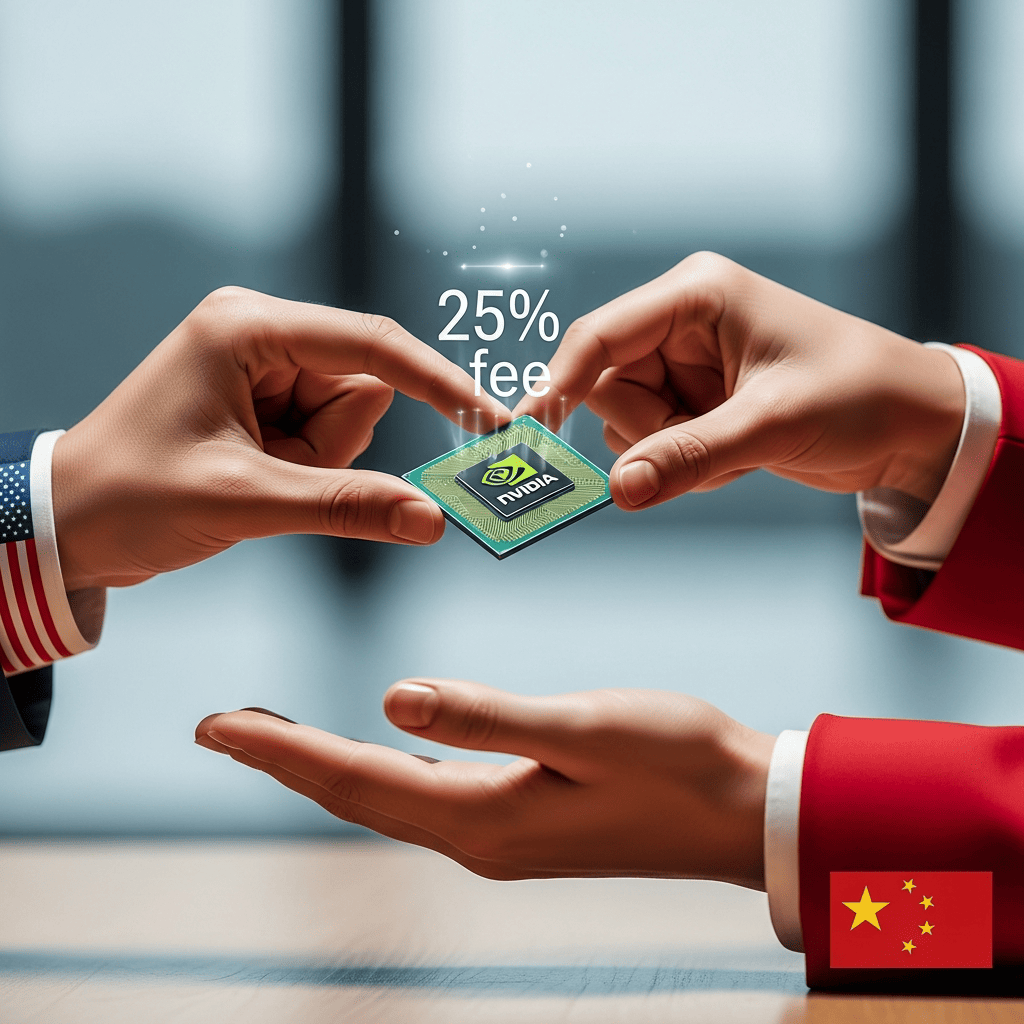
The United States has agreed to permit the export of Nvidia’s H200 processors, its second-tier AI chips, to China, with a 25% fee applicable on these sales, announced U.S. President Donald Trump on Monday.
This decision seems to resolve the debate in the U.S. about whether Nvidia and its competitors should continue leading in AI chip technology by selling to China or if exports should be restricted. However, with Beijing advising companies against using U.S. technology, it’s uncertain if Trump’s decision will result in new sales.
Nvidia’s stock increased by 2% in after-hours trading following Trump’s announcement on Truth Social, after a 3% rise during the day due to a report from Semafor.
Trump mentioned in his post that he had informed Chinese President Xi Jinping, where Nvidia’s chips face government scrutiny, and received a “positive” response.
He noted that the U.S. Commerce Department is finalizing the details and that the same arrangement will be extended to other AI chip manufacturers like Advanced Micro Devices and Intel.
According to Trump’s post, the fee payable to the U.S. government is “25%”, higher than the 15% rate suggested in August, confirmed by a White House official.
“We will safeguard National Security, create American Jobs, and maintain America’s lead in AI,” Trump stated on Truth Social. “NVIDIA’s U.S. Customers are already advancing with their exceptional, highly sophisticated Blackwell chips, soon to be joined by Rubin, neither of which are included in this deal.”
Trump did not specify the quantity of H200 chips approved for export or any applicable conditions, only that exports would proceed “under conditions ensuring strong National Security.”
Officials describe the decision as a middle ground between sending Nvidia’s newest Blackwell chips to China, which Trump has prohibited, and stopping all U.S. chip exports to China, which could enhance Huawei’s AI chip sales in China, according to a source.
“Offering H200 to vetted commercial clients, approved by the Department of Commerce, strikes a thoughtful balance beneficial for America,” Nvidia commented in a statement.
Intel declined to comment, and neither the U.S. Commerce Department, which manages export controls, nor AMD responded to comment requests.
A White House representative stated that the 25% fee would be collected as an import tax from Taiwan, where the chips are manufactured, to the U.S., where they will undergo a security review before being exported to China.
Asked about the approval on Tuesday, China’s foreign ministry expressed the belief that cooperation with the U.S. could yield mutual benefits.
Washington’s China hawks worry that providing China with advanced AI chips could accelerate its military capabilities, a concern initially leading to export restrictions by the Biden administration.
The Trump administration had been contemplating the sale, sources told Reuters last month. Trump mentioned last week that he met with Nvidia’s CEO Jensen Huang, who understood his stance on export controls.
“Trading off national security for trade benefits is a grave mistake,” said Eric Hirschhorn, a former senior Commerce Department official during the Obama administration. “It contradicts the consistent policies of both Democratic and Republican administrations to avoid aiding China’s military progress.”
A report by the Institute for Progress (IFP), a non-partisan think tank, released Sunday, indicated that the H200 is nearly six times more powerful than the H20, the most advanced AI chip legally exportable to China, following the reversal of Trump’s brief sales ban earlier this year.
The IFP noted that the Blackwell chip, in use by U.S. AI companies, is about 1.5 times faster than H200 chips for AI training and five times faster for inferencing tasks. Nvidia’s research suggests Blackwell chips are 10 times faster than H200 for certain tasks.
Several Democratic U.S. senators criticized Trump’s decision as a “massive economic and national security failure” that would benefit China’s industry and military.
Republican Representative John Moolenaar, chair of the House China Select Committee, stated that China would leverage these chips to bolster its military and surveillance capabilities.
“Nvidia should not be deceived – China will replicate its technology, produce it en masse, and attempt to eliminate Nvidia as a competitor,” he stated.
Recently, Beijing has warned Chinese tech firms against purchasing Nvidia’s downgraded chips for the Chinese market, such as the H20, RTX 6000D, and L20, according to two sources.
George Chen, a partner at consultancy The Asia Group, anticipates Chinese regulators will ease their stance towards Nvidia following Trump’s comments on Xi’s reaction, amidst efforts to improve U.S.-China relations. He noted the H200 is significantly more beneficial to China than the H20.
“I expect state media to gradually shift their narrative to be more receptive to Nvidia,” he commented.
Bo Zhengyuan, a political analyst at Plenum, also believes Beijing will act more cautiously.
“Long-term, the window may not remain open. China remains focused on developing its own advanced chip-making capabilities,” he noted.
China’s domestic AI chip landscape now includes tech giant Huawei and smaller firms like Cambricon and Moore Threads.