The UAE is poised to become one of the Gulf’s top economic performers by 2026, with a projected GDP growth of 4.3%, according to the latest insights from the Mastercard Economics Institute (MEI).
The report presents an optimistic view for the Gulf region, driven by diversification, digital transformation, and sustained investment.
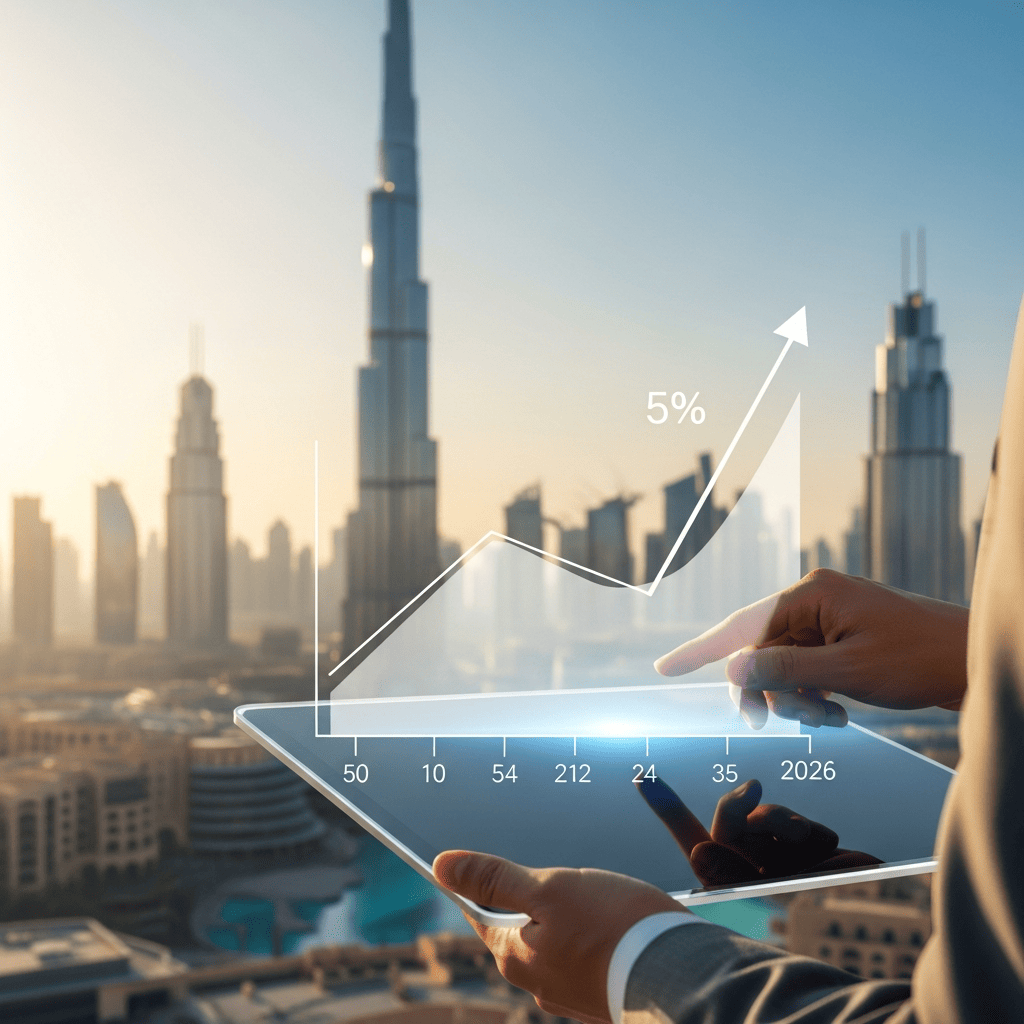
MEI forecasts MENA region growth at 3.6% in 2026, surpassing the global average of 3.1%. In this scenario, the UAE stands out, with expected GDP growth of 4.3% and non-oil growth nearing 5%. This reflects strong structural momentum, increasing non-hydrocarbon activities, ongoing investments in infrastructure and technology, and broad digital adoption across sectors.
MEI attributes the region’s growth to emerging-market trade, rapid AI tool deployment, and fiscal expansion. It highlights that UAE SMEs, now contributing over 37% of retail spending, are scaling e-commerce and tech operations, transforming consumption and business dynamics.
The MEI projection aligns with other major institutions’ forecasts, indicating strong confidence in the UAE’s 2026 outlook.
The UAE Central Bank, in its latest Quarterly Economic Review, projects real GDP growth between 5.3% and 5.4% in 2026, attributing it to robust non-hydrocarbon performance and a hydrocarbon output rebound, partly due to Opec+ production adjustments.
Independent analysts agree. The IMF, in its 2025 Article IV consultation, raised the UAE’s 2026 GDP forecast to 5.0%, citing strong non-oil growth, expanding tourism and construction, and rising hydrocarbon output. The World Bank offers a slightly more cautious but positive estimate of around 4.9% growth in 2026, supported by increased infrastructure investment, a growing services sector, and trade-driven gains.
These projections suggest 2026 could be among the UAE’s strongest economic years, even as the global economy faces slower growth.
With expectations near the 5% mark, the UAE’s structural growth drivers are clear. The non-oil sector, including tourism, real estate, logistics, technology, and financial services, continues to grow, supported by national strategies, regulatory reforms, and significant foreign direct investment. Meanwhile, renewed strength in hydrocarbon production offers a cyclical boost that complements the country’s diversification efforts.
Regionally, the UAE’s strong performance bolsters optimism across Gulf economies. MEI highlights similar investment-driven diversification efforts across the GCC, focusing on renewables, advanced industries, infrastructure, and technology, aligned with national visions.
Trade patterns across MENA are evolving, with increasing economic ties to emerging markets in Eastern Europe, Africa, and Asia, reducing reliance on traditional Western partners and tapping into faster-growing economic blocs. MEI expects this trend to continue through 2026, supporting export sectors and enhancing resilience to global volatility.
Digital transformation is a key focus across the region. MEI notes rapid adoption of AI, cloud services, fintech, and digital infrastructure as major growth drivers. In the UAE, national strategies for AI and the digital economy are reshaping government services, finance, logistics, and retail, boosting productivity and creating new opportunities for tech-enabled firms. SMEs embracing digital tools are poised for rapid growth, gaining ground in sectors traditionally dominated by larger firms.
For consumers, 2026 is likely to reinforce value-conscious and experience-driven spending habits, with more travel, entertainment, and lifestyle services, supported by higher disposable incomes, stable inflation, and stronger household confidence.
In conclusion, with forecasts from MEI, CBUAE, the IMF, and the World Bank converging around 5% GDP growth, the UAE is poised for a remarkable year. Economists indicate that structural transformation is intensifying, investment is accelerating, and businesses are gearing up for expansion. “All indications suggest 2026 will be a pivotal year in the UAE’s journey towards diversified, sustainable long-term growth.”