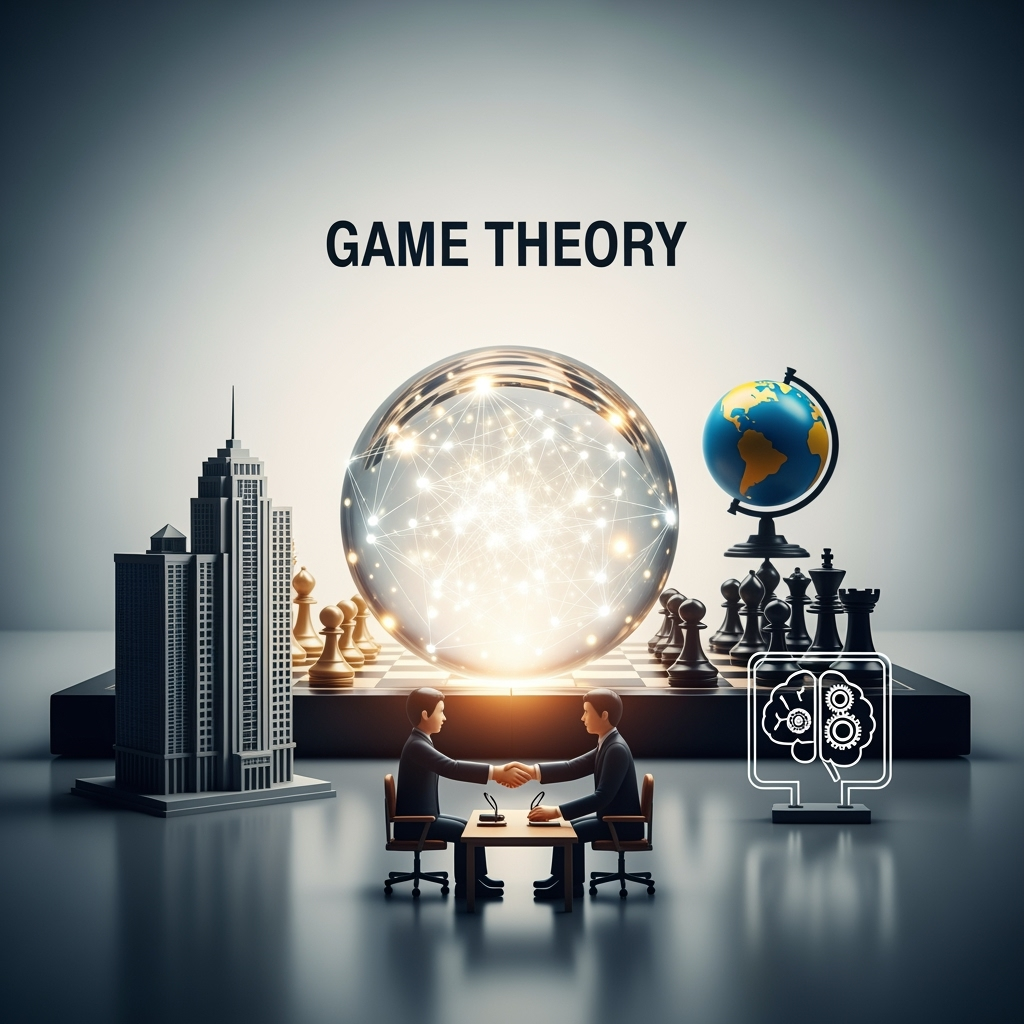
This theory is distinguished by its ability to provide quantitative and qualitative models for interpreting human behavior in conflict or cooperation scenarios. This has allowed it to transcend the boundaries of economic sciences and permeate fields such as politics, biology, philosophy, and even psychology. The theory of games, known as Game Theory, is a branch of applied mathematics that focuses on analyzing situations where multiple parties interact, with each party’s fate dependent on the choices of others.
Initially developed by John Von Neumann and Oskar Morgenstern in their foundational work “Theory of Games and Economic Behavior” (1944), the theory gained a critical dimension when John Nash introduced the concept of Nash Equilibrium. Game Theory has evolved beyond pure mathematics to become a central analytical tool in many scientific and social disciplines. Its main applications can be outlined as follows:
Game Theory is used to analyze competition between companies, especially in markets dominated by a few players, known as oligopolies. For example, if two large companies control the smartphone market, each company can choose to lower prices to attract customers or maintain high prices to achieve greater profits. Using a game model, one can analyze how each company will decide based on its expectations of the other company’s behavior.
In auctions, such as online auctions, each participant tries to make a bid that suits them without overpaying for the item. Here, strategies are used based on predicting competitors’ behavior.
In negotiations, like wage negotiations between companies and workers, each party seeks to reach the best possible deal without completely losing the other party.
Game Theory is utilized to understand how states, parties, and candidates interact in the context of elections or international alliances. For example, in election campaigns, each candidate chooses their strategies (speech, alliances, issues to focus on) based on their expectations of other candidates’ behavior and voters’ reactions. Another example is in international relations when two countries decide whether to acquire nuclear weapons or agree on disarmament. This situation resembles the “Prisoner’s Dilemma,” where cooperation is better for both parties, but the fear of betrayal drives them to arm themselves.
It is used to understand how survival and reproductive strategies evolve among living organisms over generations. Another example is analyzing the relationship between parasites and hosts, where each party evolves over time to enhance its survival against the other.
Game Theory helps analyze ethical decisions in situations involving multiple actors, highlighting how individual and collective choices can conflict. For instance, in the “Trolley Problem,” if one must choose between saving one person or a group of people by switching the train’s path, a game-like theoretical framework can be used to understand how ethical outcomes are evaluated.
It is also used to analyze how rules of justice and moral commitment naturally emerge from individual interactions, as John Rawls did with the idea of the “original position,” which can be formulated as a game.