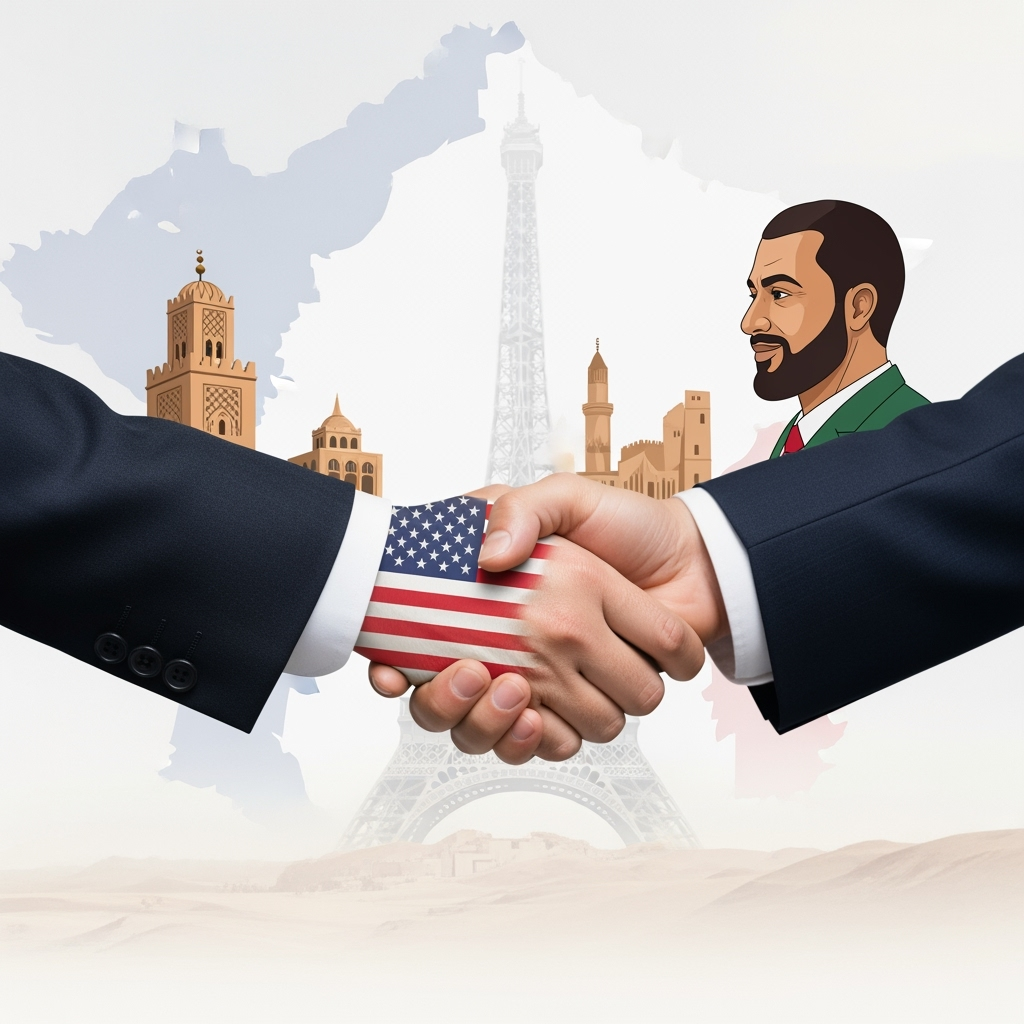
According to experts, Washington has been actively seeking to establish broader and stronger relations with North and West African countries, especially after the decline of French influence there. Experts believe that the Maghreb tour undertaken by Masad Boulos, advisor to US President Donald Trump on African and Middle Eastern affairs, is linked to rapprochement between these countries and Eastern nations. This can be seen as an attempt for an American return to the region, as the visit included Tunisia, Libya, Algeria, and Morocco, with a stop in Paris.
Strategic Moves: Lebanese political expert Mohamed Saeed Al-Raz stated that the US administration’s plan towards the Middle East has become clear, especially since President Donald Trump prioritized cutting off the expansion of the Eastern international axis towards the Middle East, parts of Europe, and most of Latin America. He explained that his advisor Masad Boulos’s visit to several African countries is an attempt to overlook the injustices and the dark history of Western colonialism and exploitation in Africa.
Al-Raz added in his conversation with Sputnik that President Trump chose Masad Boulos for this mission because he is of Lebanese origin, emigrated to Africa, built his wealth there before finally settling in the US, and befriended Trump, sharing businesses with him, including casinos, and encouraged his son to marry Trump’s daughter. This is seen as an attempt to whitewash the US role in Africa after these countries found hope in the Eastern axis and its clear strategy to help third-world countries gain their rights and develop.
American Attempt: He continued, “Nations and their systems are no longer blind but are keeping pace with the developments and changes occurring worldwide, something President Trump has not yet grasped, leading to clashes with the will of countries committed to independence, and forcing him to retreat to the known limits of the US, which is in dire need of help to save its economy.”
He added, “We have seen examples of Trump’s behavior towards Canada, then Mexico and Panama, followed by raising and then lowering tariffs on goods, understanding the Russian position in Ukraine, and then retreating and threatening China, only to backtrack when treated in kind. All this indicates a lack of strategic stability in the US both internally and externally, causing significant embarrassment for Trump’s envoys, like Barak, Boulos, and Witkoff.”
Presence Affirmation: Algerian security expert Ahmed Mizab stated that Washington seeks to establish its presence in North Africa, a region it considers strategically sensitive and part of the direct extension of the northern Mediterranean’s security. He added in his conversation with Sputnik that the US aims to ensure security stability on Europe’s southern borders amid increasing cross-border threats like irregular migration, human trafficking, and rising armed activities in the Sahel region.
He explained that Masad Boulos’s visit to North Africa can be understood on three interconnected levels. On the security level, Washington seeks to contain the fragility affecting the Sahel region, especially after consecutive coups in Mali, Burkina Faso, and Niger, and the rise of armed groups’ activities. The US realizes that Algeria holds influential cards in this area, whether through intelligence coordination or its long borders with concerned countries, and thus aims to renew cooperation channels and avoid any strategic vacuum that competing powers like Russia, China, or even Turkey might exploit.
On the energy level, America seeks to diversify energy sources for its European allies in the context of the Russian-Ukrainian crisis, which has reshaped the global supply map. Algeria remains a pivotal partner in terms of capabilities, but Washington does not bet on a complete partnership as much as it seeks basic guarantees ensuring minimum coordination and understanding in this vital field, according to Mizab.
On the geopolitical level, the primary goal is to revive relations that have cooled in recent years. Washington understands that political neglect or disregard pushes Algeria further towards alternative axes, especially Moscow and Beijing. Therefore, it seeks to open direct dialogue channels and offer indications that partnership is still possible if mutual will is present.
Masad Boulos visited Tunisia on July 22, followed by Morocco and Algeria, where during his meeting with President Kais Saied at the Carthage Palace, Saied showed Boulos pictures of children in Gaza suffering from famine, considered a symbolic protest against the US position. According to Algerian state television, Boulos shared with the president “Trump’s vision of cooperation to achieve common interests, peace, defeat terrorism, secure our borders, and enhance fair trade benefiting both Americans and Algerians, within a framework of mutual respect and dialogue.”