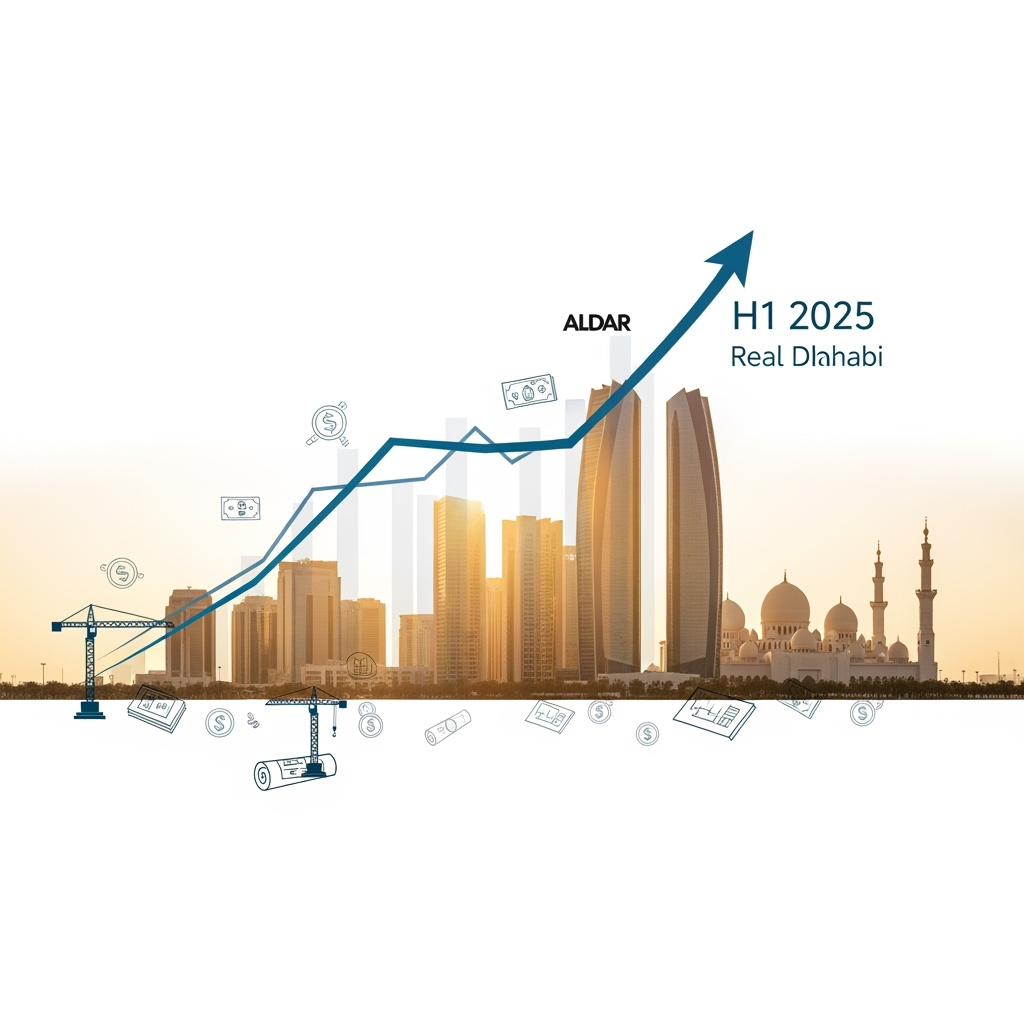
Abu Dhabi’s real estate market showed strong resilience in the first half of 2025, overcoming global economic challenges and reinforcing its status as a haven for long-term investments.
Driven Properties’ H1 2025 report highlights the sector’s growth, driven by fiscal discipline, infrastructure-led growth, and increased institutional interest.
Residential prices: A maturing market
The residential sector in Abu Dhabi continued its growth, with off-plan and ready properties performing well and showing signs of price alignment.
Off-plan properties: Prices rose from Dh487 per square foot in H1 2019 to Dh1,350 per square foot in H1 2024, before settling at Dh1,127 per square foot in H1 2025. This adjustment reflects developers’ more realistic pricing aligned with delivery schedules and market saturation. Official figures may not fully capture the resale market’s strength due to data limitations, suggesting stronger performance than reported.
Ready properties: Prices, which were Dh966 per square foot in H1 2019, dropped during the pandemic to Dh680 per square foot in H2 2020, then steadily recovered to Dh1,086 per square foot in H1 2025. This recovery is fueled by increased end-user demand, improved inventory, and the benefits of immediate occupancy and rental income.
Segment convergence: The price difference between off-plan and ready units has narrowed to Dh41 per square foot, indicating market maturity. Buyers are appreciating the value of completed inventory, while developers adopt conservative pricing for new projects.
Yield stability: Residential rental yields have consistently ranged between 5.9% and 6.3% over the past five years. In H1 2025, yields rebounded to 6.2%, supported by population growth, robust rental demand, and stable capital values, enhancing Abu Dhabi’s appeal to yield-focused investors.
The residential market is increasingly investor-friendly, offering various opportunities from speculative off-plan investments to income-generating ready units. Transparent pricing, low transaction fees, and no property taxes enhance Abu Dhabi’s appeal to regional and international investors.
Top-performing communities
Al Reem Island led in transaction volume, driven by affordable mid-tier apartment activity. Prices increased to Dh1,194 per square foot, up 10.7% from H2 2024. Nurai Island and Saadiyat Island remained the highest-priced submarkets, at Dh3,068 and Dh2,342 per square foot respectively, reflecting their ultra-prime status and exclusivity.
Key drivers of growth
Infrastructure Expansion: The UAE’s national rail network advances towards full connectivity, with future high-speed services expected to reduce Abu Dhabi–Dubai travel time to 30 minutes.
Regulatory innovation: The introduction of Madhmoun, a blockchain-based property data platform, has improved market transparency and transaction efficiency.
Global investment confidence: Disney’s announcement of its first Middle East theme park on Yas Island and the expansion of Abu Dhabi Global Market (ADGM) have attracted major players like BlackRock and Morgan Stanley, boosting demand for commercial and executive housing.
Strategic capital allocation: Investors increasingly favor “collateral-backed cash flows,” with Abu Dhabi’s real estate offering inflation-linked returns and fiscal defensiveness.
Office market trends
Non-free zone office occupancy remained stable at 90.3%, while Grade A assets in ADGM and free zones exceeded 95% due to demand from global financial institutions. The market is splitting, with premium assets outperforming older properties lacking modern amenities.
Outlook
Abu Dhabi is becoming a crucial market in the GCC, offering yield-enhancing opportunities and policy clarity amid global uncertainties. With ongoing infrastructure investment, regulatory reforms, and strong sovereign support, the emirate is well-positioned to attract both regional and international capital in the second half of 2025.
“In a global environment marked by high rates, stagflationary risks, and geopolitical division, Abu Dhabi stands out for its policy clarity, investability, and potential for long-term growth. For investors seeking regional diversification and inflation-aligned returns, the case for real estate remains strong and is strengthening,” the report stated.