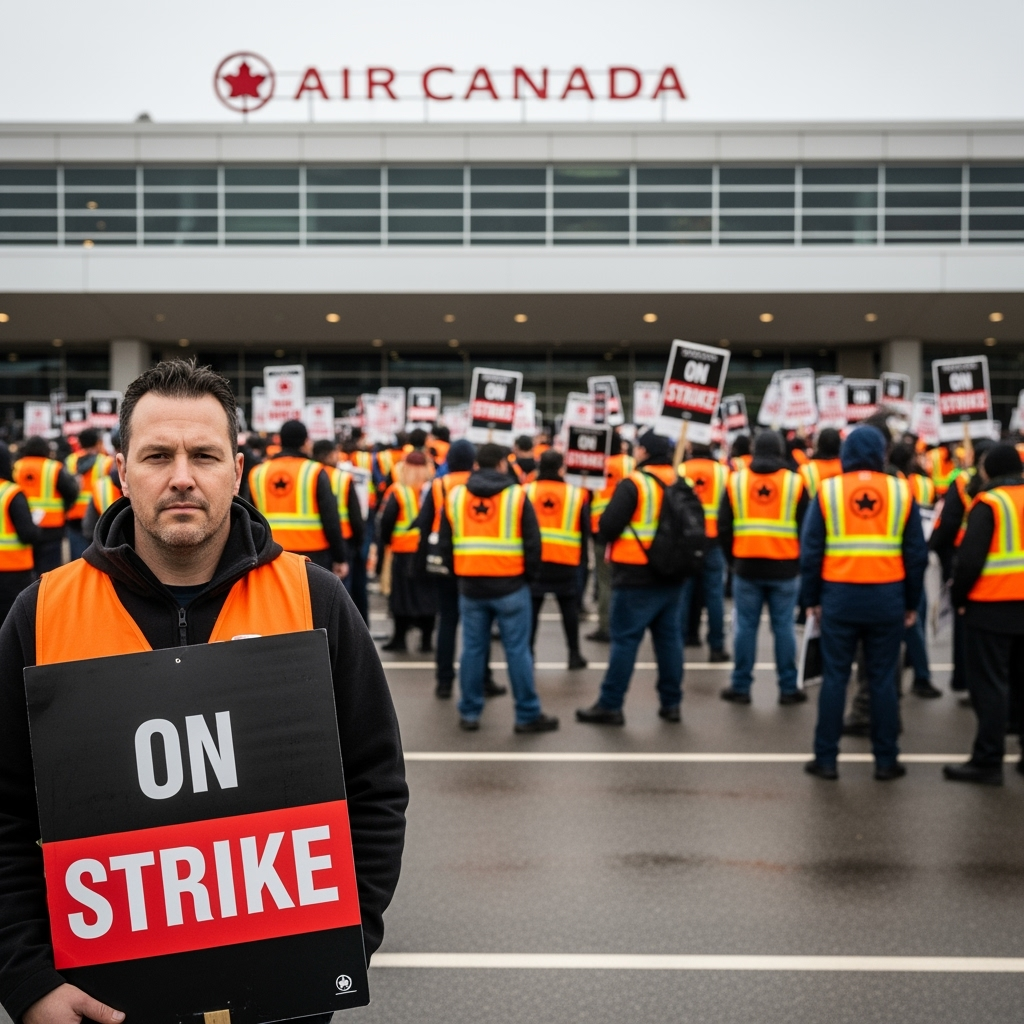
Air Canada flight attendants announced on Sunday their intention to continue striking, defying a government-backed labor board’s mandate to resume work by 2pm ET (6pm GMT), deeming it unconstitutional.
The Canadian Union of Public Employees issued a statement affirming that members would persist in their strike and urged Air Canada to return to negotiations for a fair agreement. The airline responded by postponing its plan to restart operations from Sunday to Monday evening.
On Saturday, the Canadian government, led by Prime Minister Mark Carney, sought to halt the strike involving over 10,000 flight attendants at the country’s largest airline by requesting the Canada Industrial Relations Board (CIRB) to enforce binding arbitration. The CIRB complied with Air Canada’s request, though unionized flight attendants opposed the decision.
Stay updated with the latest news by following KT on WhatsApp Channels.
According to the Canada Labour Code, the government is authorized to request the CIRB to impose binding arbitration to safeguard the economy.
Previously, under former Prime Minister Justin Trudeau, the government intervened to prevent rail and dock strikes that threatened economic stability, though it is rare for a union to defy a CIRB order. The government’s options remain unclear if the union continues its strike.
Air Canada initially planned to resume flights on Sunday evening, anticipating the strike’s end, which had led to the suspension of approximately 700 daily flights on Saturday, affecting over 100,000 passengers. This marked the first walkout by Air Canada flight attendants since 1985, following prolonged contract negotiations.
The union criticized CIRB chair Maryse Tremblay’s decision to remain on the case, citing a “staggering conflict of interest” due to her previous role as Air Canada’s senior counsel. Tremblay’s LinkedIn profile indicates she served as counsel for Air Canada from 1998 to 2004.
Representatives from Air Canada, the CIRB, and a Canadian government spokesperson were unavailable for comment at the time.
Other unions showed solidarity by joining the flight attendants’ picket line in Toronto on Sunday.
“They are here today because they witness our rights being undermined,” stated Natasha Stea, an Air Canada flight attendant and local union president.
Air Canada began canceling flights on Thursday in anticipation of the stoppage.
Travelers at Toronto Pearson International Airport expressed confusion over whether their flights would resume or if Air Canada would provide alternative arrangements.
“We are left to navigate this on our own, with no guidance or options offered by Air Canada,” said Elizabeth Fourney from Vancouver.
The primary point of contention has been the union’s demand for compensation for time spent on the ground between flights and while assisting passengers with boarding, as attendants are mainly paid only when the aircraft is moving.
CUPE advocated for a negotiated settlement, asserting that binding arbitration would relieve pressure on the airline.
On Sunday, Air Canada stated that the CIRB ordered the extension of the expired collective agreement terms, dating back to March 31, until a new agreement is reached.