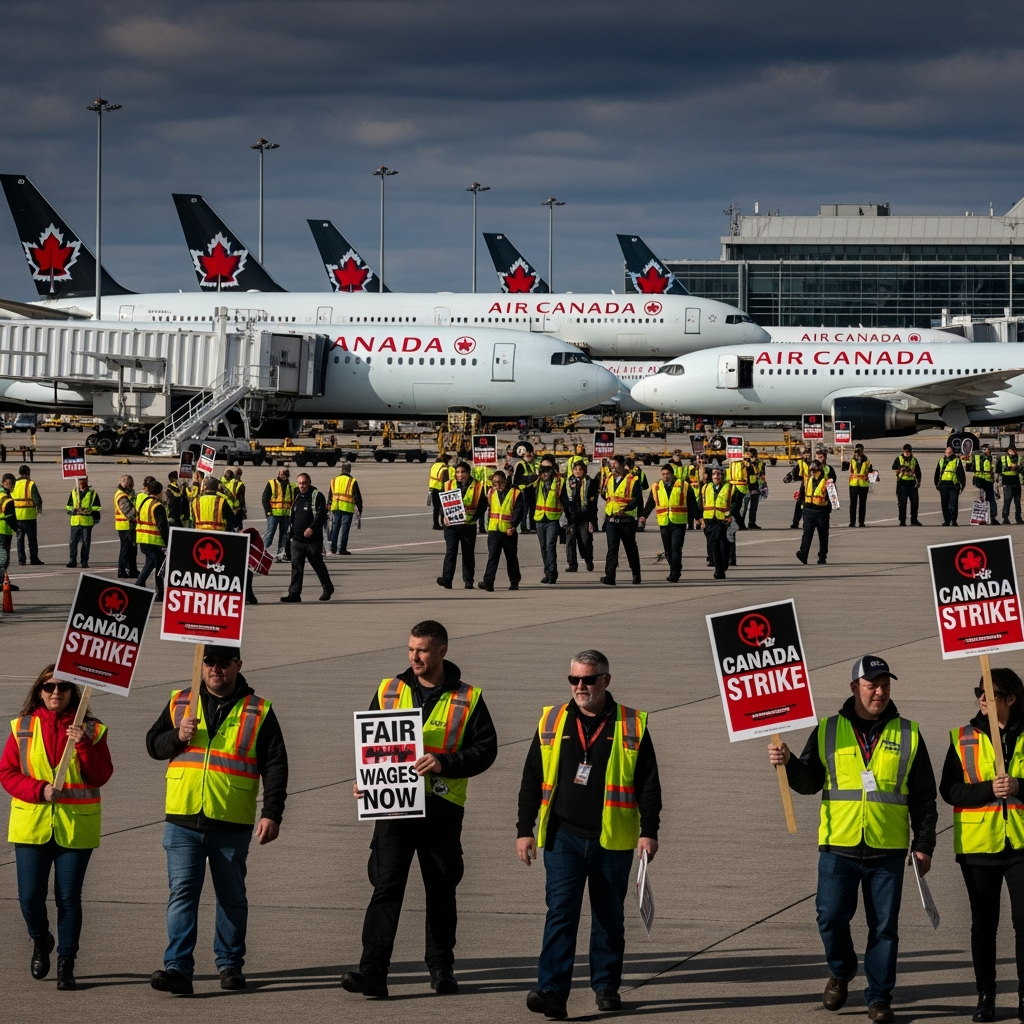
On Monday morning, Air Canada’s extensive fleet remained grounded after striking flight attendants defied a government-backed order to resume work, urging the airline to return to negotiations.
Typically transporting 130,000 passengers daily and a member of the global Star Alliance, the airline had aimed to gradually resume operations by Sunday evening, following a labor relations board directive for the union to return and engage in binding arbitration.
The union refused, creating an unusual confrontation with the Canadian government, which had requested the return-to-work mandate.
Stay informed with the latest updates. Follow KT on WhatsApp Channels.
The Canadian Union of Public Employees, representing 10,000 Air Canada cabin crew, advocated for a negotiated resolution, arguing that binding arbitration lessens the airline’s pressure.
The strike focuses on demands for better wages and compensation for ground duties, like passenger boarding. Currently, attendants are paid only when planes are airborne, garnering public support on social media.
CUPE invited Air Canada to “negotiate a fair deal,” labeling the strike-ending order as unconstitutional. The airline postponed its operation restart from Sunday to Monday evening, accusing the union of illegally defying the labor board.
The government’s options to end the strike include court enforcement of the back-to-work order and an expedited hearing. Alternatively, the minority government might propose legislation needing rival political support and approval from both parliamentary houses, which are on recess until September 15.
“The government will be cautious in its approach because, in Canada, the Supreme Court has emphasized the need for careful consideration when restricting strike rights, even for essential public sector workers,” noted Dionne Pohler, a dispute resolution professor at Cornell University.
Another strategy could involve encouraging negotiations, Pohler suggested. The government declined to comment.
On Saturday, Prime Minister Mark Carney’s Liberal government attempted to resolve the strike by asking the Canada Industrial Relations Board for binding arbitration. The CIRB issued this order, sought by Air Canada but opposed by the unionized flight attendants.
The former government, led by Prime Minister Justin Trudeau, intervened last year to prevent strikes that could harm the economy, but it’s rare for a union to defy a CIRB directive.
CUPE claimed its rejection was unprecedented given the government’s use of Section 107 rules in this situation.
Travelers at Toronto Pearson International Airport expressed confusion and frustration over their travel plans.
Italian traveler Francesca Tondini, 50, at Toronto airport, supported the union despite uncertainty over her return home.
“They are right,” she said, smiling and pointing at the striking crew.
The dispute centers on airline compensation for flight attendants. Traditionally, including at Air Canada, they are paid only while the aircraft is moving.
In recent contract talks, flight attendants in both Canada and the U.S. have sought pay for hours worked, including during passenger boarding.
New agreements with American Airlines and Alaska Airlines require pay to start when passengers board. American’s attendants now also receive compensation for some layover hours. United Airlines’ crew, having rejected a recent contract, seeks similar terms.