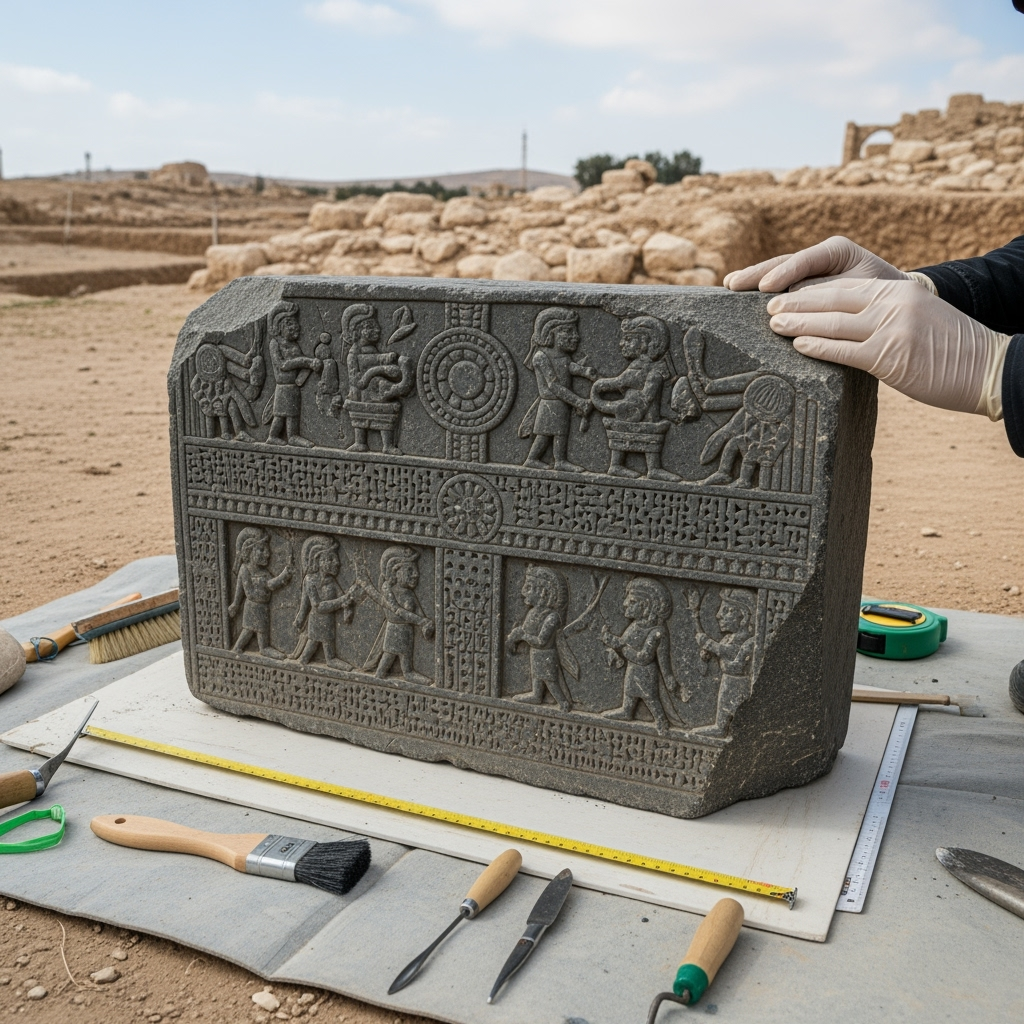
A city resident discovered a stone made of black basalt, believed to date back about two thousand years. However, archaeologists confirmed that determining its exact date requires specialized studies, according to Syrian media. Some bloggers viewed this inscription as reflecting the significance of the eagle in Syrian history and its deep roots, while others saw its presence as an opportunity to respond to criticisms comparing the new Syrian emblem to European symbols that also feature birds of prey. The interactions were not without humor, as one commenter wrote, “Even the artifacts have renewed their visual identity.”
In archaeological sites, deep within villages and on their outskirts, on mountain slopes and inside caves, the geographical landmarks change overnight due to continuous digging day and night in search of ingots, gold coins, or ancient statues. The age, civilization, or historical value of these artifacts does not matter.
According to the latest statistics from the Directorate General of Antiquities and Museums in the former Syrian regime government, nearly a million artifacts have been stolen in Syria, and around 710 archaeological sites suffered damages ranging from partial damage to complete disappearance and destruction from 2011 to 2019. With the current looting, the number is undoubtedly increasing, making it essential to protect what remains of Syria’s history and civilization.
It is noteworthy that the current Syrian Penal Code considers illegal excavation of antiquities a crime punishable by imprisonment and financial fines. Article 741 states: “Anyone who excavates antiquities without a license shall be punished with imprisonment from three months to three years and a financial fine.”