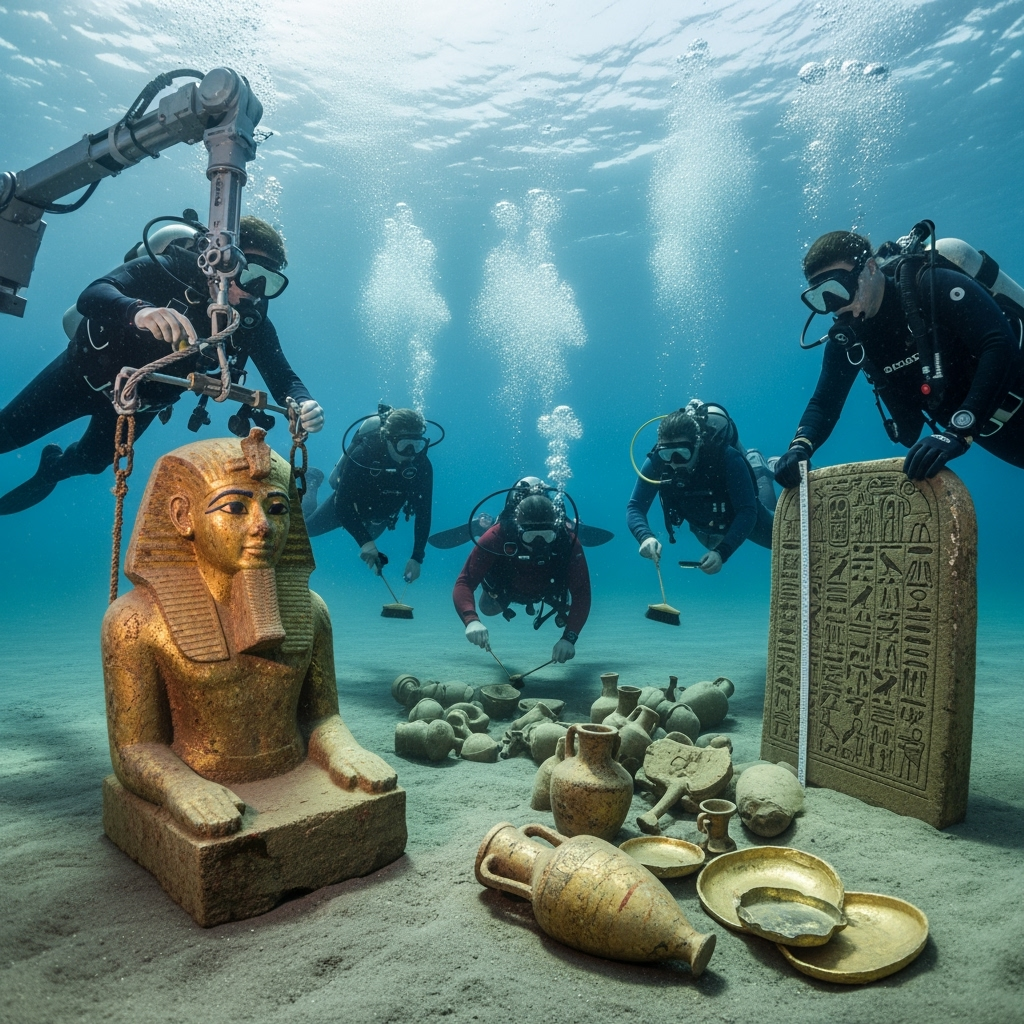
The site is believed to be an extension of the ancient city of Canopus, which flourished during the Ptolemaic and Roman eras. The city was submerged due to earthquakes and rising sea levels, preserving archaeological treasures that have been recently excavated, including statues and stone buildings used for worship, residence, and trade.
Among other notable discoveries are statues of royal figures and sphinxes from the pre-Roman era, including a partially preserved sphinx bearing the cartouche of Ramses II, one of the most famous and longest-reigning pharaohs of ancient Egypt. Many statues were found with missing body parts, including a headless Ptolemaic statue made of granite and the lower half of a Roman noble statue carved from marble.
The Egyptian Minister of Tourism and Antiquities, Sherif Fathy, confirmed that part of the heritage will be left underwater as a sunken legacy. He also warned of the threat of rising sea levels on Alexandria, which is gradually sinking and could be significantly affected by 2050.