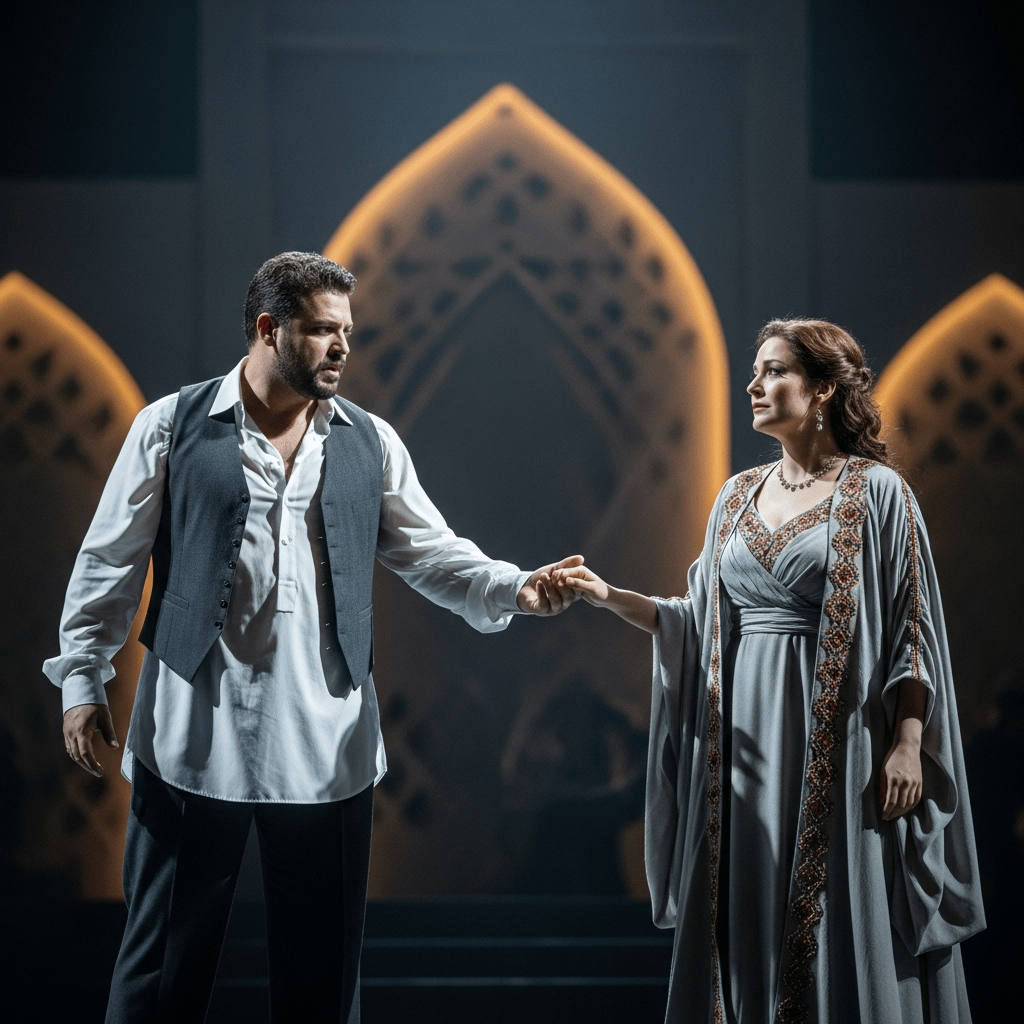
Beneath the vast Abu Dhabi sky, the cherished warrior-poet of the Arab world, Antar, comes alive once more. The operatic rendition of Antar & Abla unites performers from across the region, including Shaolin monks, to weave a tale of exile, honor, forbidden love, and tribal strife. In an interview with Khaleej Times following a VIP preview, the cast shared the emotional impact of portraying characters deeply ingrained in their cultural heritage, while the creative team discussed how they adapted this age-old legend for a contemporary audience.
The story of Antar and Abla, long celebrated in poetry and folklore, takes on a modern twist in the Abu Dhabi production. It marks the first opera sung entirely in Arabic with an Arab operatic technique, showcased as an open-air hybrid performance with cinematic visuals, martial arts choreography, and a live Chinese orchestra. For the cast, it’s not merely a show but, as Executive Producer and Lead Tenor Amine Hachem describes it, “a moment in history.”
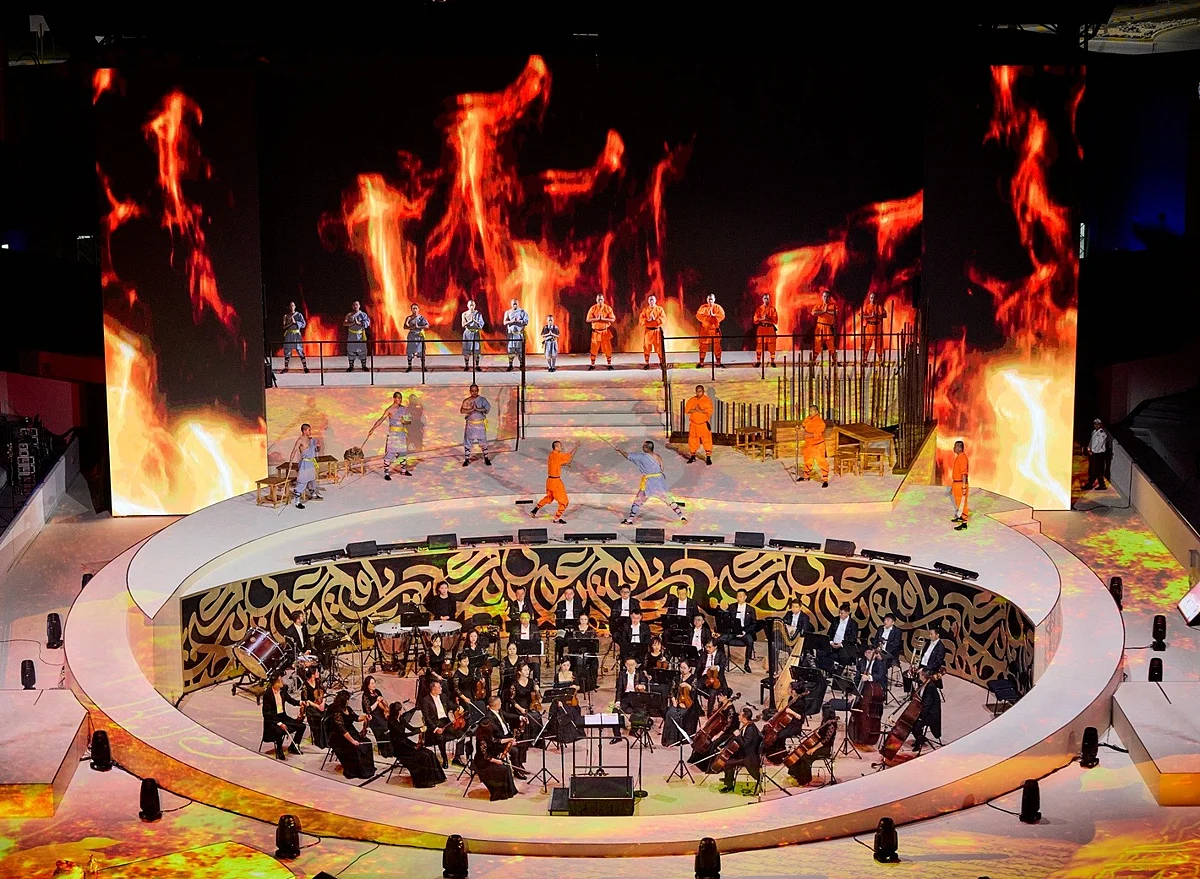
The preview night offered a glimpse of the production’s grandeur and ambition. The Lanzhou Symphony Orchestra delivered a sweeping musical backdrop, while lighting, projections, and choreography brought the desert epic to life with a modern touch. The team, in just ten days, transformed the International Tennis Centre at Zayed Sports City, constructing a vast 300-sqm stage with digital backdrops, ensuring poetry and movement unfold with striking clarity for an outdoor opera.
A Complex Hero and a Voice Crafted for the Role
Taking on the role of Antar is a significant responsibility for Hachem. In a conversation with Khaleej Times, he detailed the emotional and vocal challenges of the part.
“Antar is torn,” he explained. “He loves Abla but is exiled by his tribe. He feels out of place in both Yemen and Hejaz. His tribe sees him as a bastard, despite being their hero.”
This internal conflict, revolving around identity, belonging, and dignity, makes the performance “emotionally demanding.”
The role was tailored specifically for his voice. “Being the first to undertake something like this is always intriguing,” he said. “We’re making history, hoping it will resonate with future generations.”
Growing up in Lebanon, Antar was a familiar figure. “When we describe someone as strong, we say, ‘Ya Antar!’” he laughed. “It’s a legacy I cherish, honor, and respect.”
When asked what young Arab men facing adversity might learn from the character, he highlighted Antar’s resilience and determination not to succumb to prejudice. “People will see him for who he is, beyond his race or skin color.”
“Everyone’s calling me Antar these days,” he added. “And I welcome it.”
Abla’s Strength and the Emotion at the Opera’s Heart
For mezzo-soprano Mariam Mouawad, playing Abla, the character’s resilience is central to the narrative.
“She endures kidnapping and numerous challenges, yet remains unwavering in love and principle.”
This marks Mouawad’s debut in Abu Dhabi, and she noted the opera’s blend of classical poetry, digital visuals, and martial arts as a fusion of diverse art forms. She highlighted the lover’s reunion — set to the production’s main theme ‘My heart’s throbs chant Antar’ — as a particularly powerful moment.
Regarding the Shaolin fusion, she simply stated: “It was beautiful and unprecedented.”
The Rival: Noble Values in Opposition
Lebanese baritone Cesar Naassy, portraying Mared Tay — Antar’s rival — views his character through the lens of tribal honor.
Abla’s beauty is used strategically by the tribe to weaken Antar, he explained:
Yet, even the antagonist, he noted, isn’t purely evil. “There’s no character that’s entirely villainous.”
Every character, including Mared Tay, embodies both intensity and poetry — a nod to the archetypal Arab warrior-poet.
On cultural fusion, he remarked: “Every nation brings something unique to the table.”
Shayboub: Humor, Agility, and Cultural Revival
Actor Pierre Sammia, as Shayboub, Antar’s quick-witted half-brother, noted his character’s balance of humor and strategy. His role is to lure Antar from exile to secure the tribe’s victory.
Sammia recalled memorizing mu‘allaqat poetry in school and believes the opera rekindles a profound cultural connection to the Arabic language. “Audiences will be drawn back to classical Arabic, reviving its vitality,” he emphasized.
Shaolin Monks Meet Arabic Opera
At the heart of the production’s intercultural dynamism is the Shaolin martial arts troupe, performing choreographed combat scenes throughout.
Coordinator Leo Zheng expressed that the team prepared “with full energy” for the production, describing the collaboration as “an amazing cultural crossover.” It marks the first time the group has performed in an Arabic opera.
A New Chapter in Arab Opera
For Maestro Maroun Al Rahi, composer of Antar & Abla, the production heralds a new era. Despite its historical roots, the opera is presented “with a modern vision,” featuring a libretto crafted in operatic form by Dr. Antoine Maalouf and set to a newly developed Arab operatic technique.
“There was never an Arabic technique for opera,” Al Rahi stated. “This is the first opera fully sung in classical Arabic — marking a new phase for Arabic music and art.”
The Abu Dhabi staging is also the first open-air rendition of the opera, utilizing the night sky and expansive digital design to captivate younger audiences — a scale Al Rahi describes as “five times” that of traditional opera houses.
A Love Story Retold for a New Generation
The production chronicles Antar — the renowned Black Arab warrior-poet, born into slavery and denied recognition — and his unwavering devotion to Abla, whose loyalty and bravery mirror his own. Their journey encompasses exile, betrayal, and a climactic battle where poetry and honor triumph over deceit.
The Abu Dhabi staging retains the epic scope of the story while enriching it with modern choreography, martial arts sequences, a live international orchestra, and a visually stunning reunion scene that performers say remains the opera’s emotional core.