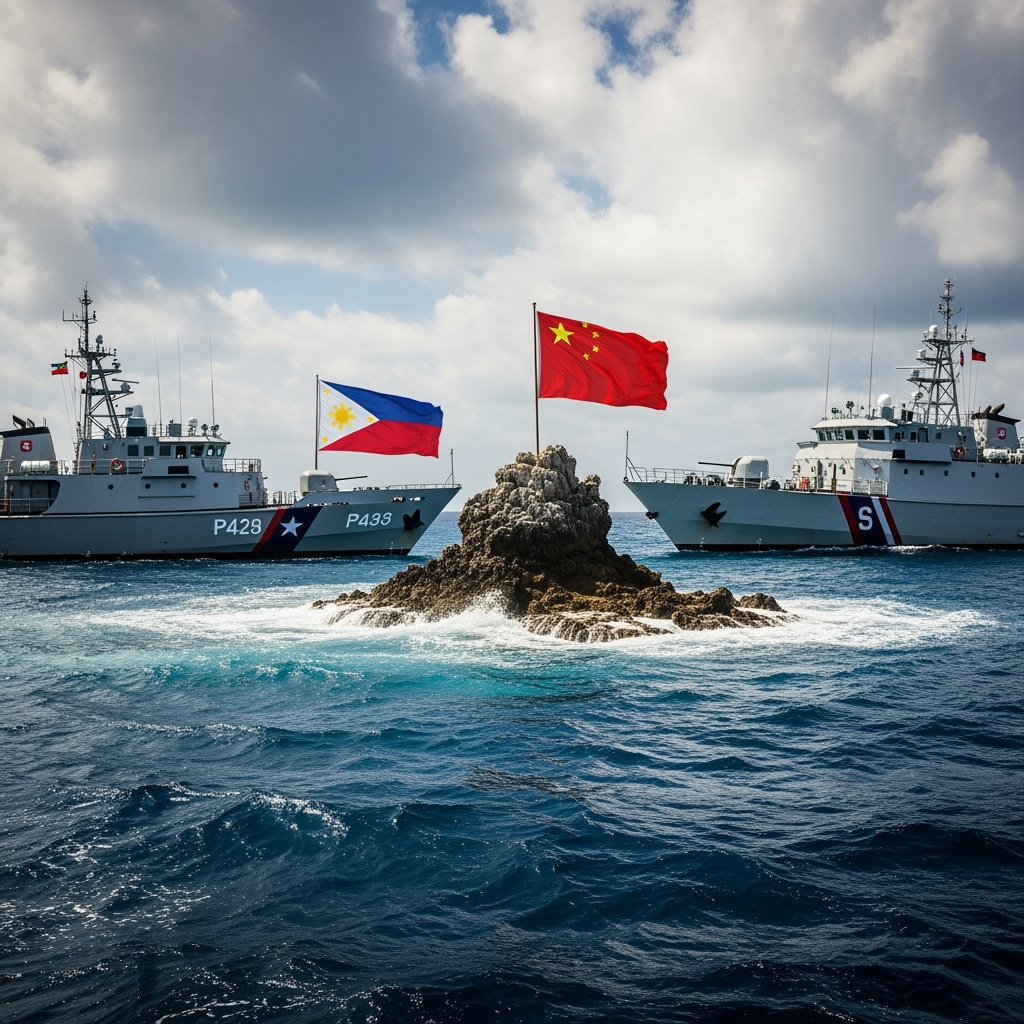
China’s Coast Guard stated on Tuesday that it fired water cannons at Philippine ships near the disputed Scarborough Shoal in the South China Sea. The Philippines accused Beijing of “aggressive” actions that resulted in one injury.
This confrontation follows a week after China’s approval to turn the shoal into a national nature reserve, a decision defense analysts believe will test Manila’s reaction to the 150 sq km (58 sq mile) triangular chain of reefs and rocks.
The Philippine Coast Guard accused its Chinese counterpart of harassing vessels on a humanitarian mission to support fishermen.
Tuesday’s incident involved over 10 Philippine ships, according to Gan Yu, a spokesperson for China’s Coast Guard, who accused these vessels of “illegally invading China’s territorial waters of the Scarborough Shoal from different directions.”
Gan specifically criticized Philippine government vessel 3014, stating it “disregarded solemn warnings from the Chinese side and deliberately rammed a Chinese coast guard vessel.”
“The China coast guard lawfully implemented control measures against the Philippine ships,” he said.
These measures included verbal warnings, route restrictions, and water cannon spraying, Gan added.
A video released by the Chinese Coast Guard showed the bow of Philippine vessel 3014 making contact with a Chinese ship, damaging part of the deck railing as the Chinese coast guard ship fired water cannons at the Philippine vessel.
In a statement, the Philippine Coast Guard reported that it was on a mission to resupply more than 35 Philippine fishing boats at the shoal when they encountered “aggressive actions” by nine Chinese vessels.
The PCG later stated that two Chinese Coast Guard ships had directed water cannons at the 3014 fisheries vessel.
The “aggressive action” caused “significant damage” to the Philippine vessel, and one person sustained injuries from shattered glass due to the water cannon, it stated.
SIMMERING TENSION
Simmering tension over the shoal has led to diplomatic disputes in recent years, but no incidents have escalated into armed conflict there.
Each side accuses the other of provocations and trespassing, with incidents involving water cannon use, boat-ramming, and maneuvers by China’s Coast Guard that the Philippines considers dangerously close, as well as jets shadowing Philippine aircraft in the area.
A spokesperson for the Philippine Maritime Council denied China’s claim of taking control measures, dismissing it as “another case of Chinese disinformation and propaganda.”
Analysts suggest Beijing’s plan to categorize the shoal as a nature reserve is an attempt to claim the moral high ground in the dispute over the atoll, known as Huangyan Island in China and Panatag Shoal in the Philippines.
The dispute is part of a larger contest over sovereignty and fishing access in the South China Sea, a vital conduit for over $3 trillion in annual ship-borne commerce.
China claims nearly the entire South China Sea, overlapping with the exclusive economic zones of Brunei, Indonesia, Malaysia, the Philippines, and Vietnam. These unresolved disputes have persisted for years over the ownership of various islands and features.
In 2016, the Permanent Court of Arbitration in the Hague ruled that China’s sweeping claims in the region were not supported by international law, a decision Beijing rejects.