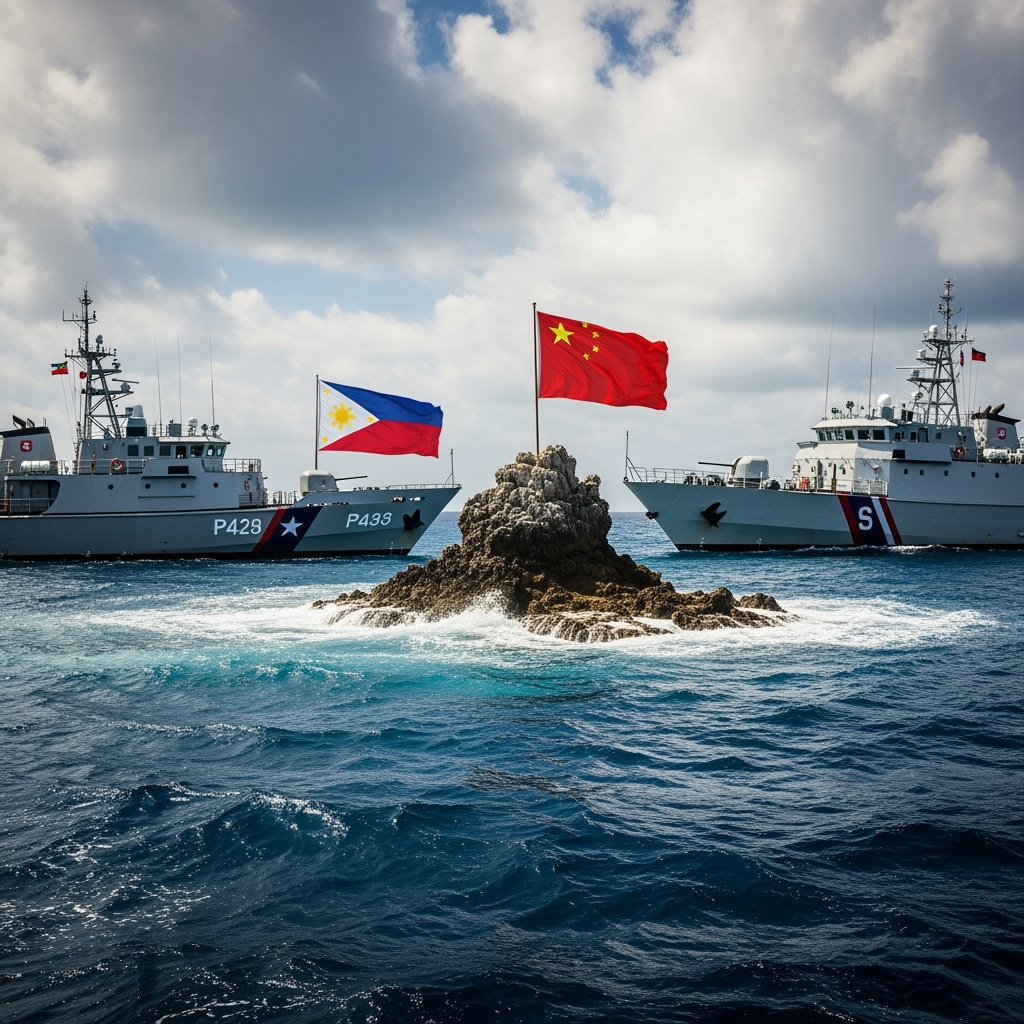
On Tuesday, China’s Coast Guard announced it used water cannons against Philippine ships near the contested Scarborough Shoal in the South China Sea. The Philippines accused China of “aggressive” actions that led to one injury.
The clash follows China’s recent decision to designate the shoal as a national nature reserve, a strategic move analysts suggest is a challenge for Manila concerning the 150 sq km (58 sq mile) area of reefs and rocks.
The Philippine Coast Guard accused China’s forces of harassing ships on a humanitarian mission to aid fishermen.
Tuesday’s incident involved over 10 Philippine ships, according to Gan Yu, a spokesperson for China’s Coast Guard, who claimed the vessels “illegally entered China’s territorial waters at Scarborough Shoal.”
Gan specifically criticized Philippine government vessel 3014, stating it “ignored serious warnings from China and intentionally collided with a Chinese Coast Guard vessel.”
“The China Coast Guard lawfully executed control measures against the Philippine ships,” he said.
These measures included verbal warnings, route restrictions, and water cannon use, according to Gan.
A video from the Chinese Coast Guard showed the bow of the Philippine vessel 3014 making contact with a Chinese ship, damaging its deck railing as the Chinese ship fired water cannons.
The Philippine Coast Guard reported they were resupplying more than 35 Philippine fishing boats at the shoal when confronted by “aggressive actions” from nine Chinese vessels.
In a separate statement, the PCG noted that two Chinese Coast Guard ships targeted the 3014 fisheries vessel with water cannons.
This “aggressive action” resulted in “significant damage” to the Philippine vessel, injuring one person due to broken glass caused by the water cannons.
ONGOING TENSION
Tensions over the shoal have sparked diplomatic disputes in recent years, though no incidents have led to armed conflict.
Both nations accuse each other of provocations and trespassing, with incidents involving water cannons, boat collisions, and maneuvers by China’s Coast Guard, deemed dangerously close by the Philippines, as well as jets shadowing Philippine aircraft.
A Philippine Maritime Council spokesperson refuted China’s statement on control measures, labeling it “another example of Chinese disinformation and propaganda.”
Experts suggest Beijing’s plan to declare the shoal a nature reserve is an attempt to gain moral high ground in the dispute over the atoll, known as Huangyan Island in China and Panatag Shoal in the Philippines.
This conflict is part of a broader struggle over sovereignty and fishing rights in the South China Sea, a major trade route with over $3 trillion in annual commerce.
China’s claims cover nearly the entire South China Sea, overlapping with the exclusive economic zones of Brunei, Indonesia, Malaysia, the Philippines, and Vietnam. Unresolved territorial disputes have persisted for years.
In 2016, the Permanent Court of Arbitration in The Hague ruled that China’s extensive claims in the region lacked legal basis, a decision Beijing rejects.