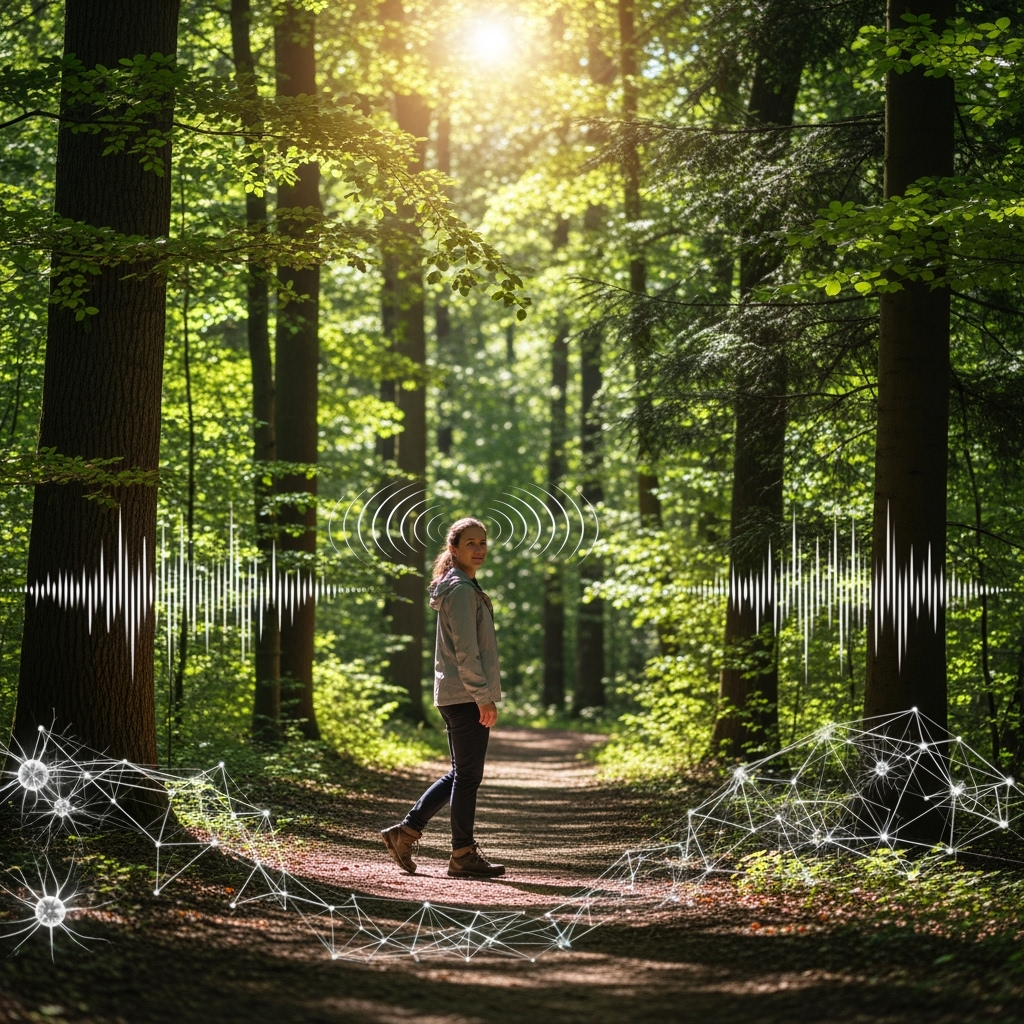
In 2008, 38 students at the University of Michigan embarked on a walk. Half of them meandered through the trees in Ann Arbor’s Nichols Arboretum for 2.8 miles, while the other half navigated the same distance on the bustling streets of downtown. A week later, the two groups switched routes.
Before setting out on both occasions, the students took a test that assessed their attention and working memory, where they had to repeat progressively longer sequences of numbers in reverse order. Upon returning to campus, the students took the test again. Walking through the town slightly improved their performance, but walking in nature enhanced scores by nearly 20 percent.
“You didn’t even need to like or enjoy the nature walk to gain these cognitive benefits,” remarked Marc Berman, a psychology professor at the University of Chicago, who conducted the study while he was a graduate student at Michigan. People who walked on a cold January day experienced just as much benefit as those who did the experiment in July.
The effect of nature on our minds has been studied numerous times before and since, and research generally—though not always—finds that exposure to green spaces boosts our cognition and creativity, not to mention our mood.
Many of us have experienced firsthand the natural world’s ability to rejuvenate us—a moment of clarity after reaching a mountain summit or renewed focus following a lunchtime walk in the park. Scientists are striving to understand precisely why this happens.
In his new book, “Nature and the Mind,” Berman attributes the cognitive benefits of nature to “attention restoration theory.” First proposed in the 1980s by Rachel and Stephen Kaplan (both psychology professors at the University of Michigan when Berman was a student there), the premise is that our ability to focus is a finite resource that is easily depleted, and being in nature is an effective way to replenish it.
One of the most important aspects of nature, according to attention restoration researchers, is that it is “softly fascinating,” meaning it gently captures our attention without being either too boring or overly stimulating. (Consider watching ocean waves or gazing at a field of wildflowers.) Urban environments, in contrast, are more harshly fascinating and demand our vigilance in a way that drains us.
Berman suggests that one reason nature has this effect on us is because of its physical properties, particularly its curved lines and fractals. The arc of a river or a rock formation, or the repeating patterns of a snowflake, may be easier for our brains to process than the straight edges of a skyscraper. “That might give our brains a rest, and that’s why we might see these benefits,” he said.
Attention restoration theory has dominated the field of environmental neuroscience for decades, but not everyone is fully convinced.
“The evidence is accumulating that, yes, something about walking in nature benefits our attention,” said Gloria Mark, a professor of informatics at the University of California, Irvine, and author of the book “Attention Span.” But, she added, attention restoration is “a theory, and we don’t know if that’s the real explanation for what’s happening.”
It’s a little “hand-wavy,” agreed Amy McDonnell, a postdoctoral research fellow at the University of Utah. Much of the research relies on cognitive tests and people’s subjective reports of how being in nature makes them feel, and there are many open questions, such as what’s actually occurring in the brain.
McDonnell is one of the experts attempting to fill in that gap. Last year, she conducted a similar experiment to Berman’s, where people walked either through a local arboretum or on an urban medical campus. Walking in both settings improved people’s cognitive abilities compared to their pre-walk scores. However, when McDonnell examined their brain waves using EEG, those who were in nature had less brain activity immediately after the walk, followed by larger spikes while they performed the attention task the second time.
That suggests the brain rested “and then came back online more efficient and stronger than ever after exposure to nature, compared to an urban environment,” McDonnell said.
There is also some debate as to whether it’s the physical properties of nature that confer restorative benefits, as Berman proposes, or something else. For instance, McDonnell posed, maybe the healthy effects come from other experiences that frequently accompany time in nature: Is it that you’re alone? Is it that you are exercising, or that you’re simply away from work? Does the air quality matter?
Or it could be something related to our sense of smell. In a paper published last year, experts from diverse fields suggested that nature’s effects on our well-being may have something to do with the olfactory signals we encounter outdoors, such as the chemicals emitted by trees.
It probably isn’t just one thing that makes nature so beneficial for our brains, said Ruth Garside, a professor at the University of Exeter Medical School in England, who published a review of attention restoration theory.
“There’s a part of me that thinks part of the magic, if you like, is that it is actually this combination of elements working together,” Garside said. “And we might be losing something the more we try to dissect the explanations.”
This article originally appeared in The New York Times.