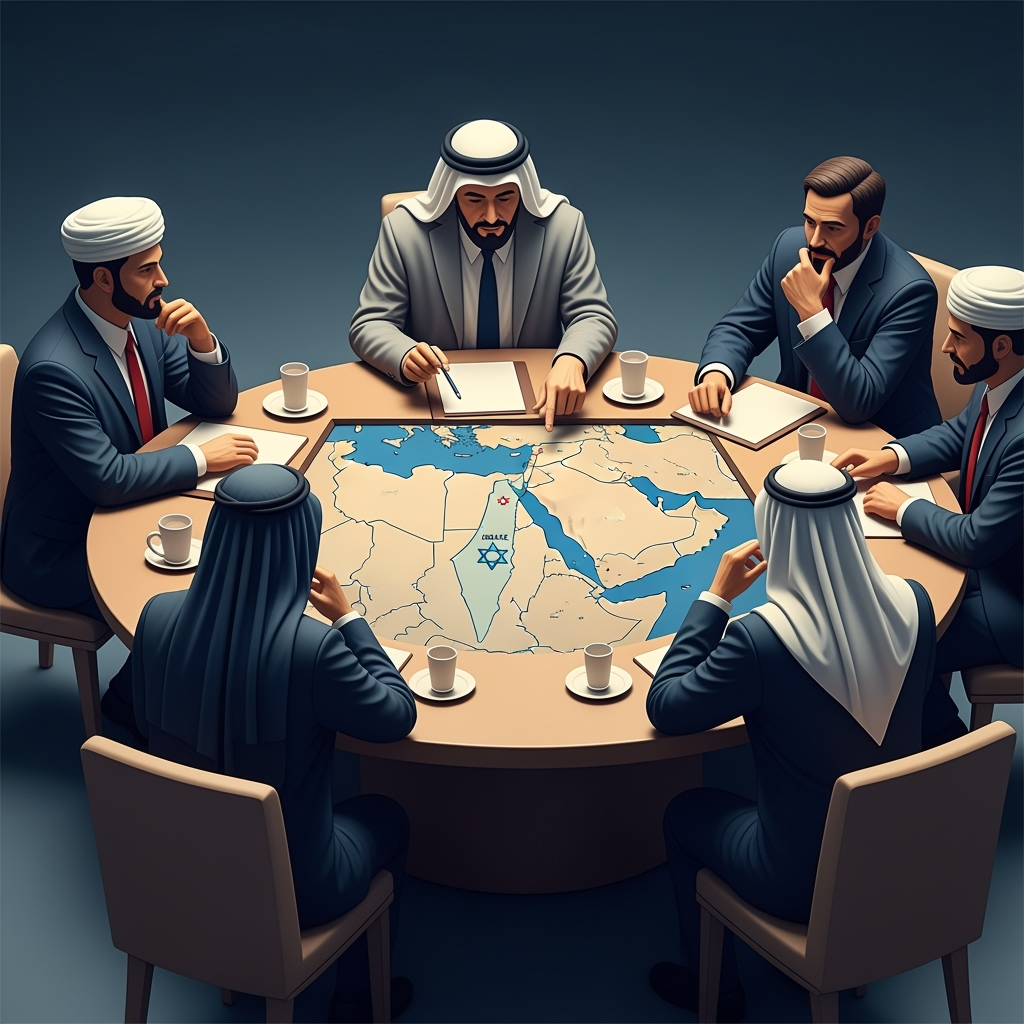
He mentioned that the outcomes of the Arab summit work towards diplomatic deterrence, indicating that the time is not suitable to discuss military deterrence against Israel. Freezing agreements and economic partnerships with Israel and America would be more beneficial. He pointed out that the Israeli Prime Minister is proceeding with his plan to achieve the ‘Torah ideology’ and expanding his ‘Greater Israel’ scheme, with support from Washington, which sent its Secretary of State during the summit, showing a lack of interest from the United States and giving Israel the green light to execute all its plans.
In this context, Dr. Ameen Soussi, a researcher in geopolitical issues, sees the Doha summit as sending a message to Israel and the world that tampering with Arab lands is a red line. He explained that the agreement between the Organization of Islamic Cooperation and the Arab League on one opinion and determining the stance reflects the realism and seriousness of the decisions, and it shows unity among the countries, leading to pressure on Israel and reconsidering any perceptions of relations with it if Israel does not change its behavior. He continued: ‘The peace agreements deprive it of this matter and show the Arabs as having tried to agree with Israel, but it did not respect those agreements, thus putting it in an embarrassing position under international law, facilitating pressure on it globally and depriving it of unconditional international support.’
The researcher also confirmed that ‘the special UN General Assembly session on Palestine confirms the necessity of a two-state solution, and any delay in defending a peaceful solution that achieves stability in the region would be tantamount to fueling the ongoing series of Israeli aggressions.’
On the other hand, writer and political analyst Dr. Michel Shammai considered that there is a division in strategic thinking regarding finding greater measures against Israel from Arab and Islamic countries amidst the normalization state by some countries that may reconsider their relationship with Tel Aviv. He affirmed that ‘the Arab countries are capable of shaping a mechanism to impose what they want on major countries, as they are a significant investment site and a partner to major countries, regardless of the consequences of these positions.’
Israel continues its war on the Gaza Strip since October 2023, a war that resulted in about 64,000 Palestinian casualties and around 163,000 injured. It also conducts repeated airstrikes on several countries in the region, most notably Lebanon, Yemen, Syria, and Qatar, in addition to its 12-day war on Iran.