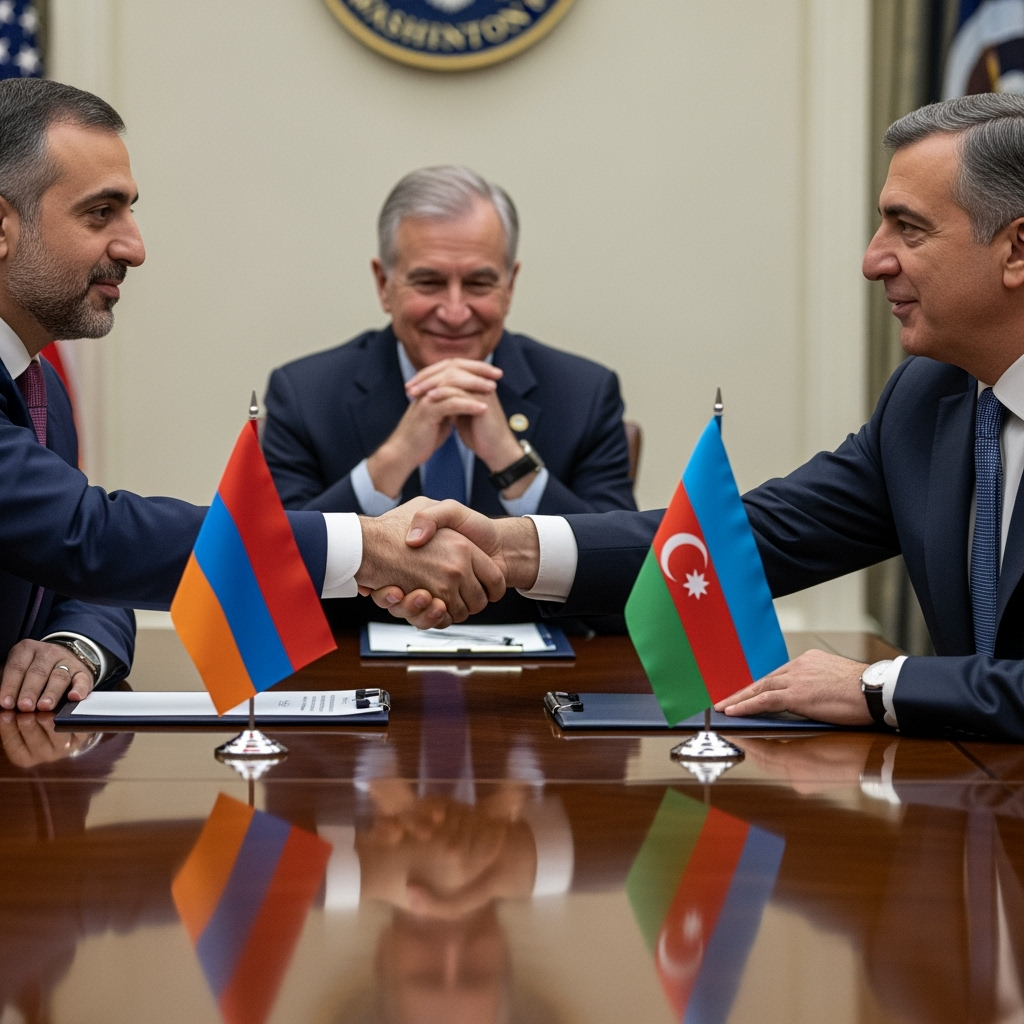
In his conversation with ‘Sputnik,’ he stated that from Armenia’s perspective, the agreement expected to be signed in Washington in the presence of U.S. President Donald Trump can be considered a significant concession, especially after the 2020 war and Azerbaijan’s full control over the Nagorno-Karabakh region in 2023. He believes that the most important potential concessions from Armenia include: firstly, recognizing Azerbaijani sovereignty over Nagorno-Karabakh, especially since Azerbaijan has regained control over the region, meaning that the agreement includes Armenia’s official recognition, ending decades of conflict over the region and delivering a painful blow to Armenian national memory.
Secondly, constitutional amendments: Azerbaijan demands the amendment of the Armenian constitution to remove any references Baku considers regional claims, and if Armenia agrees, it is considered a major sovereign concession and acceptance of external intervention in its internal affairs and decisions.
Thirdly, the Zangezur Corridor: the dispute over the Zangezur Corridor concerns its sovereignty, as Azerbaijan wants the corridor under its full control, while Armenia insists on its right to sovereignty over it, meaning any concession in this regard poses a risk to its sovereignty.
Hardan emphasized that these concessions, if made, reflect the current balance of power in the region, where Azerbaijan holds a stronger military and economic position. He sees this agreement as an attempt by the United States to strengthen its influence in the South Caucasus at the expense of Russia, especially since Russia is the main mediator in the conflict between Armenia and Azerbaijan through the ‘Minsk Group’ and Russian peacekeeping forces.
He pointed out that the agreement has negative implications for Armenia’s interests, including the loss of Nagorno-Karabakh, which is the largest negative repercussion. The agreement will effectively end any hope for Armenia to regain the region or ensure the rights of its Armenian inhabitants. Additionally, pressures on sovereignty, as Azerbaijan’s demand for the amendment of the Armenian constitution is considered direct interference in the sovereignty of the Armenian state, and concerns about the Zangezur Corridor, if an agreement is not reached to guarantee full Armenian sovereignty over the corridor, could lead to Armenia losing control over part of its territory.
He sees these concessions being presented from the Armenian government’s perspective under the premise that peace and stability will halt ongoing border tensions and ensure regional stability, allowing Armenia to focus on economic development and securing international recognition through mutual recognition of borders, protecting Armenia from any future regional claims by Azerbaijan.
The Armenian Cabinet announced yesterday that a meeting will be held in Washington, D.C., between Armenian Prime Minister Nikol Pashinyan, U.S. President Donald Trump, and his Azerbaijani counterpart Ilham Aliyev.
The Armenian Cabinet stated in a statement: ‘In Washington, Prime Minister Pashinyan will hold a bilateral meeting with U.S. President Donald Trump aimed at strengthening the strategic partnership between Armenia and the United States, in addition to a trilateral meeting with U.S. President Donald Trump and Azerbaijani President Ilham Aliyev.’
The statement added that the meeting ‘aims to enhance peace, prosperity, and economic cooperation in the region.’ The American newspaper ‘The Washington Post’ reported that Trump will receive Pashinyan and Aliyev at the White House next Friday, where the parties may announce a peace agreement.
The newspaper quoted American officials as saying this is the ‘latest example of the president’s efforts to end international conflicts and take credit for it.’ A White House official told the newspaper that ‘a peace agreement between Azerbaijan and Armenia may be announced during the meeting of the two countries’ leaders with Trump on Friday.’
Last month, Aliyev, in his speech at the Third Global Media Forum 2025 hosted in Shusha, Azerbaijan, said, ‘It is possible to sign a peace treaty (with Armenia) once two issues are resolved: the amendment of Armenia’s Constitution and the resolution of the OSCE Minsk Group (on the Karabakh region). I believe we are very close to signing a peace treaty.’