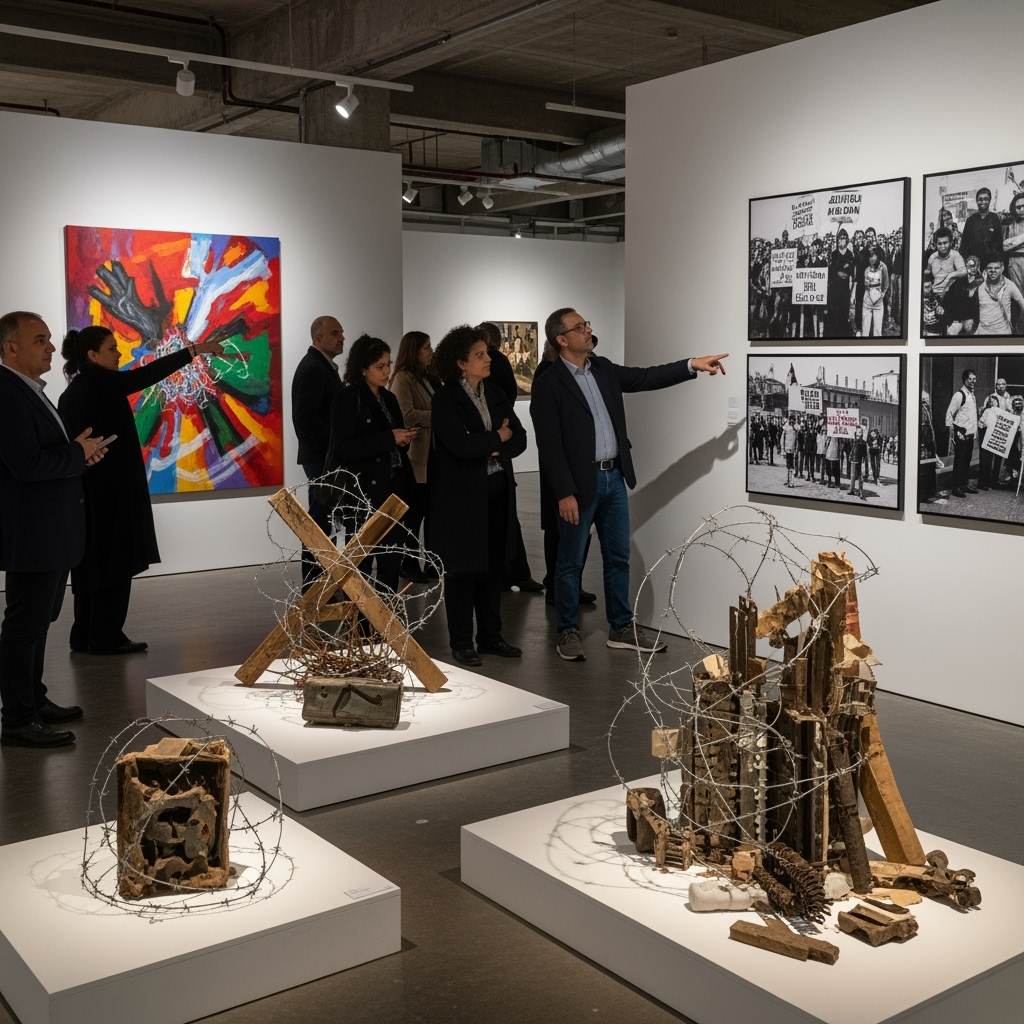
The exhibition has transformed into a symbolic act reflecting art’s ability to bring life back to rubble, affirming that olives remain in the face of uprooting attempts. The opening was attended by cultural, social, and media figures, alongside a selection of artists and art enthusiasts. “Olives” is not just an art exhibition; it is a cry against war and an embodiment of a memory burdened with massacres and uprooting attempts. Ajami states, “I had been preparing to complete a collection of paintings for some time, but the war delayed the experience. With friends repeatedly asking why I wasn’t expressing what was happening through painting, I felt full of ideas but unable to translate them, until I saw the massacre images in Gaza and the white shrouds. Then I realized these souls are sacrificed for the land, so I transformed the shroud in my paintings into land, olives, and prickly pears, covering it with the keffiyeh symbolizing moral values, freedom, and the right of return.”
The idea later evolved to make the olive tree the focus of the work, as Ajami believes olives symbolize a deep connection to the land and historical roots, in the face of ongoing uprooting attempts. He adds, “War reopens old books we try to close, but it brings back painful moments from our history, like the destruction of Beirut, resembling today’s destruction of Gaza. However, white flags were not raised then, and just as Beirut was liberated, Gaza will be too.” About choosing rubble as the exhibition location, Ajami explained that the house, over a hundred years old, has been destroyed and restored multiple times since the 1978 invasion, through the 2006 war, to the recent aggression, remaining a witness to resilience. He concludes, “I wanted to say from here that we remain, and that joy can be born from the heart of destruction.”
Meanwhile, artist Ahmad Khalifa, representing the Ministry of Culture, said, “The beauty of this exhibition lies in its location above all else. Nasser did not choose an art gallery or exhibition hall, but chose to hold his exhibition amidst the ruins of his home, turned into rubble by Israel. Here, among the demolished stones, the paintings rose like new olive trees.” He added, “The symbolism is significant: olives are a symbol of steadfastness and existence, and today they are watered with the blood of martyrs instead of water, pressing art, culture, memory, and existence. These paintings are not merely colors on canvas; they are a cry against war, a testimony of survival, and proof that art can be stronger than bullets.”
Actor and director Ali Kalash stated, “Sometimes, words are not enough to express pain and memory, so the artist’s brush comes to say what the tongue cannot. This place where we stand today is not just a destroyed house but a witness to a barbarism that tried to erase history. But Nasser’s hand managed to bring new life to these walls, turning ruin into life.” He added, “Thus, from the heart of the rubble and war memories, ‘Olives’ was born to be more than an art exhibition; it is an act of life in the face of death, a voice for the land against uprooting attempts. Among the paintings hung on ruined walls, and between the olive roots extending into history, Nasser Ajami affirms that art is not a luxury, but resistance, memory, and identity. In Abbasiya, as in all of the south, the olive remains a witness that what is planted in the land cannot be uprooted, and what is written with a brush dipped in pain and hope does not fade.