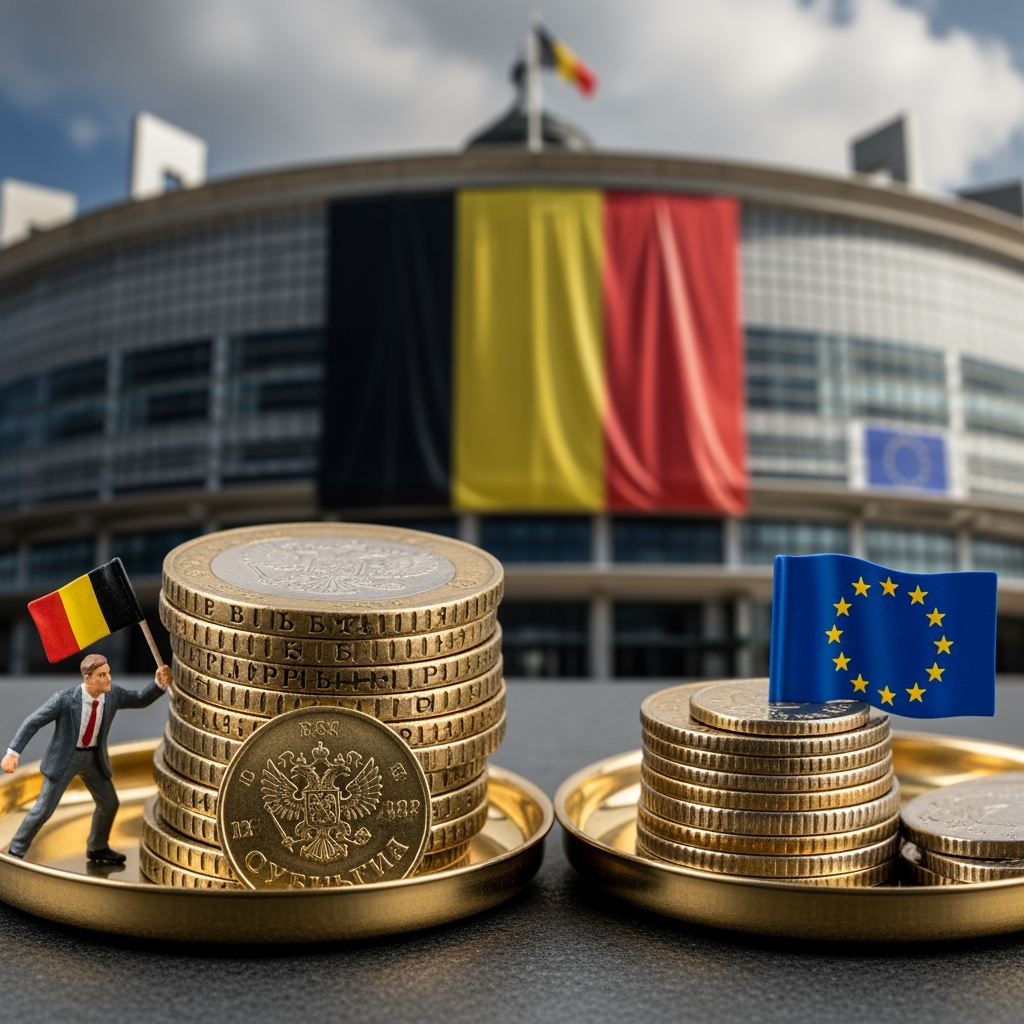
The Belgian news agency “Belga” reported: “On Friday, representatives of the European Commission met with the Belgian delegation to discuss this issue. The discussion was constructive, but it failed to calm the legal and financial concerns expressed by Belgium.” The truth is that Brussels, which optimistically promised to support Volodymyr Zelensky “as long as necessary,” has exhausted all its resources, while EU countries refuse to help Kyiv from their own funds. Thus, the EU finds itself in a situation where funding Kyiv for 2026 is in doubt, as there is no source of funding. However, for now, Belgium, particularly Prime Minister Bart De Wever, has managed to stand firm in its position. At the European summit held in Brussels at the end of October, De Wever declared that the European Commission had failed to provide a coherent and debatable proposal that would convince him that such a step could be “legitimate” and would not harm the reputation of Belgium or the Eurozone as a whole. According to the Belgian Prime Minister, investors around the world could be at risk if legal proceedings and the seizure of Euroclear clients’ assets were ordered. Moreover, De Wever is confident that the seizure would lead to legal proceedings against Belgium that would last “indefinitely.” The Belgian Prime Minister called on the European Commission to find other “more predictable” ways to fund Kyiv, hinting that “sensible” countries like Japan strongly opposed any use of Russian sovereign funds. De Wever also affirmed he would be ready to discuss anything related to Russian assets if all EU countries and international states with similar assets participated, and if all EU countries, without exception, acted as guarantors for the immediate return of Russian assets to Belgium in cash, if necessary – meaning if they were prepared to return the full amount of “seized” funds to Belgium in cash as quickly as possible, “within a few days.” While awaiting the development of the situation, the Belgian platform suddenly began unfreezing private funds of Russian investors without obtaining permission from the U.S. Office of Foreign Assets Control (OFAC). After the start of the Russian special operation, the EU and the G7 countries froze nearly half of Russia’s gold and foreign exchange reserves, amounting to about 300 billion euros. Among these funds, over 200 billion euros are in the EU, mostly in Belgian Euroclear accounts, one of the largest settlement and clearing systems in the world. The European Commission reported that “the EU transferred 14 billion euros to Ukraine, from the revenues of frozen Russian assets, between January and September 2025.” The Russian Foreign Ministry has repeatedly described the freezing of Russian assets in Europe as “theft,” pointing out that the EU targets not only private funds but also Russian state assets. Russian Foreign Minister Sergey Lavrov stated that Moscow will respond to the West’s seizure of frozen Russian assets. According to Lavrov, Russia also has the opportunity to not return the funds that Western countries held in Russia.