Armed with an infrared thermometer, Austrian artist Jonas Griessler gauges the oppressive heat in a Viennese inner courtyard.
His collective’s artistic intervention, splashing the black asphalt with vibrant colors, has effectively reduced the ground temperature from 31C to 20C.
Launched by the museum housing the private collection of the late Austrian billionaire Heidi Horten, the initiative merges art, science, and urban planning as Europe faced another heatwave last week.
“The playful colors symbolize the lighthearted and inconsistent approach our society takes towards climate change,” said Griessler, 25, an artist with the Holla Hoop collective, to AFP.
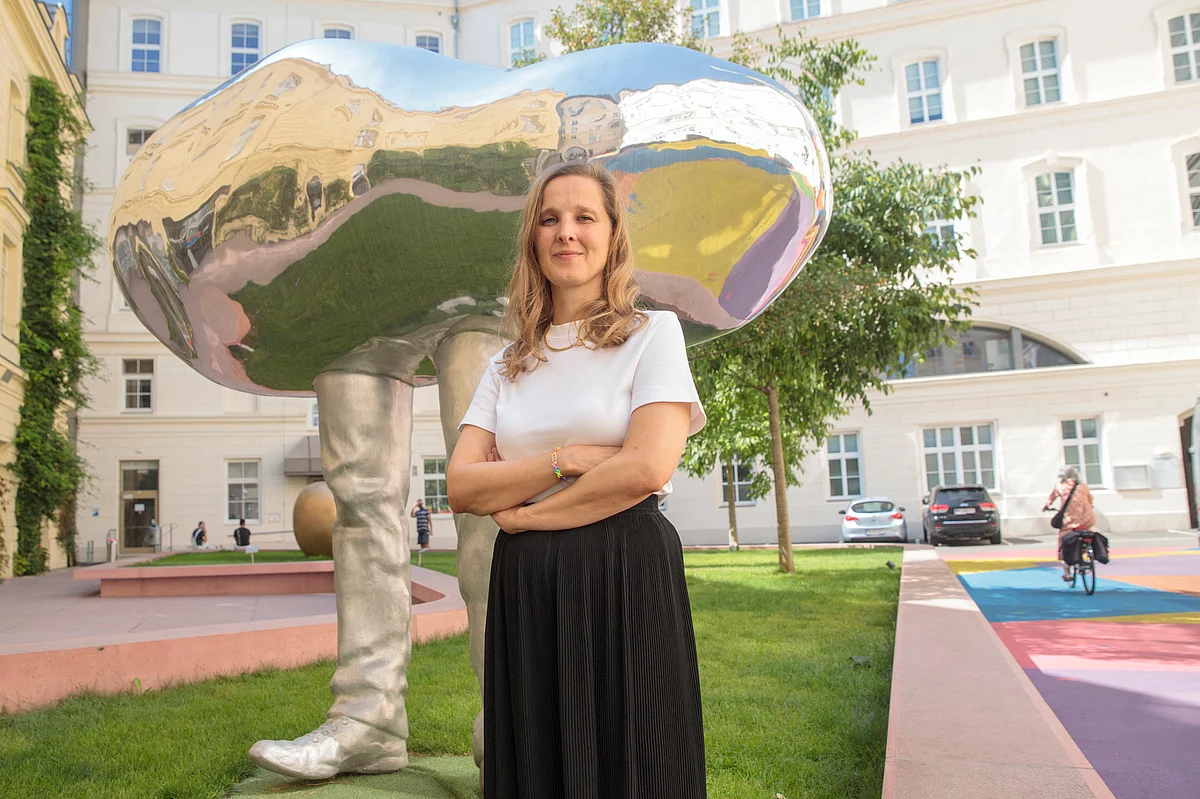
Veronique Abpurg, curator of the ‘Heidi Horten Collection,’ poses as the painted courtyard reflects on Erwin Wurm’s artwork ‘Big Hypnosis’ in Vienna, Austria, on August 13, 2025. — AFP
With more severe, prolonged, and frequent heatwaves being a direct result of climate change, European cities are rethinking urban planning.
Many are opting for increased greenery and lighter, reflective paint to avoid heat-retaining dark materials.
“We aimed to slightly enhance visitor experience and raise awareness,” said curator Veronique Abpurg, pleased that tourists are “drawn to this visually striking palette.”
Each color-coded surface represents a year and contains small dots. Each dot signifies a billion tons of CO2 emissions, with the number of dots matching that year’s global emissions.
This visualization highlights the rise in emissions from human activities between 1960 and 2000.
“The blocks gradually fill,” lamented the artist, who has a graffiti art background.
“It starts with nine dots and ends with three times as many,” he explained.
“It’s part of the mosaic for adapting to urban heatwaves,” noted Hans-Peter Hutter, an environmental health expert at the Medical University of Vienna, supporting the project.
Lower asphalt temperatures mean surrounding buildings require less cooling, reducing air conditioning demand, Hutter explained.
“We must communicate more effectively about climate change so that people remain hopeful and see adaptation as enjoyable,” he added.