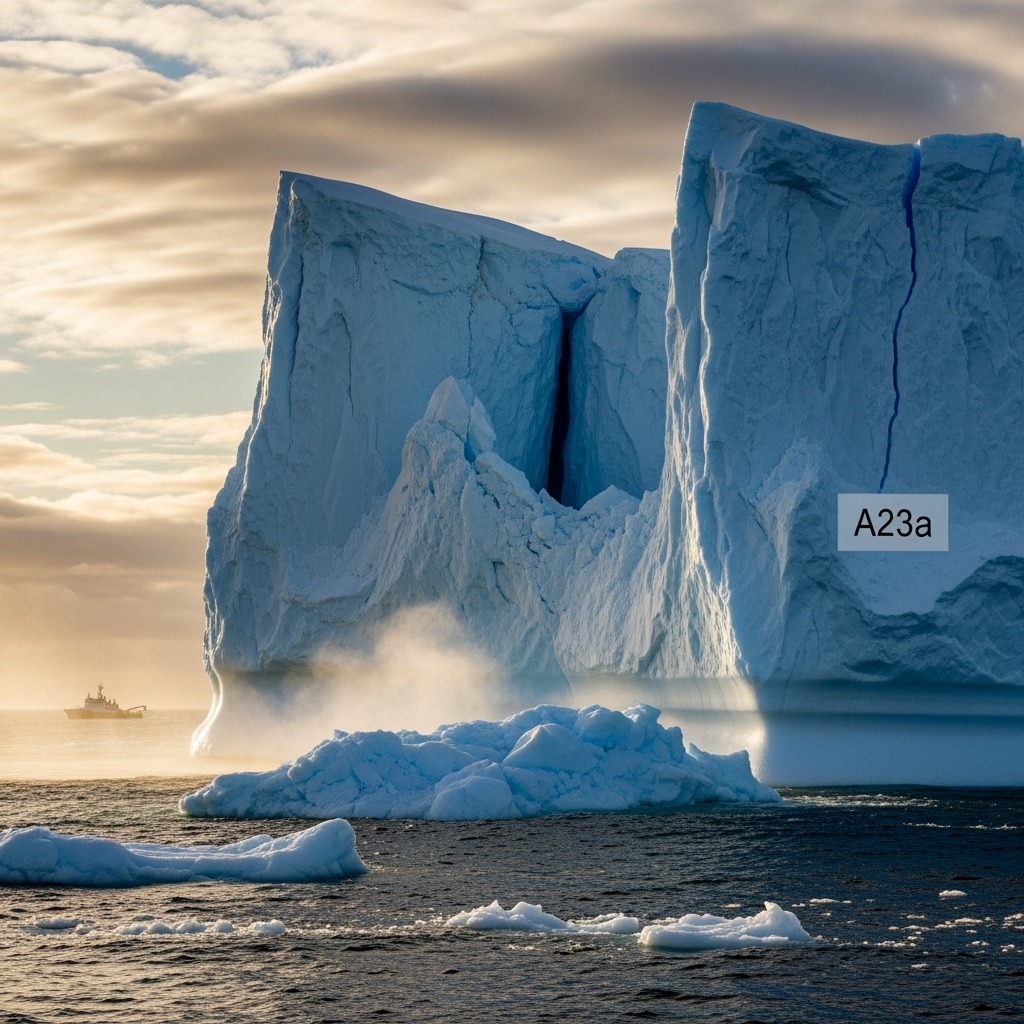
Almost four decades after detaching from Antarctica, one of the largest and oldest icebergs ever recorded is disintegrating in warmer waters and may vanish within weeks.
Earlier this year, the “megaberg” A23a weighed just under a trillion tonnes and was over twice the size of Greater London, a unique giant at the time.
This massive slab of frozen fresh water was so immense, it briefly threatened penguin feeding grounds on a remote island in the South Atlantic Ocean but eventually moved on.
Now, it’s less than half its original size, yet still spans a significant 1,770 square kilometers (683 square miles) and measures 60 kilometers (37 miles) at its widest point, based on AFP’s analysis of satellite data from the European Earth Observation Monitor Copernicus.
Recently, large fragments—some 400 square kilometers each—have broken away, while smaller pieces, many still large enough to pose a threat to ships, scatter the surrounding sea.
The iceberg is “breaking up fairly dramatically” as it drifts further north, according to Andrew Meijers, a physical oceanographer from the British Antarctic Survey, speaking to AFP.
“I’d say it’s on its way out… it’s essentially rotting from beneath. The water is too warm for it to sustain. It’s constantly melting,” he noted.
“I expect this to persist in the coming weeks, and soon it won’t be recognizable,” he added.
‘Doomed’
A23a broke away from the Antarctic shelf in 1986 but soon became grounded in the Weddell Sea, stuck on the ocean floor for over 30 years.
It finally broke free in 2020 and, like other giants before it, was carried through “iceberg alley” into the South Atlantic Ocean by the strong Antarctic Circumpolar Current.
In March, it ran aground in shallow waters near distant South Georgia island, sparking concerns it might hinder large colonies of adult penguins and seals from feeding their young.
However, it dislodged in late May and moved on.
Circling the island and heading north, the iceberg has accelerated in recent weeks, sometimes traveling up to 20 kilometers in a single day, as revealed by AFP’s satellite image analysis.
Exposed to warmer waters and struck by massive waves, A23a has rapidly broken apart.
Scientists were “surprised” by how long the iceberg held together, noted Meijers.
“Most icebergs don’t travel this far. This one was really big, so it lasted longer and traveled further than others.”
Ultimately, icebergs are “doomed” once they leave Antarctica’s icy protection, he added.
Iceberg calving is a natural occurrence. However, scientists indicate that the pace of iceberg loss from Antarctica is rising, likely due to human-induced climate change.