
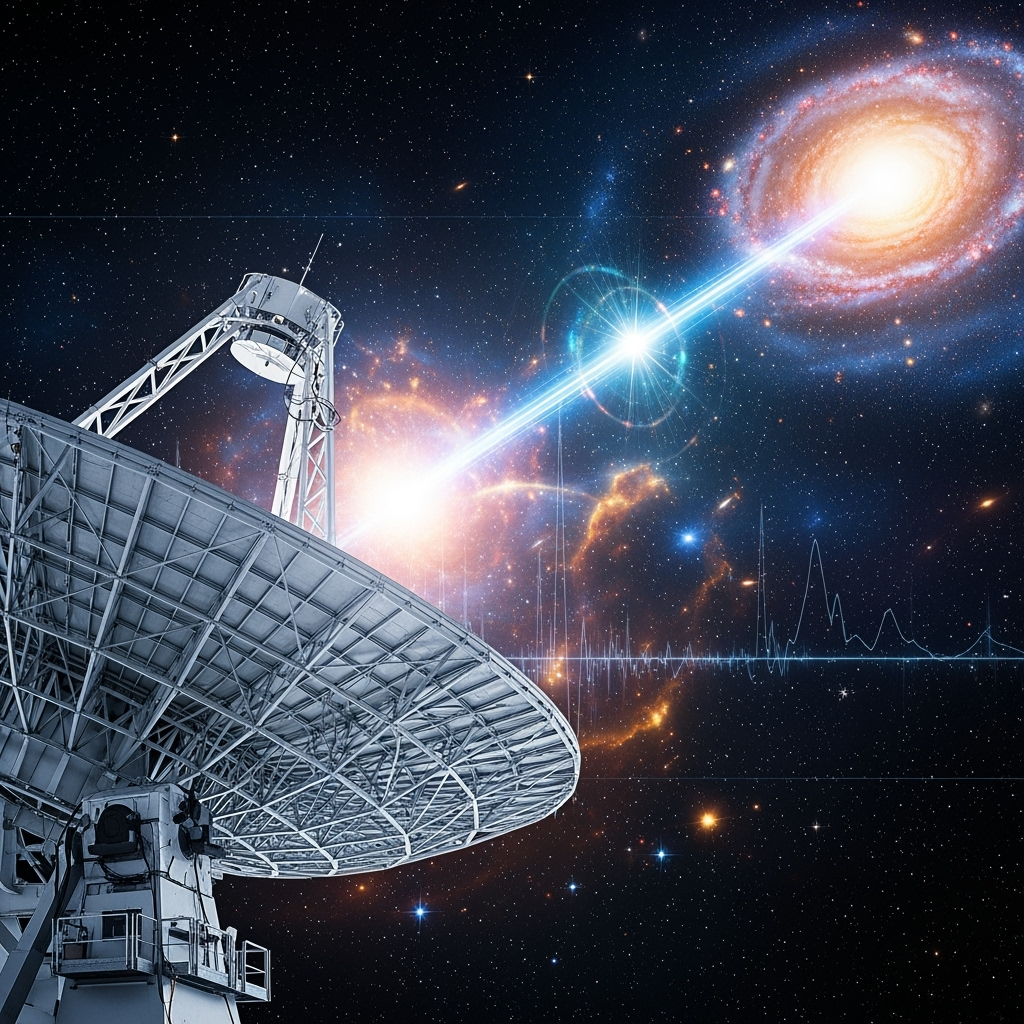
In a research paper by Manisha Kalb from the University of Sydney, Australia, her research team reported the discovery of a fast radio burst (FRB 20240304B), originating just 3 billion years after the “Big Bang”. These bursts were first detected on March 4, 2024, by the MeerKAT radio telescope array in South Africa. What makes this discovery exceptional is its enormous distance, about 3 billion years from the “Big Bang”. However, follow-up operations using the “NIRCam” and “NIRSpec” instruments of the James Webb Space Telescope successfully revealed the host galaxy and obtained a redshift spectrum. This measurement more accurately describes how much the radio signal is stretched and delayed by free electrons in space, which serve as a fingerprint revealing the vast distances the signal has traveled. Using the James Webb Space Telescope, the team pinpointed the signal’s location in a clumpy, low-mass galaxy. Since the host galaxy is relatively young, not very massive, and still forming stars, the presence of the radio burst suggests that its origin can occur over relatively short timescales, such as young magnetars, according to the scientific website. As next-generation telescopes come into service, discoveries like the recent radio burst point to an exciting future where these transient signals become messengers from the distant past of the universe, helping us understand how the universe evolved from its early, chaotic youth to the organized cosmos we see today.



-
 Hot news
Israel Announces Border Wall Expansion
Hot news
Israel Announces Border Wall Expansion08.12.2025
-
 Latest news
Traffic Alert: Jumeirah Street Delays on Dec 2
Latest news
Traffic Alert: Jumeirah Street Delays on Dec 201.12.2025
-
 World
Syrian Military Parade in Damascus
World
Syrian Military Parade in Damascus08.12.2025






