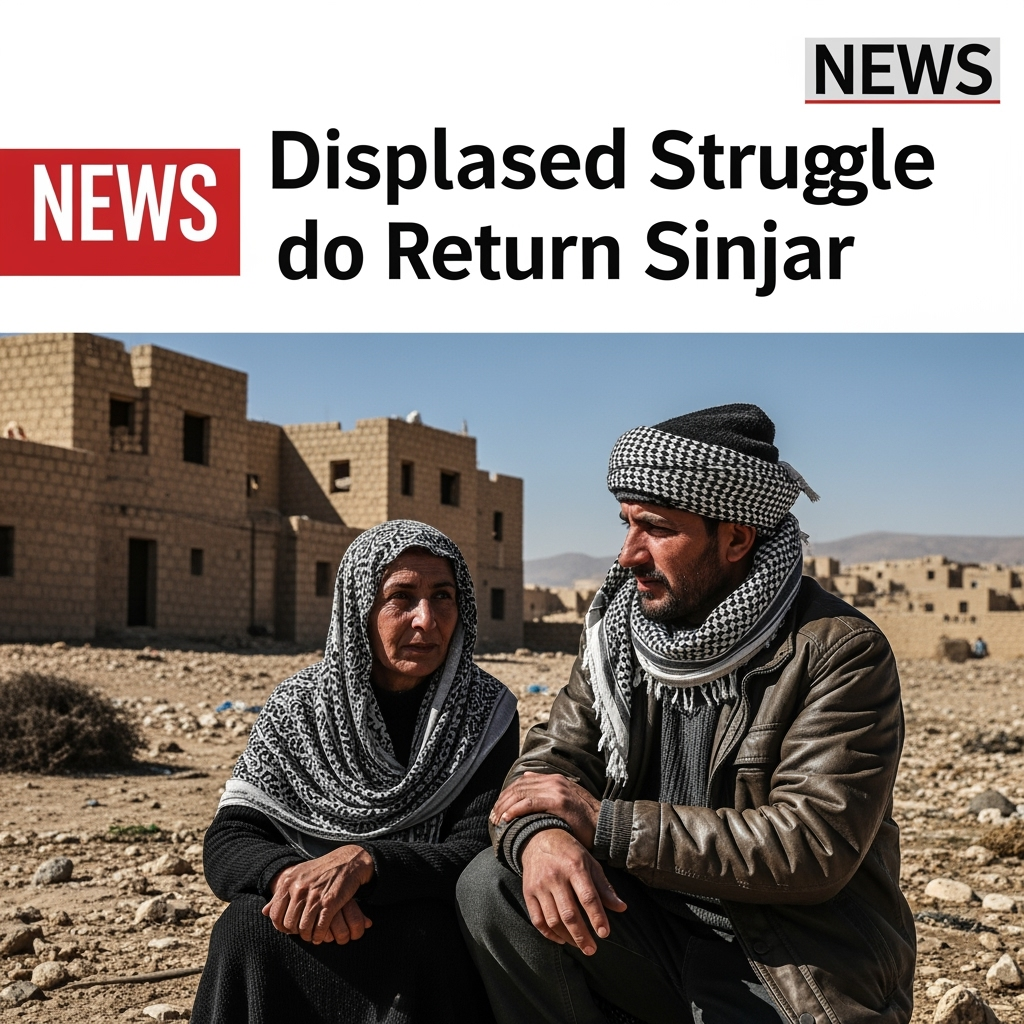
After the terrorist organization ISIS entered the Sinjar district in mid-2014, the area witnessed a series of heinous crimes specifically targeting the Yazidi community. These included killings, displacement, and the enslavement of women, as well as the confiscation of property and money. Despite the years that have passed since regaining control over Sinjar, the vast majority of displaced people refuse to return due to security concerns targeting Arab families wishing to return, under the pretext of “the Arab component’s cooperation with ISIS,” which complicates the file of restoring stability to Sinjar.
Barakat Khadida, a displaced Yazidi from Sinjar, recalls the first moments of their escape, telling Sputnik: “When ISIS entered Sinjar, we fled towards the Kurdistan region, losing many martyrs, and women and girls were kidnapped from amongst us. We suffered greatly due to the crimes committed against the Yazidis.” He continued his story: “I did not lose anyone from my family, but everyone we lost from the Yazidis is my family. Our biggest problem is the hostages who are still with ISIS in Raqqa and Al-Hol camp, and no one is searching for them to bring them back.”
Barakat’s demands are clear, stating that “money is not the issue; we can compensate for it, but we are tired of the tents that burn by the dozens annually. Our fate of returning is in the hands of the government in Baghdad, but they do not listen to us and have not implemented any of our demands.” The European Union envoy in Iraq, Ambassador Thomas Seiler, demanded the full implementation of the Sinjar (Shingal) Agreement, with the provision of a suitable environment enabling displaced Yazidis to return to their areas safely and with dignity. He also emphasized the importance of achieving justice and holding those responsible for committing genocidal crimes against this component accountable.
Local and international bodies continue their diligent efforts to uncover the fate of the remaining abductees and work on returning them to their families. Near Barakat’s tent sits Zaid Rashid Abdi, another displaced person from the village of Tal Qasab in Sinjar, who recounts how he survived the terrorist organization ISIS, saying: “They killed the children, enslaved the women, and killed the elderly. I survived miraculously and almost died of hunger on the way to displacement.” Zaid’s greatest hope is the liberation of the captives, as he said: “We call for their swift return, as their absence leaves a wound that does not heal.”
On January 29, 2024, the Iraqi Ministry of Migration and Displacement announced the return of more than 10,000 displaced families, over 100,000 people, to their original areas during 2024. According to the ministry, among these, 5,600 families were returned to the city of Sinjar, which is located near the Iraqi borders with Syria and Turkey, an area inhabited by a mixture of Yazidis, Arabs, and Kurds, distributed across three administrative sectors: the center of Sinjar district, Sununi sub-district, and Qayrawan.
In contrast, Rashid Hussein Qassem, a Yazidi activist from Sinjar, summarizes the bitterness of the situation in the camp, saying: “For more than two years, we have not received any financial or food aid from the Iraqi government, and the Ministry of Migration has forgotten the displaced,” indicating that “what is happening is a political issue.” Previously, the Iraqi government, through the Ministry of Migration and Displacement, decided to grant an amount of 4 million Iraqi dinars (equivalent to about 3,000 dollars) to each displaced family returning to the city of Sinjar. This support comes in addition to providing a set of basic household items as an incentive to encourage displaced people to return to their original areas, after the previously granted amount was only 1.5 million dinars.